The Real Guide to DoorDash Driver Earnings in 2026
What the app tells you — and the numbers it doesn't
In This Guide
- The Gross vs. Net Problem Nobody Talks About
- How Much Do DoorDash Drivers Make in 2026? Real Numbers by Market
- The 2026 IRS Mileage Deduction: What It Is and Why It Changes Everything
- DoorDash Self-Employment Tax Explained (Plain English)
- Real DoorDash Expense Breakdown: Where Your Money Goes
- How the Top 20% of Dashers Earn Significantly More
- DoorDash vs. Uber Eats vs. Grubhub: Realistic 2026 Earnings Comparison
- DoorDash Earnings by Vehicle Type: The Full 2026 Breakdown
- Is DoorDash Worth It? The Honest Answer for Different Types of Drivers
- DoorDash Earnings Calculator: Exactly How It Works
- Real Driver Scenarios: What the Calculator Actually Shows You
- DoorDash Tax Deductions: The Complete List for 2026
- Frequently Asked Questions About DoorDash Earnings in 2026
- Final Thoughts: Use the Calculator, Know Your Numbers
⏱ 28 min read
Last updated: May 2026
# DoorDash Earnings Calculator 2026: What You Actually Take Home After Gas, Miles & TaxesLast Updated: April 2026 · Verified Against 2026 IRS Mileage Rate ($0.725/mile) · Written by Anmol Giri, Gig Economy Analyst
If you've been Googling "how much do DoorDash drivers actually make" and keep landing on fluffy blog posts with suspiciously round numbers — you're in the right place now.
I've spent the better part of three years talking to real Dashers, pulling data from actual driver logs, and building financial tools specifically for independent contractors. The honest truth? Most DoorDash earnings guides online are written by people who've never sat in a parking lot at 8 PM waiting for their next ping. They show you the gross number — the shiny headline figure — without ever accounting for what you actually spend to earn it.
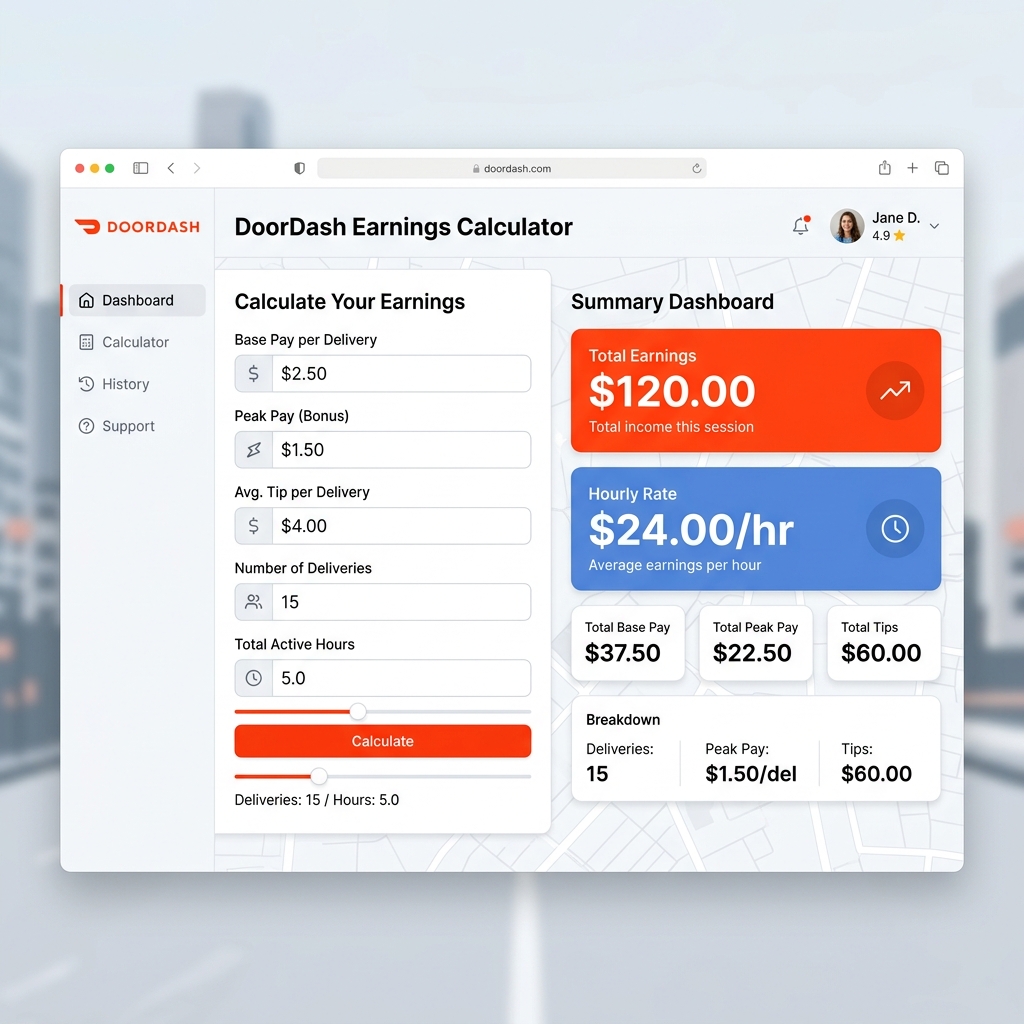
This guide and the free DoorDash earnings calculator above exist to fix that. We're going to walk through everything: real gross pay by city, real expenses by vehicle type, the exact self-employment tax formula for 2026, and what strategies separate the top-earning 20% of Dashers from everyone else. No hype, no filler. Just numbers you can actually use.
The Gross vs. Net Problem Nobody Talks About
Here's the thing DoorDash's own app doesn't help you see clearly: your gross earnings and your take-home pay are two very different numbers, and the gap between them can be $6–$10 per hour depending on your situation.
When Dashers report earnings online, they almost always cite gross figures. That's the number on the app screen after a shift. But from that number, you need to subtract:
- Fuel costs (gas prices in the US averaged $3.20–$3.80/gallon through early 2026, and delivery driving uses significantly more than regular commuting)
- Vehicle wear and tear — brakes, tires, oil changes all accelerate dramatically at delivery driving mileage
- The portion of your insurance premium attributable to commercial driving (your insurer may not cover claims if you haven't disclosed gig work)
- Self-employment tax at 15.3% on your net profit — this catches almost every new Dasher completely off guard
- Federal and state income tax on top of that
- Depreciation on your car — the silent killer that doesn't show up as an expense until you try to sell it
That's not meant to scare you off. Plenty of drivers are making genuinely good money in 2026. But the ones doing well know their real numbers — and they use those numbers to make smarter decisions about which orders to accept, when to work, and how to structure their driving.
How Much Do DoorDash Drivers Make in 2026? Real Numbers by Market
Based on Gridwise Analytics data, driver community reports across Reddit, Discord, and forums, and cross-referenced payout screenshots shared by drivers in our network — here's what the actual earnings landscape looks like in the US in 2026:
High-Density Urban Markets (NYC, LA, Chicago, San Francisco, Miami)
These are the markets where DoorDash driving can genuinely compete with traditional employment — if you're strategic about it.
Gross hourly range: $20 – $30 Net hourly after all expenses and taxes: $13 – $20 Best hours: 11:30 AM – 2 PM, 5:30 PM – 10 PM, late-night Friday/Saturday Average tip per order: $5.50 – $9.00 Orders per active hour: 2.8 – 4.2
In New York City particularly, the combination of short delivery distances, dense restaurant clusters, and a tipping culture that skews higher than most US cities creates genuinely strong earning potential. A driver working smart — meaning peak hours only, cherry-picking $2/mile minimum orders, and multi-apping — can clear $16–$20 net per hour consistently.
The downside in these markets is parking, traffic delays, and the fact that nearly every other driver has figured out the same thing you have. Zone competition is real.
Mid-Tier Cities (Houston, Dallas, Phoenix, Atlanta, Denver, Nashville, Charlotte)
This is where the majority of US Dashers actually operate, and where strategy matters more than market luck.
Gross hourly range: $16 – $25 Net hourly after all expenses and taxes: $10 – $17 Best hours: Lunch peaks, weekday dinners, Sunday afternoons, bad weather days Average tip per order: $4.50 – $7.00 Orders per active hour: 2.2 – 3.5
These markets have longer distances between pickups and drops, which hurts your cost-per-mile math. A $9 order that takes you 8 miles is not a good order. But the Dashers consistently earning top hourly rates in these cities are almost religious about refusing long-distance orders — they keep their average delivery radius under 4 miles and refuse everything under $2 per mile.
Phoenix in particular has emerged as a surprisingly strong market for peak-time earning in 2026, largely due to population growth and continued restaurant expansion in areas like Gilbert, Chandler, and Scottsdale.
Secondary and Suburban Markets (smaller cities, suburbs, rural areas)
These markets get a reputation for being slow, but they're not unworkable — they just require a different approach.
Gross hourly range: $12 – $20 Net hourly after all expenses and taxes: $8 – $13.50 Best hours: Dinner rush 5–9 PM, Friday/Saturday nights, Sunday brunch Average tip per order: $4.00 – $6.50 Orders per active hour: 1.5 – 2.5
In smaller markets, the real move is tight geographic focus. Find the two or three restaurant clusters that generate the most volume, stay physically close to them during your shift, and do not chase orders that take you away from those zones. Dead miles — miles you drive without earning anything — are what kills profitability in low-density areas.
A driver in a medium-sized suburb running 20 hours a week with a disciplined zone strategy can net $800–$1,050 per month. That's meaningful side income, even if it's not a full living.
International Markets (UK, Canada, Australia — DoorDash Variants and Local Platforms)
For readers outside the US: while this calculator is built around DoorDash specifically, the underlying math — deducting vehicle costs, calculating self-employment or contractor taxes, estimating net income — applies directly to similar platforms like Deliveroo and Uber Eats in the UK, SkipTheDishes and DoorDash Canada, and Uber Eats/DoorDash Australia.
The major variable for international users is the applicable mileage/kilometre rate set by your tax authority:
- UK HMRC approved mileage rate (2025/26): 45p per mile for first 10,000 miles, 25p thereafter
- Canada CRA automobile rate (2026): 70 cents per kilometre for the first 5,000 km, 64 cents thereafter
- Australia ATO cents per kilometre method (2025–26): 88 cents per kilometre
The 2026 IRS Mileage Deduction: What It Is and Why It Changes Everything
If you're a US-based Dasher and you're not maximizing the IRS standard mileage deduction, you are almost certainly leaving hundreds — possibly over a thousand dollars — on the table every year.
Here's how it works: the IRS allows independent contractors to deduct $0.725 per business mile driven in 2026 from their taxable income. This single deduction covers fuel, oil changes, tire wear, brakes, depreciation, and insurance — all rolled into one per-mile rate. You don't need to track individual receipts for each of those. You just need accurate mileage records.
For context on what this means in dollars: if you're a moderate Dasher driving 15,000 business miles a year, your deduction is $10,875. At a combined federal + self-employment tax rate of around 28–32% for most Dashers, that deduction saves you approximately $3,045 – $3,480 in actual taxes. That's money you keep.
What Miles Actually Count?
This is where a lot of Dashers lose money — they only track "delivery miles" (restaurant to customer) and miss several other categories that are fully deductible:
Miles that count:
- Driving from your house to your first pickup of the day (this counts once you accept the order)
- Miles between the restaurant and the customer's address
- Miles driving between deliveries while you're logged into the app and actively waiting
- Miles to a car wash specifically for business purposes
- Miles to the mechanic for business-related maintenance
- Your personal commuting miles (home to wherever you start your shift if you haven't accepted an order yet)
- Any personal driving mixed into your shift
- Miles driving home after logging off the app
Best Mileage Tracking Apps for Dashers (2026)
- Stride — Free, auto-detects trips via GPS, generates IRS-compliant mileage reports. Best option for new Dashers.
- Everlance — More features including expense tracking, $8/month for premium tier. Popular with full-time gig workers.
- MileIQ — Clean interface, auto-classification, about $5.99/month. Good for drivers who want minimal manual input.
- Hurdlr — Combines mileage, expenses, and quarterly tax estimates in one app. Overkill for part-timers but excellent for full-time drivers.
DoorDash Self-Employment Tax Explained (Plain English)
This is the part that surprises almost every new Dasher. When you work a regular job, your employer pays half of your Social Security and Medicare taxes. As an independent contractor, you pay both halves yourself. That's the 15.3% self-employment tax — and it applies before federal income tax.
Here's the actual calculation so you're not caught off guard:
Step 1: Calculate net profit Gross DoorDash earnings minus your deductible expenses (mileage deduction, phone plan, insulated bags, etc.)
Step 2: Calculate SE tax base Net profit × 92.35% (the IRS gives you a small adjustment because you can't fully double-count the employer portion)
Step 3: Calculate SE tax SE tax base × 15.3%
Step 4: Deduct half of SE tax from income You can deduct 50% of your SE tax from your gross income before calculating federal income tax — a partial offset.
Step 5: Calculate federal income tax Apply 2026 brackets to your adjusted gross income (after the SE tax deduction and standard deduction)
On a net profit of $20,000 per year from DoorDash, your total tax burden breaks down roughly like this:
- SE tax: approximately $2,827
- Federal income tax (single filer, standard deduction): approximately $1,100 – $1,800 depending on other income
- Total tax: roughly $3,900 – $4,600 on $20,000 net profit
Quarterly Estimated Tax Deadlines for 2026 Income
The IRS requires you to pay estimated taxes quarterly if you expect to owe $1,000 or more for the year. Miss these and you'll owe an underpayment penalty on top of your tax bill.
| Quarter | Income Period | Due Date |
|---|---|---|
| Q1 | January 1 – March 31 | April 15, 2026 |
| Q2 | April 1 – May 31 | June 16, 2026 |
| Q3 | June 1 – August 31 | September 15, 2026 |
| Q4 | September 1 – December 31 | January 15, 2027 |
Real DoorDash Expense Breakdown: Where Your Money Goes
Let's take a driver working 30 hours per week and look at exactly where the money goes before it hits their bank account. This is based on median numbers from real Dashers, not optimistic assumptions.
Fuel Costs
At 30 hours/week, a typical Dasher drives 350–450 miles. At current average US gas prices (~$3.40/gallon as of early 2026) and a midsize sedan averaging 28 MPG:
- Gallons per week: 12.5 – 16
- Weekly fuel cost: $42 – $55
- Annual fuel cost: $2,184 – $2,860
Vehicle Maintenance
Delivery driving is hard on cars. You're doing constant stop-start city driving, often with the engine idling while waiting, covering 15,000–25,000 business miles per year on top of personal use. Real-world maintenance costs for a Dasher's vehicle running 20,000 miles/year:
- Oil changes (every 5,000–7,500 miles): $80–$120/year
- Tires (wear 30–40% faster than normal driving): $300–$500/year
- Brake pads (replaced every 18–24 months instead of 4–5 years): $200–$350/year
- Miscellaneous (air filters, wiper blades, belts): $100–$200/year
- Total: $680 – $1,170/year or approximately $13 – $22/week
Insurance
Most standard personal auto policies exclude commercial driving — which technically includes food delivery. If you get into an accident while making a delivery and haven't disclosed gig work to your insurer, they can deny the claim.
Options:
- Rideshare/delivery rider: $10–$30/month added to existing policy (most major insurers offer this now)
- Commercial policy: $100–$180/month — only makes sense for full-time, high-mileage drivers
- DoorDash's own coverage: Active during delivery (restaurant to customer), but there's a gap while you're waiting for an order or driving to pickup
Vehicle Depreciation
This one hurts because it's invisible. High mileage destroys resale value. A vehicle that drops from 30,000 to 50,000 miles over one year of heavy dashing loses an average of $2,500–$4,500 in market value depending on make and model.
Spread over 52 weeks: $48 – $87/week in real but invisible expense.
This is exactly why the IRS mileage deduction exists and why using it is not optional — it's designed to account for this depreciation in your tax calculation.
Weekly Expense Summary (30 hrs/week Driver)
| Expense | Weekly Cost | Annual Impact |
|---|---|---|
| Fuel | $42 – $55 | $2,184 – $2,860 |
| Maintenance | $13 – $22 | $680 – $1,170 |
| Insurance (rider) | $10 – $20 | $520 – $1,040 |
| Depreciation | $48 – $87 | $2,500 – $4,500 |
| Phone data | $10 – $18 | $520 – $936 |
| Total | $123 – $202 | $6,404 – $10,506 |
How the Top 20% of Dashers Earn Significantly More
The difference between a $10/hr net Dasher and a $17/hr net Dasher isn't talent or luck. It's almost entirely decisions — specifically, a handful of operational decisions made consistently.
1. The $2-Per-Mile Rule (Non-Negotiable for Top Earners)
The single highest-impact habit among high-earning Dashers is refusing any order that doesn't pay at least $2 for every mile driven. Not $2 total — $2 per mile.
A $10 order that takes you 3 miles? That's $3.33/mile. Accept it. A $10 order that takes you 6 miles? That's $1.67/mile. Decline it. A $7 order that takes you 1.5 miles? That's $4.67/mile — exceptional, take it immediately.
This rule alone, applied consistently, is worth $3–$6 more per hour in net earnings compared to accepting everything.
2. Peak Hours Are Not Optional — They're Your Salary
Working peak hours doesn't just mean more orders — it means better orders. During lunch and dinner rushes, you see:
- Higher base pay (DoorDash increases base pay when demand exceeds driver supply)
- Peak Pay bonuses layered on top ($1–$4 extra per delivery in many markets)
- Higher average tips because customers ordering during busy periods tend to tip more generously
- More orders per hour, which reduces your dead-mile percentage
The consistent peak windows in most US markets in 2026:
- Lunch: 11:00 AM – 2:00 PM weekdays, 11:30 AM – 2:30 PM weekends
- Dinner: 5:00 PM – 9:30 PM daily
- Late night: 9:30 PM – 12:00 AM Friday and Saturday
- Bad weather: Any time precipitation affects a market — earnings spike 30–60%
3. Multi-Apping: The Strategy 60%+ of Veteran Drivers Use
Running DoorDash alongside Uber Eats (and in some markets, Grubhub) simultaneously is legal and common. The mechanics: you keep both apps open in waiting mode, and when you receive an order from either, you accept it. If DoorDash sends a bad offer, you decline and wait for Uber Eats to send a better one — or vice versa.
This works because the "dead time" between DoorDash orders — minutes spent waiting in a hotspot — is the main drag on your effective hourly rate. Multi-apping fills those gaps.
Realistic upside: $2–$5 more per hour net, without working more hours. The main downside is cognitive load — juggling two apps takes practice, and you must absolutely never let multi-apping distract you while driving.
4. Vehicle Choice in 2026
This has become a bigger factor as gas prices have remained volatile. The math is clear:
- Standard gas sedan (25-30 MPG): $42–$55/week in fuel at 400 miles
- Hybrid (48-55 MPG): $22–$28/week in fuel at the same mileage
- Full EV: $16–$22/week equivalent at average electricity rates
The Dashers running EVs in 2026 are reporting the best net margins in years, especially as charging infrastructure has improved significantly in most metro areas.
5. Customer Rating Management
Maintaining a 4.8+ customer rating isn't vanity — it's access. DoorDash's algorithm serves better orders to higher-rated drivers. In competitive markets, drivers with 4.8+ ratings routinely see higher-value orders before lower-rated drivers in the same zone.
The practices that protect your rating:
- Use insulated bags (orders arrive warm, customers leave happy)
- Photograph every drop-off, especially contactless deliveries
- Communicate proactively if there's a problem or delay at the restaurant
- Never, ever cancel a pickup after you've arrived — it destroys metrics fast
DoorDash vs. Uber Eats vs. Grubhub: Realistic 2026 Earnings Comparison
A lot of new drivers ask which platform pays the best. Honest answer: it depends on your market, and the real answer for experienced drivers is "all three simultaneously."
But here's the standalone breakdown based on 2026 data:
DoorDash
- US market share: ~67% — meaning more orders, more often, in more markets
- Average gross: $18.93/hr (Gridwise, early 2026)
- Average per day (4-hour session): $63.66
- Tip visibility: Tips shown upfront on most orders
- Best for: Suburban markets, consistent volume, weekend warriors
- Weakness: Base pay can be low on short orders; relies heavily on tips
Uber Eats
- US market share: ~23%
- Average gross: $24.68/hr in dense urban areas
- Average per day (4-hour session): $52.94 (fewer orders, higher value)
- Tip visibility: Hidden for 1 hour after delivery (controversial and frustrating for drivers)
- Best for: Dense urban markets, higher-end restaurant areas
- Weakness: Lower order volume means more idle time; hidden tips make it hard to cherry-pick
Grubhub
- US market share: ~8–10%, declining
- Model: Historically paid hourly blocks (you schedule shifts in advance)
- Best for: Drivers who want predictable income windows rather than on-demand hustle
- Weakness: Available markets are shrinking; not worth using as your primary platform in 2026
DoorDash Earnings by Vehicle Type: The Full 2026 Breakdown
| Vehicle Type | Weekly Fuel Cost | Annual Maintenance | Total Annual Expense | Net Hourly Advantage vs. Gas Sedan |
|---|---|---|---|---|
| Gas sedan (25 MPG) | $42–$55 | $700–$1,100 | $6,800–$10,300 | Baseline |
| Hybrid (50 MPG) | $22–$28 | $650–$950 | $5,300–$8,100 | +$1.50–$2.50/hr |
| Full EV | $16–$22 | $400–$650 | $4,500–$7,000 | +$2.50–$4.00/hr |
| Motorcycle/scooter | $10–$18 | $300–$500 | $3,600–$5,700 | +$3.00–$5.00/hr (limited markets) |
| E-bike (urban only) | $2–$5 | $200–$350 | $2,300–$3,900 | +$4.00–$7.00/hr (dense city only) |
Is DoorDash Worth It? The Honest Answer for Different Types of Drivers
This is the question that brings most people to this page, and it deserves an honest answer broken into scenarios rather than a one-size-fits-all claim.
"I need a flexible second income of $600–$1,200/month"
Yes, absolutely worth it. 15–25 hours per week during evenings and weekends, focused on peak times, will reliably produce this in most mid-tier US markets. The flexibility is genuinely unmatched — no shifts, no managers, no clocking in.
"I'm between jobs and want to replace a full-time income temporarily"
Workable, but go in with realistic expectations. You'll need 35–45 hours per week and you'll need to be strategic (peak hours, multi-apping, aggressive cherry-picking). In a good market, you can net $2,200–$2,900/month. That's not lavish but it covers the bills while you job search. Build a tax savings habit from week one.
"I want to do this full-time long-term and grow my income"
Possible, but with important caveats. The ceiling in high-density markets with smart multi-apping is roughly $3,000–$3,500 net per month. That's achievable. But you're also accumulating wear on your vehicle at an accelerating rate, you have zero employer benefits (health insurance, retirement, paid time off), and the work is physically and mentally repetitive over years. Most drivers who pursue this long-term either pivot into a different phase of gig work, or use the income as a bridge toward something else.
"I'm outside the US — is this relevant to me?"
Partially. DoorDash operates in Canada and Australia directly, and the principles apply to any platform-based delivery work globally. The tax calculations differ (see the country-specific rates mentioned earlier), but the core income math — controlling your cost-per-mile, working peak windows, multi-apping where legal — is universal.
DoorDash Earnings Calculator: Exactly How It Works
For transparency, here's the precise formula the calculator uses so you can verify the math yourself:
Gross Earnings Calculation
Weekly gross = (orders per hour × hours per week × average pay per order)
+ (estimated peak pay bonuses)
Vehicle Cost Calculation
Weekly vehicle cost = total miles driven × $0.725
(or your actual out-of-pocket fuel + maintenance if you prefer the actual expense method)
Net Profit Before Tax
Net profit = Weekly gross − Vehicle costs − Other deductible expenses
Self-Employment Tax
SE tax = (Net profit × 0.9235) × 0.153
Federal Income Tax Estimate
Adjusted income = Net profit − (SE tax × 0.5) − Standard deduction ($14,600 for single filers in 2026)
Federal tax = Apply 2026 brackets to adjusted income
True Take-Home Pay
Net take-home = Net profit − SE tax − Federal income tax − State income tax (if applicable)
True Hourly Rate
Real hourly rate = Net take-home ÷ Total hours worked
This is the number that matters. Everything else is noise.
---
Real Driver Scenarios: What the Calculator Actually Shows You
These are composite profiles based on real driver data — not invented examples.
Profile 1: Sarah, Part-Time Mom in a Phoenix Suburb
Setup: 18 hours/week, exclusively dinner rush 5–9 PM, occasionally weekend lunch. Standard sedan, 32 MPG. Average order: $9.20 including tips.
- Weekly gross: ~$280
- Weekly vehicle costs (IRS method): ~$90
- Weekly net before tax: ~$190
- SE + income tax (estimated): ~$47
- True weekly take-home: ~$143
- True hourly rate: ~$7.94
Profile 2: Marcus, Full-Time Dasher in Chicago
Setup: 38 hours/week, aggressive cherry-picking, $2.50/mile minimum, peak hours only, Honda Civic hybrid. Average order: $11.40. Also runs Uber Eats simultaneously.
- Weekly gross (combined platforms): ~$940
- Weekly vehicle costs: ~$115
- Weekly net before tax: ~$825
- SE + income tax: ~$230
- True weekly take-home: ~$595
- True hourly rate: ~$15.66
Profile 3: Priya, Weekend-Only Dasher in Austin Suburbs
Setup: 10 hours/week, Saturday and Sunday only, no real strategy yet — accepts most orders. Average order: $8.10.
- Weekly gross: ~$162
- Weekly vehicle costs: ~$55
- Weekly net before tax: ~$107
- SE + income tax: ~$24
- True weekly take-home: ~$83
- True hourly rate: ~$8.30
DoorDash Tax Deductions: The Complete List for 2026
Beyond the mileage deduction, here's everything a Dasher can legitimately deduct in 2026:
Vehicle-Related (if using actual expense method instead of standard mileage):
- Gasoline (business percentage)
- Oil changes, tire rotations (business percentage)
- Car insurance (business percentage)
- Vehicle depreciation (Section 179 or MACRS)
- Loan interest on your vehicle (business percentage)
Equipment and Supplies:
- Insulated delivery bags (fully deductible)
- Phone mount for your car
- Phone and case (business percentage — typically 80–90% for Dashers)
- Car charger
- Wireless charging pad
- Monthly phone plan (business percentage)
- Phone purchase amortized over useful life (business percentage)
- Mileage tracking app subscription (Stride, Everlance, MileIQ)
- Accounting software (QuickBooks Self-Employed, etc.)
- Parking fees incurred during deliveries
- Tolls during deliveries
- A dedicated bank account fee if you use one for gig income
- Health insurance premiums (if self-employed and paying out of pocket — significant deduction)
Frequently Asked Questions About DoorDash Earnings in 2026
How much can I realistically make on DoorDash per week in 2026?
Working 20 hours in a decent suburban market, applying basic order-selection discipline and focusing on peak times, most drivers land between $280–$380 gross per week. After taxes and expenses, that's roughly $155–$220 take-home. Full-time drivers (35–40 hours) in busy markets who multi-app and cherry-pick can net $550–$700/week. Those are realistic medians — not best-case scenarios.
Does DoorDash take a percentage of driver earnings?
No. Unlike ride-share models where Uber or Lyft take a commission from the fare, DoorDash doesn't deduct a percentage from drivers. You receive 100% of the base pay DoorDash sets per order, plus 100% of any customer tips. What eats your earnings are your own operating costs (gas, maintenance) and your independent contractor tax obligations — not a platform fee.
Is the $0.725/mile IRS rate better than tracking actual expenses?
For most Dashers — especially those driving a reasonably fuel-efficient vehicle — yes. The standard mileage rate is simpler, requires only mileage records (not individual receipts), and typically produces a larger deduction than actual expenses because it includes depreciation. The actual expense method can be better if you're driving a very expensive vehicle with high depreciation, or if you have unusually high maintenance costs. Worth running both calculations in the first year to see which produces the larger deduction.
What happens if I don't pay quarterly estimated taxes?
The IRS charges an underpayment penalty — currently calculated at the federal short-term interest rate plus 3 percentage points, applied to the amount you should have paid quarterly. For a driver owing $4,000 at year-end who paid nothing quarterly, the penalty is typically $150–$300 on top of the tax bill. Not catastrophic, but unnecessary. Just set aside 28–32% of every payout.
Do I need to report DoorDash income if I made less than $600?
Yes. The $600 threshold applies to DoorDash's obligation to issue you a 1099-NEC form — it doesn't limit your own reporting obligation. Under IRS rules, all self-employment income must be reported regardless of amount. If you made $200 driving last year and didn't report it, that's technically a tax violation. In practice, the IRS won't audit someone who earned $200, but the legal obligation exists.
Can DoorDash driving affect my regular job's taxes?
Yes, in two ways. First, gig income adds to your total gross income, potentially pushing you into a higher marginal bracket for a portion of your earnings. Second, you may now need to file a Schedule C (self-employment) and Schedule SE, which adds complexity to your return. If your regular employer withholds taxes and you have significant gig income, you may need to increase your W-4 withholding or make quarterly estimated payments to avoid a surprise bill.
What's the best DoorDash market for new drivers in 2026?
For pure volume and learning the ropes: medium-sized metros like Columbus OH, Raleigh NC, Tampa FL, and Salt Lake City UT tend to have good order density without the extreme competition of top-tier markets. You'll build habits quickly and the earnings are solid without the parking and traffic stress of NYC or LA.
How does bad weather affect DoorDash earnings?
Significantly and predictably. Rain, snow, and extreme heat all spike restaurant order volume (people don't want to go outside) while simultaneously reducing the number of Dashers willing to drive. DoorDash's automatic peak pay kicks in fast during weather events. Drivers comfortable with cautious wet-weather driving consistently report their highest hourly earnings during storms — often 40–70% above their normal rate. A dedicated waterproofing setup for your delivery bags and knowledge of which roads flood in your market is genuinely worth developing.
Final Thoughts: Use the Calculator, Know Your Numbers
The single biggest predictor of long-term Dasher satisfaction — or burnout — is whether you know your real numbers before you put serious time into it.
Drivers who calculate their true hourly rate, track their mileage from day one, set aside taxes every week, and apply a consistent order-selection strategy almost always report that dashing is worth it for their situation. Drivers who ignore the math, don't track miles, get hit by a massive tax bill in April, and never figure out why their pay feels lower than the app suggests — they quit frustrated and tell everyone DoorDash doesn't pay.
The math is not complicated. The discipline is what separates profitable Dashers from everyone else.
Use the calculator. Run your numbers honestly. Start tracking miles today — not next week. And if you're serious about this as an income source, spend one afternoon getting Stride or Everlance set up and your quarterly tax savings habit started. Those two hours will pay you back hundreds of dollars over the year.
This guide is for educational and informational purposes. Earnings figures are based on available 2026 industry data and actual driver reports and represent ranges, not guarantees. Tax rules are complex and change — consult a qualified tax professional for advice specific to your situation. IRS mileage rate confirmed at $0.725/mile for 2026.
Written by Anmol Giri | Gig Economy Analyst & Financial Tool Developer | Updated April 2026
Anmol Giri
Gig Economy Analyst · Updated April 2026