Free · 180+ Countries · No Sign-Up · 2026 Rates

Loan Calculator

Monthly Payment · Amortization Schedule · Extra Payment Savings

Calculate your exact monthly loan payment, generate a complete amortization schedule with extra payments, see your total interest cost and payoff date, calculate deferred balloon loan maturity amounts, and price zero-coupon bonds. Works for any mortgage, auto, personal, student, or business loan — anywhere in the world.

4.9/5 · 12,847 users Extra payment savings Full amortization table Deferred loan calculator Bond / zero-coupon pricing 180+ countries No login needed
← Back to Calculators
Finance · Free · Worldwide Tool

Loan Calculator

Monthly payment · Amortization schedule · Extra payments · Deferred loans · Bond pricing

Updated for May 2026⚡ Instant Results
Free · Instant · No Sign-Up

Loan & Yield Calculator

Amortized EMI · Deferred balloon payment · Bond present value & yield — three calculators, one tool

4.9 / 5 rating Bank-accurate formula 180+ countries Instant results

Amortized Loan Calculator — Monthly EMI & Amortization Schedule

Fixed equal payments until full payoff — mortgage, car, personal & student loans

mortgageauto loanpersonal loanstudent loanEMImonthly payment

Amortized Loan Calculator — Monthly EMI with Full Schedule

Calculate your exact monthly loan payment (EMI), see a complete amortization schedule showing principal vs interest every month, and discover how extra payments cut your total interest and shorten your loan term. Works for mortgages, car loans, personal loans, student loans, and business loans in US Dollar, Indian Rupee, Euro, British Pound.

Free, no login requiredBank-accurate formulaFull amortization tableExtra payment savingsDownloadable schedule

E.g. 500,000 for a home loan, 25,000 for a car loan

Common: 30 yrs (mortgage) · 5 yrs (car) · 10 yrs (student)

Average rates 2026: Mortgage ~6.8% · Car loan ~7.1% · Personal ~12%

How extra payments work: Every extra you pay reduces your principal balance immediately. Because interest is calculated on the outstanding balance, a lower balance means less interest charged next period — creating a compounding effect that accelerates payoff. Even 100/month extra on a 300,000 mortgage saves ~30,000 in interest.
Advanced options: balloon payment & deferral

Monthly EMI Formula (used by all lenders)

EMI = P × r × (1+r)^n

÷ [(1+r)^n − 1]

P = Principal (loan amount)

r = Monthly rate = APR ÷ 12 ÷ 100

n = Term in months

Standard actuarial method — consistent with CFPB (US), FCA (UK), ASIC (Australia), FCAC (Canada).

Monthly Payment

₹9,901

per monthly · INR · 7% APR

Total Repayment

₹594.0K

Total Interest

₹94,036

Payoff Date

2031-05-08

Principal
₹500.0K
Total Interest
₹94,036
0.2% of principal
Total Payments
60
monthly
Effective Rate
7.23%
APY (compounded)

Principal vs Total Interest — where your money goes

Principal ₹5,00,000(84%)Interest ₹94,036(16%)

Loan balance over time

How your outstanding balance decreases each period

Key insights for your loan

  • You pay ₹94,036 in interest — that's 0.2% extra on top of the principal amount borrowed.
  • Loan fully paid off by 2031-05-08 — that's 5.0 years of repayments.
  • Effective annual rate (after compounding) is 7.23% vs stated APR of 7%.

What is loan amortization?

Amortization is the process of repaying a loan through equal periodic payments over its full term. Each payment covers two parts: interest (the lender's fee for lending you money) and principal (reducing the balance you owe).

In the early months of a loan, most of each payment goes to interest because your balance is highest. As the balance falls, the interest portion shrinks and the principal portion grows — this shift is the amortization curve.

This is why making extra payments early in a loan saves the most interest — you reduce the balance before the bank charges interest on it.

How to pay less interest on your loan

  • 1
    Make extra payments: Even small extra amounts reduce principal immediately and compound into big savings over years.
  • 2
    Switch to bi-weekly payments: 26 half-payments/year = 13 full payments vs 12 monthly. One extra payment/year goes entirely to principal.
  • 3
    Refinance to a lower rate: Even 0.5% lower on a large loan saves thousands. Use our Refinance Calculator to find your break-even point.
  • 4
    Shorten your loan term: A 15-year mortgage at 6.5% vs 30-year at 6.8% saves over $150,000 on a $400,000 home.

How interest rate affects monthly payment

₹5,00,000 loan · 30-year term

RateMonthly paymentTotal interest
5%₹2,684₹4,66,279
6%₹2,998₹5,79,191
6.5%₹3,160₹6,37,722
7% ← yours₹3,327₹6,97,544
7.5%₹3,496₹7,58,586
8%₹3,669₹8,20,776
9%₹4,023₹9,48,321

Common loan terms by type — quick reference

Home Mortgage

15 or 30 years · 6–7.5% (2026 avg)

Typical: ₹300K–500K

Auto Loan

36–84 months · 6.5–9% (2026)

Typical: ₹25K–50K

Personal Loan

12–60 months · 10–20%

Typical: ₹5K–50K

Student Loan

10–25 years · 5–8% federal

Typical: ₹30K–100K

Business Loan

1–10 years · 6–12% (SBA)

Typical: ₹50K+

Which calculator should I use?

Choose the right tool for your loan type

Institutional accuracy · CFPB · FCA · ASIC · FCAC · CFA standard formulas

All calculations run locally in your browser • No data stored • For estimation purposes only

Monthly Loan Payment Quick Reference — Common Scenarios at 7% APR

Calculated using the standard actuarial amortization formula at a 7% annual interest rate. Use the calculator above for your exact rate and term.

Loan AmountLoan Type / TermMonthly PaymentTotal InterestTotal Cost
$15,000Personal Loan · 36 months$463/mo$1,668$16,668
$25,000Auto Loan · 60 months$495/mo$4,700$29,700
$35,000Auto Loan · 72 months$378/mo$7,216$42,216
$200,000Mortgage · 30 years$1,331/mo$279,160$479,160
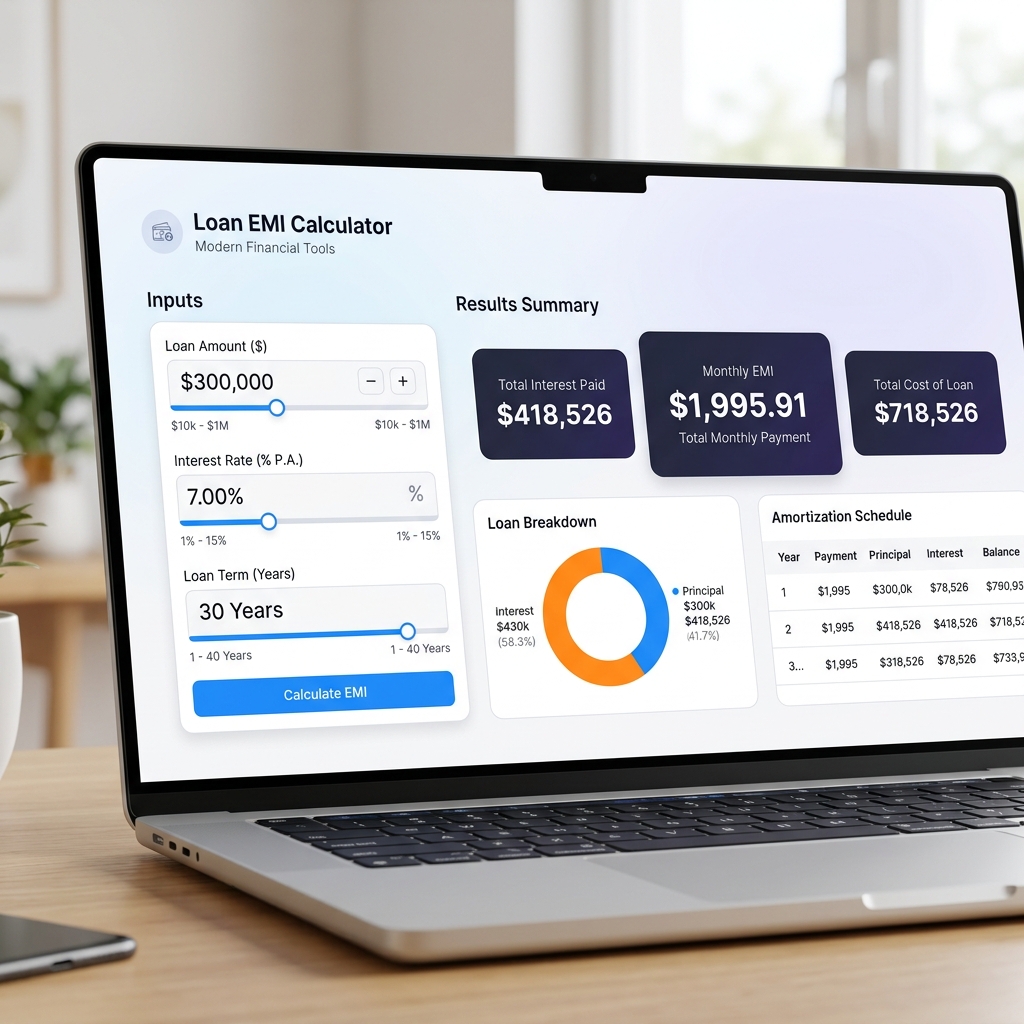
$300,000Mortgage · 30 years$1,996/mo$418,740$718,740
$400,000Mortgage · 30 years$2,661/mo$558,320$958,320
$300,000Mortgage · 15 years$2,696/mo$185,280$485,280
$50,000Student Loan · 10 years$581/mo$19,720$69,720
$100,000Business Loan · 60 months$1,980/mo$18,800$118,800

All figures use 7% annual interest rate and standard monthly amortization. Use the calculator above for your exact rate, term, and extra payment scenarios.

Works for Every Loan Type & Financial Instrument Worldwide

Mortgage Calculator15yr · 30yr · ARM · FHA · VA
Auto Loan CalculatorNew & used · 36–84 months
Personal Loan CalculatorUnsecured & secured
Student Loan CalculatorFederal, private & income-based
Business Loan CalculatorSBA, commercial & bridge
Bond / Zero-CouponPresent value · Yield to maturity

What Extra Payments Save — Real Numbers on Common Loans

$74,000+
Saved on $300K mortgage with $200/mo extra
6 years
Cut off 30yr mortgage with $200/mo extra
$90,000
Saved on $400K mortgage with bi-weekly payments
5 years
Shorter loan term — bi-weekly strategy

Full Amortization Schedule

Month-by-month principal & interest table for every payment. Download or print. See exactly where every dollar goes.

Extra Payment Savings

See exactly how much interest you save and how many months you cut off by paying extra each period.

Deferred Loan Maturity

Calculate the exact lump sum owed at maturity for balloon, bridge, and deferred-payment loans with any compounding frequency.

Bond Present Value

Price any zero-coupon bond or deferred instrument. Compare present values across yield rates and compounding conventions.

How Monthly Loan Payments & Amortization Work — 2026 Complete Guide

Monthly payment formula · Amortization explained · How to pay off your loan faster

~15 min readFinance Guide · Worldwide

⏱ 32 min read

Last updated: June 2026

# Loan Calculator 2026: Monthly Payment, Amortization Schedule & Extra Payment Savings

Free · No Sign-Up · Works for Mortgages, Auto Loans, Personal Loans, Student Loans & Bonds · Updated May 28, 2026

You are staring at a loan offer. It shows a monthly payment that looks manageable. What it does not show you is the total interest over 30 years, what happens if you pay $200 extra per month, or whether a 15-year mortgage actually makes more financial sense than a 30-year one for your situation.

This free loan payment calculator — and the complete guide below — answers all of that. It covers how monthly payments are calculated, what an amortization schedule really tells you, how extra payments save tens of thousands of dollars, and the real-world interest rates for mortgages, auto loans, personal loans, student loans, and bonds as of May 2026 across the US, UK, Canada, Australia, and India.

How Monthly Loan Payments Are Calculated

Every mortgage, car loan, and personal loan payment you make follows one standard mathematical formula. Banks in the US, UK, Canada, Australia, and India all use the same calculation — understanding it puts you on equal footing with any lender.

The Standard Loan Payment Formula


Monthly Payment = [ P × r × (1 + r)^n ] ÷ [ (1 + r)^n − 1 ]

Where:

  • P = Principal — the amount you are borrowing
  • r = Monthly interest rate = Annual interest rate ÷ 12 ÷ 100
  • n = Total number of monthly payments = Loan term in years × 12

A Step-by-Step Example

Borrowing $25,000 for a car at 7% APR for 5 years (60 months):

  • Monthly rate: 7 ÷ 12 ÷ 100 = 0.005833
  • Total payments: 5 × 12 = 60
  • Monthly payment: [25,000 × 0.005833 × (1.005833)^60] ÷ [(1.005833)^60 − 1] = $495.03
  • Total paid over 5 years: $29,702
  • Total interest paid: $4,702
That $4,702 is the real cost of borrowing $25,000. Most people only look at the monthly payment. The smarter move is always total cost — and that is exactly what a proper amortization schedule reveals.

Why the Interest Front-Loading Feels Unfair (But Isn't)

In Month 1 of any amortized loan, your payment is almost entirely interest. In Month 360 of a 30-year mortgage, it is almost entirely principal. This is not the bank cheating you. It is how amortization math works: interest is charged on whatever balance remains, which is highest at the start and lowest at the end. Once you understand this, extra payments — which reduce that remaining balance immediately — make intuitive financial sense.

What Is an Amortization Schedule?

An amortization schedule is a month-by-month table showing every single payment split into its interest and principal components, plus your remaining loan balance after each payment.

Sample Amortization Table: $300,000 Mortgage at 6.5% for 30 Years

MonthPaymentInterest PaidPrincipal PaidRemaining Balance
1$1,896.20$1,625.00$271.20$299,728.80
12$1,896.20$1,623.53$272.67$296,513.26
60$1,896.20$1,594.32$301.88$275,950.28
120$1,896.20$1,546.77$349.43$267,368.04
180$1,896.20$1,484.34$411.86$256,315.21
240$1,896.20$1,400.52$495.68$241,793.68
300$1,896.20$1,227.31$668.89$211,570.18
360$1,896.20$10.27$1,885.93$0.00
At Month 1, you pay $1,625 in interest and only $271 toward your actual balance. At Month 360, nearly the entire payment clears the remaining debt. That is the amortization curve — and it is why five years into a 30-year mortgage, your balance has barely moved despite hundreds of thousands of dollars in payments. Knowing this changes how you think about refinancing and extra payments.

Monthly Payment Quick Reference Table — All Loan Types 2026

Calculated at 7% annual interest rate — close to current US market averages. Use the calculator above for your actual rate.

Loan AmountType / TermMonthly PaymentTotal InterestTotal Cost
$10,000Personal Loan · 24 months$452$848$10,848
$15,000Personal Loan · 36 months$463$1,668$16,668
$25,000Auto Loan · 60 months$495$4,700$29,700
$35,000Auto Loan · 72 months$378$7,216$42,216
$50,000Student Loan · 10 years$581$19,720$69,720
$100,000Business Loan · 60 months$1,980$18,800$118,800
$200,000Mortgage · 30 years$1,331$279,160$479,160
$300,000Mortgage · 30 years$1,996$418,740$718,740
$300,000Mortgage · 15 years$2,696$185,280$485,280
$400,000Mortgage · 30 years$2,661$558,320$958,320
$500,000Mortgage · 30 years$3,327$698,118$1,198,118
$750,000Mortgage · 30 years$4,991$1,046,768$1,796,768
The 15 vs 30 year insight most people miss: On a $300,000 mortgage, the 15-year option costs $700 more per month — but saves $233,460 in total interest. That is not a marginal difference. That is a retirement account worth of money.

Current Loan Interest Rates: US, UK, Canada, Australia, India (May 2026)

Real-time rate data sourced from Bankrate, Zillow, CBS News, Finder Australia, and central bank publications as of May 28, 2026.

United States 🇺🇸

Rates have been volatile in May 2026. After briefly dipping below 6% in April, the 30-year fixed mortgage spiked to 6.62% mid-month before retreating. The average 30-year fixed mortgage rate is 6.49% as of May 27, 2026, according to Zillow — down from 6.62% at mid-month but significantly above the 5.99% seen in April. The Federal Reserve has paused rate changes through all of 2026 so far, and inflation surged to 3.8% annually, the sharpest in three years and well above the Fed's 2% target, making near-term cuts unlikely.

Loan TypeRate Range (May 2026)Typical Term
30-Year Fixed Mortgage6.40% – 6.75%30 years
15-Year Fixed Mortgage5.75% – 6.15%15 years
30-Year Refinance6.55% – 6.90%30 years
Auto Loan — New Vehicle6.50% – 8.00%48–72 months
Auto Loan — Used Vehicle7.50% – 12.00%36–60 months
Personal Loan (700 FICO)10% – 22%1–7 years
Student Loan (federal)6.53% – 8.05%10–25 years
HELOC7.24% (average)Variable
The average personal loan rate is 12.27% for customers with a 700 FICO score, $5,000 loan amount, and a three-year repayment term, according to Bankrate Monitor data as of May 20, 2026. The average auto loan interest rate sits at 7.04% for a 60-month new car loan, according to Bankrate's weekly survey.

United Kingdom 🇬🇧

The UK mortgage rate decreased to 6.59% in February 2026 from 6.62% in January, according to Bank of England data. Most UK borrowers are on 2- or 5-year fixed deals that revert to the Standard Variable Rate (SVR) — typically 7–8.5% — when the introductory period ends.

Loan TypeRate Range (May 2026)Notes
2-Year Fixed Mortgage4.20% – 5.10%Most popular residential term
5-Year Fixed Mortgage4.10% – 4.90%Better long-term certainty
Standard Variable Rate (SVR)7.00% – 8.50%Avoid staying here
Personal Loan6.5% – 18%Based on credit score
Car Finance (HP / PCP)7% – 13%Always compare total cost of credit
UK-specific warning: When your fixed introductory period ends and you roll onto the SVR, your monthly payment can jump by £400–£800 per month on a typical mortgage. Set a calendar reminder 6 months before your deal expires and start remortgage comparisons early.

Canada 🇨🇦

Canadian mortgage borrowers face a mandatory stress test — they must qualify at their contract rate plus 2%, or the Bank of Canada's qualifying rate (whichever is higher). This directly limits how much you can borrow.

Loan TypeRate Range (May 2026)
5-Year Fixed Mortgage4.40% – 5.25%
Variable Rate Mortgage5.10% – 5.70%
Auto Loan6.99% – 10.99%
Personal Line of CreditPrime + 1% to 3%
Personal Loan9.99% – 19.99%

Australia 🇦🇺

Following the RBA's decision on May 6, 2026 to change the official cash rate, variable loan interest rates increased by 0.25%, effective May 20, 2026. The RBA cash rate now stands at 4.10%. Most Australian mortgages are variable-rate, which means rate decisions hit borrowers immediately.

Loan TypeRate Range (May 2026)
Variable Home Loan6.15% – 7.65%
Fixed Home Loan (2-year)5.60% – 6.80%
Car Loan7.00% – 13.00%
Personal Loan (Excellent credit)5.76% – 9.00%
Personal Loan (Average credit)12.00% – 18.00%
The average interest rate for unsecured personal loans in Australia is 10.32% p.a. as of April 2026, based on borrowers with excellent credit, according to Finder's database.

India 🇮🇳

Home loan EMI rates in India are closely tied to the RBI repo rate. Public sector banks (SBI, Bank of Baroda) offer lower rates; private lenders (HDFC, ICICI, Axis) are typically faster to approve.

Loan TypeRate Range (May 2026)
Home Loan (EMI)7.10% – 9.90%
Car / Auto Loan7.35% – 10.85%
Personal Loan8.75% – 18%+
Education Loan8% – 11.5%
Loan Against Property7.50% – 11.00%

How Extra Payments Save You Tens of Thousands

This is where most borrowers leave serious money on the table. Even a small extra payment every month — applied directly to principal — has a compounding acceleration effect that builds over time.

Extra Payment Impact: $300,000 Mortgage at 7% for 30 Years

Standard monthly payment: $1,996

Extra Monthly PaymentTotal Interest SavedYears SavedNew Loan Term
$0 (standard)30 years
$100/month$30,2004 yrs 4 months25 yrs 8 months
$200/month$74,0006 yrs 11 months23 yrs 1 month
$300/month$101,0009 years21 years
$500/month$133,00011 yrs 6 months18 yrs 6 months
$1,000/month$177,00015 yrs 9 months14 yrs 3 months
Paying $200 extra per month on a $300,000 mortgage saves $74,000 in interest and cuts nearly 7 years off the loan. That is more than a year's salary for most American households — recovered simply by redirecting $200 per month.

Why Extra Payments Work

When you pay extra, that money goes directly to reducing your principal balance. The following month, interest is charged on a lower amount — so less of your regular payment is consumed by interest, and more chips away at the debt. This acceleration compounds over the entire remaining life of the loan.

Practical step: Add your extra amount to your regular payment with a note specifying "apply to principal." Most US lenders will honor this. Confirm in writing and check your statement to verify it is being applied correctly, not treated as an advance payment.

Bi-Weekly Payments: Save $90,000 With No Extra Money

Here is a strategy that sounds like a trick but is legitimate mathematics: instead of paying your full mortgage monthly, pay half the monthly amount every two weeks.

Why it works: There are 52 weeks in a year — meaning 26 bi-weekly half-payments, which equals 13 full monthly payments instead of 12. That one extra payment per year goes entirely to principal.

Bi-Weekly vs Monthly on a $400,000 Mortgage at 6.5% for 30 Years

StrategyTotal InterestLoan TermSavings
Monthly (standard)~$510,00030 years
Bi-weekly~$420,000~25 years~$90,000 + 5 years
How to do it without paying a setup fee: Many banks offer formal bi-weekly programs but charge $200–$500 to set them up. Skip that. Instead, divide your monthly mortgage payment by 12 and add that amount to every monthly payment. The effect is identical — one extra full payment per year applied to principal — at zero cost.

Fixed vs Variable Rate Loans: Which Is Right in 2026?

This question comes up constantly. The honest answer: it depends on your situation and timeline, not just on the current rate environment.

Fixed Rate Loans

Your interest rate stays the same for the entire loan term. Monthly payment is completely predictable.

Choose fixed when:

  • You need certainty in monthly budgeting
  • You are taking a loan term of 15 years or longer
  • You believe rates will stay high or rise further
  • You do not plan to refinance or sell before the term ends
2026 reality: At 6.49–6.62% for a 30-year US fixed mortgage, rates are elevated compared to the 2020–2021 lows (sub-3%) but improved from the 2023 peak (8%+). Current forecasts suggest the 30-year fixed rate will gradually decline from the 6.0–6.4% range in 2026 toward 5.5–5.7% by 2030 — but nobody knows if or when that happens.

Variable / Adjustable Rate Loans

Your rate moves with a benchmark — SOFR in the US, Bank of England base rate in the UK, RBA cash rate in Australia, RBI repo rate in India. Usually starts lower than fixed, then adjusts periodically.

Choose variable when:

  • You plan to sell or refinance within 3–5 years
  • You can absorb payment increases without financial stress
  • You are in a market where fixed rates are at historic highs and cuts are expected
2026 caution: In the US, ARM starter rates are only marginally below 30-year fixed rates right now — making the risk-reward less compelling than in earlier rate environments. In the UK and Australia, most borrowers are already on variable products by default after fixed introductory periods expire.

The Simple Decision Rule

If keeping the loan more than 5–7 years and rates are not at historic highs: take fixed. If you are confident you will sell or refinance within a few years: variable might make sense. Never choose variable just because the starting payment looks attractive — you are making a bet on future rate movements.

Deferred Loans and Compound Interest — The Silent Cost

Not all loans follow the standard monthly EMI model. Education loans, certain business loans, and buy-now-pay-later products have a deferred period where interest accumulates without payments. When repayments start, you owe more than you originally borrowed.

Compound Interest Formula for Deferred Loans


A = P × (1 + r/n)^(n × t)

Where:

  • A = Final amount owed at end of the deferment period
  • P = Original principal
  • r = Annual interest rate as a decimal (e.g., 0.09 for 9%)
  • n = Compounding periods per year (12 for monthly, 365 for daily)
  • t = Deferral period in years

Example: Education Loan with 2-Year Moratorium

Borrow $40,000 at 9% interest, compounded monthly, 2-year no-payment period:

  • A = 40,000 × (1 + 0.09/12)^(12 × 2)
  • A = 40,000 × (1.0075)^24
  • A = 40,000 × 1.1964
  • Amount owed after 2 years: $47,856
The student paid nothing for two years — but now owes $7,856 more than they borrowed. EMIs going forward are calculated on $47,856, not $40,000. This surprises almost every first-time education loan borrower.

How Compounding Frequency Affects the Real Cost

CompoundingEffective Annual Rate on 8% Nominal
Annually8.00%
Quarterly8.24%
Monthly8.30%
Daily8.33%
The gap looks small on percentages — but on a $50,000 loan over 10 years, daily vs annual compounding costs hundreds of dollars extra in interest. For investments, you want daily compounding (more frequent = better). For loans, you want annual compounding (less frequent = cheaper).

Mortgage Calculator — How Much Can You Actually Borrow?

Most lenders use the debt-to-income ratio (DTI) to determine your maximum loan amount. In the US, the standard guideline is keeping total monthly debt payments (including the new mortgage) below 43% of gross monthly income. Many prefer 36% or lower.

Calculate Your Maximum Mortgage (US)

  • Take your gross monthly income (before tax)
  • Multiply by 0.36 (36% DTI guideline)
  • Subtract all existing monthly debt payments (car loans, student loans, credit cards)
  • The remainder is your maximum mortgage payment
Example: Gross monthly income: $8,000 × 0.36 = $2,880. Minus existing debt payments of $650 = maximum mortgage payment of $2,230. At 6.5% for 30 years, that supports a loan of approximately $353,000.

What Your Mortgage Payment Actually Includes

A mortgage payment is not just principal and interest. Your total monthly housing cost includes:

  • Principal + Interest (what the loan calculator shows)
  • Property taxes — widely variable by state and city (0.3% to 2.5% of home value annually)
  • Homeowner's insurance — typically $100–$200/month on a median US home
  • PMI (Private Mortgage Insurance) — required when down payment is under 20%; typically 0.46–1.50% of loan amount annually
  • HOA fees — if applicable, can range from $0 to $1,000+/month
  • Maintenance reserve — budget 1–2% of home value annually
When you account for all of these, your actual monthly housing cost is typically 20–35% higher than the raw principal-and-interest calculator figure. Factor everything in before deciding how much to borrow.

The 30% EMI Rule (India)

Indian financial planners use the 30% rule: keep total monthly EMI payments (all loans combined) below 30% of gross monthly income. This maintains buffer for living costs, savings, and emergencies. Above 40% DTI, a single income disruption can trigger missed payments.

Car Loan Calculator — Monthly Payments by Credit Score (US, May 2026)

Auto loans are among the most commonly mispriced loans people take on — primarily because dealership financing is often not the cheapest option available.

Current US Auto Loan Rates by Credit Score (May 2026)

Credit ScoreNew Car RateUsed Car Rate
750+ (Excellent)5.5% – 7.0%6.5% – 8.0%
700–749 (Good)6.5% – 8.5%7.5% – 10.5%
650–699 (Fair)8.5% – 12.0%10.0% – 16.0%
600–649 (Below Average)12.0% – 18.0%15.0% – 22.0%
Below 60018.0% – 25%+20% – 29%+

Car Loan Monthly Payments at 7% APR

Vehicle PriceDown PaymentLoan AmountTermMonthly PaymentTotal Interest
$20,000$3,000$17,00048 months$407$1,536
$30,000$5,000$25,00060 months$495$4,700
$40,000$7,000$33,00060 months$653$6,180
$50,000$10,000$40,00072 months$432$11,104
$60,000$12,000$48,00072 months$518$13,296

The 72-Month Car Loan Trap

72 and 84-month car loans are now dangerously common in the US. The monthly payment looks manageable — but you are paying 15–25% more in total interest than a 48-month loan on the same amount, and you will almost certainly be "underwater" (owing more than the car is worth) for the first 2–3 years.

Rule of thumb: Never take a car loan longer than 60 months. If the payment at 60 months is not affordable, you are buying too much car.

Car Loan vs Paying Cash: When Does Financing Make Sense?

Financing makes financial sense when your loan rate is lower than what you could earn investing that cash. If you can earn 7% in a diversified index fund but your car loan is 5.5%, financing theoretically wins. At 10%+ interest, paying cash (if available) almost always beats financing.

Personal Loan Calculator — Rates, Payments, and Total Cost 2026

Personal loans are the most versatile borrowing tool available — useful for debt consolidation, home improvements, medical bills, or any major expense where you need a fixed-rate installment structure.

Average Personal Loan Rates Worldwide (May 2026)

CountryRate RangeAverage (700 credit)Typical Term
United States6% – 36%12.27%1–7 years
United Kingdom6.5% – 18%~8–10% (good credit)1–5 years
Canada9.99% – 19.99%~13%1–5 years
Australia5.76% – 25%+10.32% (excellent)1–7 years
India8.75% – 18%+~12–14%1–5 years

Personal Loan Monthly Payments — $10,000 over 36 Months

Interest RateMonthly PaymentTotal InterestTotal Paid
8%$313$268$10,268
10%$323$628$10,628
12%$332$995$10,995
15%$347$1,492$11,492
18%$362$2,032$12,032
22%$384$2,824$12,824
28%$416$3,976$13,976
The difference between qualifying for 8% vs 22% on a $10,000 loan is $2,556 in extra interest. Your credit score is the single biggest lever determining which rate you get. Improving your FICO score from 650 to 720 before applying can mean the difference between 15% and 9%.

Student Loan Payoff Calculator — US Federal Loans 2026

Student loans have unique features — income-driven repayment, moratorium periods, and potential forgiveness — that change the mathematical calculus entirely.

Standard vs Income-Driven: The Real Cost Over Time

For $50,000 in federal student loans at 6.53%:

Repayment PlanMonthly PaymentLoan TermTotal Paid
Standard (10 years)$56710 years$68,040
Income-Based (IBR)$200–$40020–25 years$80,000–$120,000+
Extended (25 years)$34125 years$102,300
Extra $200/month$767~7.5 years$57,840
Income-driven plans make sense when income is genuinely low relative to debt, or when you are pursuing Public Service Loan Forgiveness (PSLF) after 10 years of qualifying employment. For most borrowers, the standard 10-year plan is the cheapest total-cost option by a wide margin.

India Education Loan Moratorium — The Balance That Grows While You Study

Most Indian education loans have a moratorium covering the full course duration plus 6–12 months. Interest accrues daily during this time.

Example: ₹10 lakh borrowed at 9%, 2-year moratorium, monthly compounding:

  • Balance after moratorium: ₹10 lakh × (1 + 0.09/12)^24 = ₹11.96 lakh
  • Monthly EMI for remaining 7 years: approximately ₹19,200
That extra ₹1.96 lakh appeared without a single payment being missed. Always ask your lender for a statement showing the exact balance when your repayment period begins — before your first EMI is calculated.

Bond Yield to Maturity Calculator — 2026 Guide

If you are considering investing in government bonds, corporate bonds, or treasury notes, yield to maturity (YTM) tells you the true annualized return if you hold the bond to its end date — accounting for current market price, face value, coupon payments, and time remaining.

Zero-Coupon Bond Price Formula


PV = F ÷ (1 + r)^n

Where:

  • PV = Present value — what you pay today
  • F = Face value — what you receive at maturity
  • r = Required annual yield
  • n = Years until maturity

Example: 10-Year Zero-Coupon Bond

Face value: $10,000 | Market yield: 6.96% | Years to maturity: 10

  • PV = 10,000 ÷ (1.0696)^10 = 10,000 ÷ 1.9523 = $5,122
You pay $5,122 today to receive $10,000 in 10 years. Annualized return: 6.96%.

Approximate YTM Formula for Coupon Bonds


YTM ≈ [Annual Coupon + (Face Value − Current Price) ÷ Years to Maturity] ÷ [(Face Value + Current Price) ÷ 2]

Bond Rates — Global Snapshot, May 2026

Country / BondCurrent YieldInflationReal Return
US 10-Year Treasury~4.3–4.5%~3.8%~0.5–0.7%
India 10-Year Govt Bond~6.96%~4.2%~2.76%
UK 10-Year Gilt~4.5%~3.0%~1.5%
Australia 10-Year Govt~4.7%~3.5%~1.2%
Canada 10-Year Govt~3.8%~2.7%~1.1%
Before buying any bond, subtract current inflation from the nominal yield to get your real return. A 4.5% US Treasury at 3.8% inflation gives you a real return of only 0.7% annually — before tax. That is low but genuinely risk-free for US-denominated capital.

12 Smart Loan Strategies for 2026

Specific, actionable moves — not vague advice.

1. Compare at Least 3 Lenders Before Signing Anything

On a $300,000 mortgage, a 0.5% rate difference saves approximately $30,000 over 30 years. Getting multiple quotes costs nothing but time. Shopping around has been shown to result in rates roughly half a percentage point below average.

2. Keep Total Monthly Debt Payments Under 36% of Gross Income

This is the threshold most US lenders use and a reasonable personal target. Above 40%, a single unexpected expense — medical bill, car repair — can trigger missed payments and credit damage.

3. Make At Least One Extra Payment Per Year

Apply your tax refund, year-end bonus, or any windfall directly to principal. On a $300,000 mortgage, one extra $2,000 payment per year shortens the loan by 3–4 years and saves $25,000–$35,000 in interest.

4. Refinance When Your Rate Is 1%+ Above Current Market

The break-even on refinancing (closing costs vs monthly savings) typically takes 2–4 years. If you plan to stay in the home longer than that, refinancing makes financial sense. At current US rates (~6.5%), anyone who locked above 7.5% in 2023 should actively evaluate refinancing now.

5. Never Extend a Car Loan Beyond 60 Months

72 and 84-month terms exist to make expensive cars look affordable via low monthly payments. The hidden cost is significant extra interest and years of negative equity. Stick to 60 months maximum.

6. Use the Avalanche Method for Multiple Loans

Make minimum payments on all loans, then direct every extra dollar toward the highest-interest debt first. This is mathematically optimal and saves more money than the snowball method (smallest balance first), though the snowball approach works better psychologically for some people.

7. Choose Less Frequent Compounding Where Possible

When lenders offer compounding frequency options, monthly is cheaper than daily. This matters most for deferred loans (education, business) where interest accumulates during a moratorium with no payments reducing the balance.

8. Check for Prepayment Penalties Before Making Extra Payments

Most US mortgages and personal loans have no prepayment penalty. Some UK mortgages (early repayment charges) and certain car loans do. Always check the loan agreement — a prepayment fee can eliminate the benefit of extra payments entirely.

9. Account for Inflation on Fixed-Income Bond Investments

A 4.5% US Treasury yield sounds solid. At 3.8% inflation, your real return is 0.7% before tax. After a 22% federal income tax on interest, you are keeping roughly 0.2% in real terms. Worth knowing before committing large sums to long-term fixed-income instruments.

10. Factor PMI Into Your Actual Mortgage Cost

If your US down payment is under 20%, PMI adds 0.46–1.50% of your loan amount annually to your real cost. On a $300,000 mortgage, that is $1,380–$4,500 per year — or $115–$375 per month — that your payment calculator will not show by default. Budget for it. And plan to cancel it as soon as your LTV reaches 80%.

11. Use the Loan Calculator Before Negotiating, Not After

Walk into any loan negotiation knowing exactly what a 0.25% rate difference costs you over the full term, what the total interest looks like at 15 vs 30 years, and what $100 extra per month saves you. This information changes every conversation with a lender, broker, or car salesperson.

12. For Indian Home Loans — Request an EMI Reset After Prepayment

When you make a lump-sum prepayment on an Indian home loan, most lenders default to reducing your tenure (keeping EMI the same). If you want a lower monthly EMI instead, you must specifically request an EMI reset. Decide which option serves your cash flow before making any prepayment.

Loan Glossary — Key Terms Explained Simply

Amortization — The process of paying off a loan through regular scheduled payments. Each payment covers interest charged on the remaining balance plus a portion of the principal.

APR (Annual Percentage Rate) — The true annual cost of borrowing, including the interest rate plus fees. Always compare APR between lenders, not just the stated interest rate.

Balloon Payment — A large lump-sum payment due at the end of a loan term after a period of lower regular payments. Common in commercial real estate and some business loans.

Compound Interest — Interest calculated on the original principal plus all previously accumulated interest. Powerful when earning it (savings, investments). Expensive when paying it (deferred loans, credit cards).

DTI (Debt-to-Income Ratio) — Total monthly debt payments divided by gross monthly income, expressed as a percentage. The primary metric lenders use to assess loan affordability.

EMI (Equated Monthly Installment) — The standard term in India, Singapore, and Southeast Asia for a fixed monthly loan payment covering both principal and interest.

LTV (Loan-to-Value Ratio) — Loan amount divided by the appraised value of the asset. A lower LTV (larger down payment) unlocks better rates and removes PMI requirements.

Moratorium Period — A period at the start of a loan (common in education and some business loans) where no payments are required. Interest typically continues to accrue and is added to principal.

PMI (Private Mortgage Insurance) — Required in the US when down payment is less than 20%. Protects the lender, not you. Can be cancelled when your equity reaches 20%.

Principal — The original amount borrowed before any interest is applied.

Refinancing — Replacing an existing loan with a new one — typically at a lower rate, different term, or to access built-up equity.

SVR (Standard Variable Rate) — The UK's default mortgage rate that borrowers revert to after a fixed introductory deal ends. Usually 1.5–3% above introductory fixed rates.

YTM (Yield to Maturity) — The total annualized return on a bond if held to maturity, accounting for current price, face value, coupons, and time remaining.

Frequently Asked Questions

How do I calculate my monthly loan payment?

Use the formula: Monthly Payment = [P × r × (1+r)^n] ÷ [(1+r)^n – 1], where P is the principal, r is the monthly interest rate (annual rate ÷ 12 ÷ 100), and n is total monthly payments. For a $25,000 loan at 7% APR over 60 months, the result is $495.03 per month. The calculator above handles this automatically for any loan amount, rate, and term.

What is an amortization schedule and how do I read one?

An amortization schedule is a month-by-month table showing each payment split into its interest and principal portions, plus the remaining balance after every payment. In the early months, most of your payment is interest. In the final months, most is principal. Reading your schedule helps you understand exactly how much of every payment is building equity vs paying the cost of borrowing.

How much do extra payments save on a mortgage?

At 7% over 30 years, paying $200 extra per month on a $300,000 mortgage saves approximately $74,000 in total interest and cuts about 7 years off the loan. Even $100 per month saves over $30,000. The earlier in the loan term you start making extra payments, the larger the savings — because the reduced principal lowers every subsequent month's interest charge.

What is the difference between a fixed and variable interest rate?

A fixed rate stays the same for the entire loan term — predictable payments, no surprises. A variable rate moves with a benchmark index and can go up or down. Fixed rates provide certainty. Variable rates can save money if benchmark rates fall, but carry the risk of significant payment increases. In 2026, with rates elevated and uncertainty high, most long-term borrowers are better served by fixed rates.

How do bi-weekly mortgage payments work?

Pay half your monthly mortgage amount every two weeks. With 52 weeks in a year, this creates 26 half-payments — equal to 13 full monthly payments instead of 12. The extra yearly payment goes directly to principal. On a $400,000 mortgage at 6.5%, this saves approximately $90,000 in interest and shortens the loan by about 5 years.

What is a balloon payment loan?

A balloon loan has lower regular monthly payments during the loan term, followed by one large lump-sum payment at the end. For example, a 7-year balloon mortgage has lower EMIs for 7 years, but the full remaining principal balance is due at the end of year 7. Common in commercial real estate and business loans where the borrower plans to refinance or sell before the balloon date.

Is this calculator accurate for mortgages, auto loans, and personal loans worldwide?

Yes. The calculator uses the standard actuarial amortization method — the same formula used by lenders under CFPB guidelines (US), FCA standards (UK), FCAC rules (Canada), ASIC standards (Australia), and RBI guidelines (India). Results match figures from major bank calculators. All calculations run locally in your browser with no data stored.

Should I pay off my mortgage early or invest the extra money?

This is one of the most genuine personal finance dilemmas. Mathematically, if your expected investment return (7–8% in a diversified index fund, historically) exceeds your mortgage rate (currently ~6.5%), investing theoretically wins. But paying off the mortgage provides a guaranteed, risk-free "return" equal to your mortgage rate — and the psychological value of being debt-free is real. Most financial planners suggest a middle path: maximise any employer retirement match first, then split extra cash between index fund investing and mortgage prepayment.

What happens to my Indian home loan EMI if I make a prepayment?

Most Indian lenders offer two options: reduce your EMI (keeping tenure the same), or reduce your tenure (keeping the same EMI). Reducing tenure almost always saves more interest over the life of the loan. Reducing EMI helps if monthly cash flow is tight. Ask your lender which option is the default — it is often not what you would assume — and request the option that matches your financial goals in writing.

What is the best loan tenure to choose?

There is no universal answer. A shorter tenure means higher monthly payments but dramatically less total interest. A longer tenure lowers monthly payments but significantly increases total cost. Use the calculator to compare the total interest across different terms — the difference is frequently shocking. As a practical rule: choose the shortest tenure your monthly budget can comfortably sustain, with buffer for emergencies.

How do I calculate EMI for a deferred education loan?

First, calculate the balance at the end of the moratorium using the compound interest formula: A = P × (1 + r/n)^(n×t). Then plug that higher balance, the remaining loan rate, and the repayment term into the EMI calculator. This gives your actual monthly payment once repayments begin. Never assume your EMI is based on the original loan amount after a moratorium period.

What credit score do I need for the best loan rates in 2026?

In the US, a FICO score above 740 typically qualifies you for the best rates across mortgages, auto loans, and personal loans. Scores between 670–739 are "good" and get competitive rates. Below 670, you will pay a meaningful premium. For a $300,000 mortgage, the difference between a 750 FICO rate (6.5%) and a 650 FICO rate (7.5%) is approximately $58,000 in extra interest over 30 years. Improving your score before a major borrowing decision is one of the highest-ROI financial moves available.

Methodology and Data Sources

All payment calculations use the standard actuarial amortization formula, consistent with guidelines from the Consumer Financial Protection Bureau (US), Financial Conduct Authority (UK), Financial Consumer Agency of Canada, Australian Securities and Investments Commission, and Reserve Bank of India.

Interest rate data is sourced from Bankrate, Zillow, CBS News, Freddie Mac, Bank of England data via Trading Economics, Finder Australia, and central bank publications as of May 28, 2026. Rates change daily — verify with your specific lender before making any borrowing decision.

This calculator and guide are for educational and informational purposes only. All figures are estimates based on standard mathematical formulas and publicly available rate data. They do not constitute a loan offer, guarantee of credit, or financial advice. Consult a licensed financial advisor, mortgage broker, or certified financial planner before significant borrowing decisions.

Last Updated: May 28, 2026

Monthly Loan Payment Formula (Standard Actuarial Method)

Monthly Payment = P × r × (1+r)^n

÷ [(1+r)^n − 1]

P = Principal (loan amount)

r = Monthly rate = Annual interest rate ÷ 12 ÷ 100

n = Term in months = Years × 12

This actuarial formula is standard across the US (CFPB), UK (FCA), Canada (FCAC), Australia (ASIC), and the EU. Our calculator uses this exact formula for all results.

How a 1% interest rate difference changes your payment — $300,000 mortgage · 30 years

Interest RateMonthly PaymentTotal InterestDifference vs 6%
5.0%$1,610$279,767–$50,573
5.5%$1,703$313,212–$17,128
6.0%$1,799$347,515baseline
6.5%$1,896$382,633+$35,118
7.0%$1,996$418,527+$71,012
7.5%$2,098$455,154+$107,639
8.0%$2,201$492,471+$144,956

Source: Standard actuarial amortization · $300,000 loan · 360 months · monthly compounding.

More Loan & Finance Calculators

Explore more tools to calculate smarter and plan better

How to Calculate Your Monthly Loan Payment — 5 Steps

Takes under 2 minutes · No sign-up required · Works on any device

  1. 1

    Enter loan amount

    Total amount you're borrowing — e.g. $25,000 for a car or $350,000 for a home.

  2. 2

    Enter annual interest rate

    Your APR as a %. Check your lender's offer letter or online quote.

  3. 3

    Set loan term

    Duration in years or months — 30 years for a mortgage, 60 months for auto.

  4. 4

    Add extra payment (optional)

    See instantly how $100 or $200/month extra cuts total interest and shortens your loan.

  5. 5

    View full results

    Get monthly payment, total interest, payoff date & complete amortization schedule.

Loan Calculator — Frequently Asked Questions

How to calculate monthly payments · What amortization means · How extra payments save money · Deferred loans · Fixed vs variable rates

Use the formula: Monthly Payment = [P × r × (1+r)^n] ÷ [(1+r)^n – 1], where P = loan amount, r = monthly interest rate (annual rate ÷ 12 ÷ 100), and n = total months. Example: a $25,000 loan at 7% APR for 60 months gives a monthly payment of $495. Our calculator computes this instantly for any loan amount, rate, and term.

An amortization schedule is a complete month-by-month table showing each payment split into principal and interest, plus your remaining balance. In early months, most of your payment is interest. By the end, most goes to principal. Our calculator generates this full table and lets you download or print it for any loan.

Extra payments reduce your principal faster, slashing total interest. On a $300,000 mortgage at 6.5% for 30 years, paying just $200 extra per month saves over $74,000 in interest and cuts 6 years off the loan. Use the extra payment field in our calculator to see your exact savings for any loan scenario.

A fixed rate stays the same for the entire loan term — your monthly payment never changes. A variable (adjustable) rate moves with a benchmark like the US Fed Funds Rate, UK Bank of England base rate, or Canada's prime rate. Fixed rates give certainty; variable rates can save money if market rates fall but increase costs if they rise.

Amortization means repaying a loan through equal periodic payments over time. Each payment covers interest (the cost of borrowing) and principal (reducing your balance). Early payments are mostly interest; final payments are mostly principal. This gradual shift from interest-heavy to principal-heavy is the amortization curve.

Paying half your monthly payment every two weeks results in 26 half-payments per year — equivalent to 13 full monthly payments instead of 12. That one extra annual payment goes entirely to principal. On a $400,000 mortgage at 6.5% for 30 years, bi-weekly payments save approximately $90,000 and finish 5 years early.

A deferred payment loan (also called a balloon or bullet loan) requires no periodic payments during the loan term. Instead, the full balance — principal plus all accrued interest — is repaid in a single lump sum at maturity. Common examples include bridge loans, student loan grace periods, and commercial development finance. Use our Deferred tab to calculate the exact maturity amount.

For a zero-coupon bond: Price Today = Face Value ÷ (1 + r/n)^(n×t), where r = yield rate, n = compounding periods per year, and t = years to maturity. Our Bond calculator uses exact compound-interest computation to find the present value of the predetermined maturity amount, consistent with CFA and Bloomberg pricing conventions.

Yes — our Amortized Loan calculator works for any installment loan worldwide. Enter the loan amount, annual interest rate, and term in months or years. It instantly computes the monthly payment and full amortization schedule for mortgages (15yr, 30yr), auto loans (36–84 months), personal loans, student loans, business loans, and more.

Completely free — no account, no sign-up, no hidden fees. Our calculator uses the standard actuarial amortization method used by banks in the US, UK, Canada, Australia, and globally. Results match figures from CFPB mortgage tools, UK Money Helper, and Australian ASIC calculators. All computations run locally in your browser — no data is sent to any server.