2026 IRS Rates · All 50 States · Instant Results

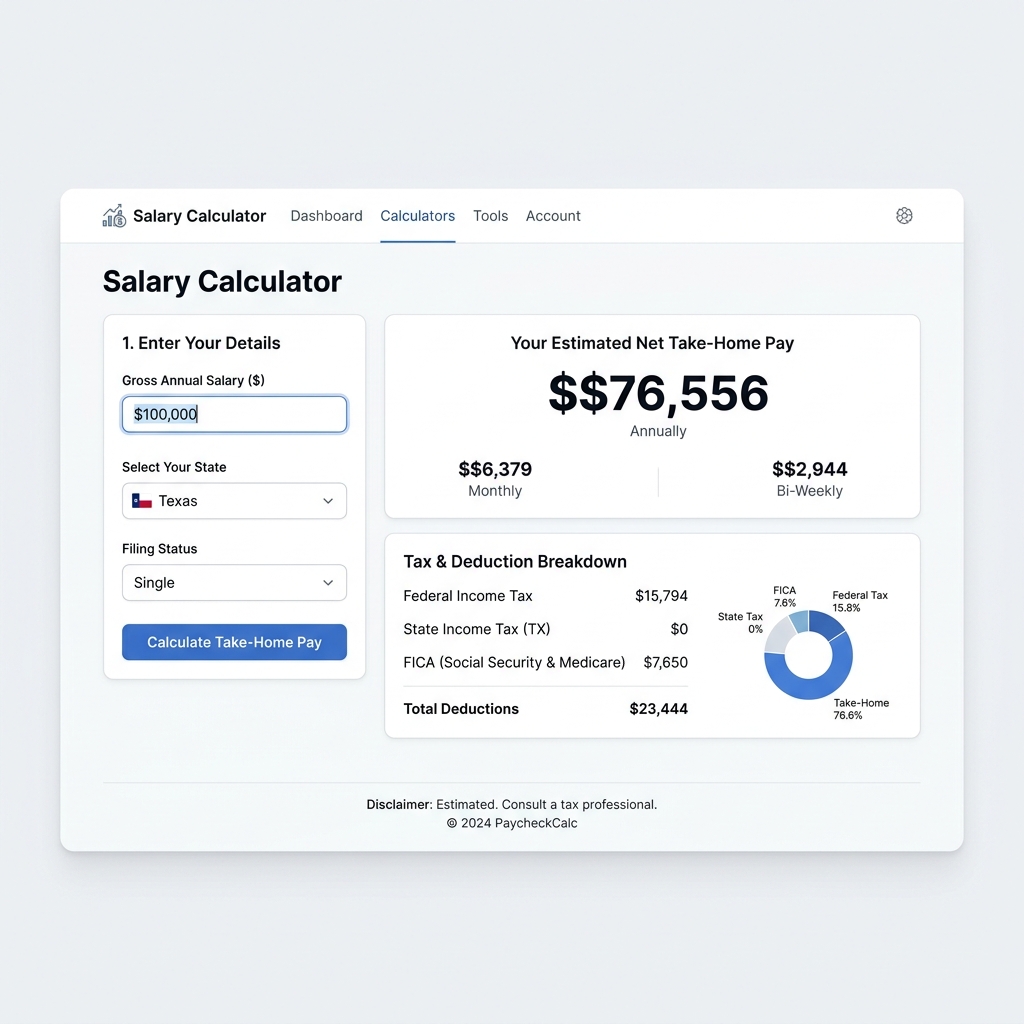
Salary After Tax Calculator

Find your real take-home pay after federal, state, and FICA taxes. Updated for 2026 — all 50 states, 401(k), HSA deductions. No signup. Instant.

4.9/5 · 12,847 usersAll 50 States + DCNo data stored401(k) & HSA included100% Free · No Login

Salary After Tax Calculator

2026 IRS Rates · All 50 States

$
$10K$500K

Enter a salary to calculate

2026 IRS Key Numbers — Built Into Every Calculation

$176,100

SS Wage Base

6.2% up to this limit

$15,000

Std Deduction (Single)

$30,000 married jointly

$23,500

401(k) Limit

$31,000 age 50+

15.3%

Self-Employment Tax

SS + Medicare combined

Featured Snippet · Most Searched

Salary After Tax Quick Reference (2026)

Single filer · Standard deduction · ~4% average state tax · No pre-tax deductions

SalaryFederal TaxFICA~State TaxMonthly NetAnnual NetEff. Rate
$40,000$2,568$3,060$1,600$2,731$32,77218.1%
$50,000$4,068$3,825$2,000$3,342$40,10719.8%
$60,000$5,918$4,590$2,400$3,924$47,09221.5%
$70,000$7,918$5,355$2,800$4,494$53,92723.0%
$80,000$10,294$6,120$3,200$5,032$60,38624.4%
$100,000$15,794$7,650$4,000$6,046$72,55627.4%
$120,000$21,294$9,180$4,800$7,061$84,72629.4%
$150,000$30,544$11,475$6,000$8,582$102,98131.3%
$200,000$46,544$14,505$8,000$10,996$131,95134.5%

FICA at $200K includes 0.9% Additional Medicare Tax. Use the calculator above for your exact state and deductions.

State Comparison

$100,000 Salary After Tax by State (2026)

Single filer · Standard deduction · Federal + FICA constant across all states

StateState RateState TaxAnnual NetMonthly Netvs Texas
🤠 Texas0%$0$76,550$6,379
🏖️ Florida0%$0$76,550$6,379
🌵 Arizona2.5% flat$1,875$74,675$6,223−$1,875
🏔️ Colorado4.4% flat$3,300$73,250$6,104−$3,300
🌸 Georgia5.49%$4,118$72,432$6,036−$4,118
🗽 New York4–10.9%$5,820$70,730$5,894−$5,820
🌉 California1–13.3%$6,500$70,050$5,838−$6,500

All figures before local/city taxes. NYC adds ~3.8% city tax on top of NY state tax.

How to Use

How to Calculate Salary After Tax

1

Enter Gross Salary

Type your annual salary or use preset buttons ($40K–$150K). The slider adjusts in $5K increments.

2

Filing Status

Single, MFJ, HOH, or MFS. This changes your standard deduction and tax brackets.

3

Select State

Tax ranges from 0% (TX/FL) to 13.3% top rate (CA). Results update instantly.

4

Add Deductions

401(k), HSA, and pre-tax deductions reduce your taxable income and tax bill.

5

Read Results

See annual, monthly, and biweekly take-home with a full donut chart breakdown.

How Salary After Tax Works — 2026 Guide

Federal brackets · FICA · Standard deduction · All 50 states

The 2026 Federal Tax Brackets

Federal income tax in 2026 is progressive — you pay different rates on different portions of income, not a flat rate on everything. For a single filer, the first $11,925 is taxed at 10%, income from $11,926 to $48,475 at 12%, and income from $48,476 to $103,350 at 22%. Before any bracket applies, you subtract your standard deduction ($15,000 for single filers in 2026), which means on a $75,000 salary, you only pay tax on $60,000.

FICA: Social Security and Medicare

FICA taxes are separate from income tax. Social Security is 6.2% on wages up to $176,100 (the 2026 wage base) — above this, it stops completely. Medicare is 1.45% on all wages with no cap. An additional 0.9% Medicare surtax applies on wages above $200,000 (single). Your employer matches the 6.2% Social Security and 1.45% Medicare — the amounts shown in our calculator are the employee share only.

State Income Tax: The Hidden Variable

State income tax is often overlooked — but it can cost more than federal tax at some income levels. California's top rate is 13.3%. New York reaches 10.9%. Meanwhile, Texas, Florida, Nevada, and six other states charge zero. On a $100,000 salary, the difference between living in Texas versus California is approximately $6,500–$8,050 per year in state income tax alone. Our calculator applies the correct rates for all 50 states.

How 401(k) Contributions Reduce Tax

Traditional 401(k) contributions reduce your taxable income dollar-for-dollar. The 2026 contribution limit is $23,500 (under 50) or $31,000 (50 and older). If you contribute $10,000 on an $80,000 salary in the 22% federal bracket, you save $2,200 in federal tax immediately — plus state tax savings. That's free money. Use the Advanced Options in our calculator to see exactly how much deductions save you.

401(k) Tax Savings at a Glance

$5,000/yr

Saves $1,100–$1,750

$10,000/yr

Saves $2,200–$3,500

$15,000/yr

Saves $3,300–$5,250

$23,500/yr

Saves $5,170–$8,225

Based on 22–35% combined federal + state bracket

FAQ

Salary After Tax — 2026 Questions Answered

$60K take-home · $100K net pay · Standard deduction · FICA · State comparison

How much is a $60,000 salary after tax in the USA?
On a $60,000 salary (single, average state tax), take-home is approximately $47,000–$49,000/year ($3,900–$4,080/month). Federal tax takes ~$5,900, FICA takes ~$4,590, and state tax varies from $0 (Texas/Florida) to $4,000+ (California/New York). Use the calculator above for your exact state.
What is a $100,000 salary after tax in the USA?
On $100,000 (single filer), take-home is approximately $72,000–$76,000/year depending on state. Federal tax is ~$15,800 (effective rate ~15.8%), FICA takes $7,650. Texas/Florida nets ~$76,550. California nets ~$68,500 — an $8,050/year difference.
What is the 2026 federal standard deduction?
The 2026 standard deduction is $15,000 for single filers and $30,000 for married filing jointly. This reduces your taxable income before brackets are applied. On a $75,000 salary (single), you pay federal tax on $60,000, not the full amount.
What is the difference between effective and marginal tax rate?
Marginal rate is the rate on your next dollar of income. Effective rate is the percentage of your total income paid in tax. On $75,000 (single), your marginal rate is 22% but your effective federal rate is ~13.6% — because lower income is taxed at 10% and 12% first.
How does a 401(k) reduce my take-home tax?
Traditional 401(k) contributions reduce federal and state taxable income. The 2026 limit is $23,500 (under 50). Contributing $10,000/year in the 22% federal bracket saves approximately $2,200 in federal tax, plus state tax savings on top.
Which states have no income tax in 2026?
Nine states have no wage income tax: Alaska, Florida, Nevada, New Hampshire, South Dakota, Tennessee, Texas, Washington (no wage tax), and Wyoming. On a $100,000 salary, living in Texas vs California saves approximately $6,500–$8,000 per year in state income tax.
How is Social Security tax calculated in 2026?
Social Security tax is 6.2% on wages up to $176,100 (2026 wage base). Above this limit, SS tax stops. Medicare is 1.45% on all wages with no cap. An additional 0.9% Medicare surtax applies above $200,000 (single) or $250,000 (married). Maximum SS employee tax in 2026 is $10,918.
Can I use this for official tax filing?
This calculator is for estimation and planning only — not official tax filing. For your actual return, use IRS Free File or consult a licensed CPA. Results are estimates based on standard withholding tables and may not reflect your exact W-4 or employer-specific deductions.

Results are estimates based on 2026 IRS withholding tables and state tax rates. Actual withholding may vary due to local taxes, credits, additional income, or employer-specific W-4 settings. Not financial or tax advice. See full disclaimer.

Free · All 50 States · No Signup

Know Your Real Take-Home Pay

Share this with anyone comparing job offers, planning a move, or negotiating salary.