All 50 US States · 2026 Brackets

Paycheck Calculator

Find out exactly how much you'll take home after federal taxes, state taxes, and FICA. Perfect for comparing job offers across different states.

W-2 Employees
State Comparisons
Pre-Tax Deductions
← Back to Calculators
Taxes & Finance Tool

Paycheck Calculator

Calculate your exact take-home pay.

Updated for 2026⚡ Instant Results
2026 IRS Rates · All 50 States · Free · Instant

USA Paycheck Calculator — All 50 States

Find your exact take-home pay after federal tax, state tax, FICA (Social Security & Medicare), 401(k), and health insurance deductions. Uses 2026 IRS Publication 15-T withholding tables, the $184,500 Social Security wage base, and correct state income tax rates for all 50 states.

SS Wage Base:$184,500
401(k) Limit:$24,500
Std Deduction (Single):$16,100
Std Deduction (MFJ):$32,200

Income

Enter your gross pay before any deductions

$
$25K$75K$500K
$
$

Location

State income tax varies from 0% to 13.3% — choose carefully

Pre-Tax Deductions

Reduce taxable income — biggest legal tax-saving tool

%
$

Enter your salary to calculate take-home pay

Fill in your gross salary, choose your state and filing status, then add any pre-tax deductions.

All calculations run locally in your browser • No data stored • For estimation purposes only

2026 IRS Key Numbers

7.65%

Total FICA Tax

Automatically withheld

$16,100

Standard Deduction

For Single Filers

9

No-Tax States

0% state income tax

$24,500

401(k) Limit

Pre-tax contribution limit

Featured Reference

Federal Tax & Take-Home (Zero State Tax)

Example breakdown for a Single filer in a state with 0% income tax (like Texas or Florida).

Gross SalaryAnnual Take-Home
$40,000$34,372
$60,000$49,492
$80,000$63,586
$100,000$76,556
$120,000$89,526
$150,000$107,981

Where Does Your Paycheck Go?

FICA · Federal Taxes · State Income Tax

Getting a job offer and wondering what you'll actually bring home? The gap between your gross salary and your net take-home pay trips up millions of Americans every year — and in high-tax states like California or New York, that gap can be genuinely shocking.

How Your Paycheck is Calculated

Every paycheck follows the same basic equation. It's not complicated once you see it laid out clearly:

Net Pay = Gross Pay − Federal Tax − State Tax − FICA − Pre-Tax Deductions

  • Gross Pay: Your total earnings before anything is removed.
  • Federal Income Tax: Calculated using progressive brackets based on your taxable income.
  • State Income Tax: Depends entirely on where you live. Nine states collect zero. California goes up to 13.3%.
  • FICA: Social Security (6.2%) and Medicare (1.45%).

The Power of Pre-Tax Deductions

Pre-tax deductions (like 401(k) contributions, HSA deposits, and health insurance premiums) come out before taxes are calculated. This means they reduce your taxable income, lowering your tax bill at the exact same time you are saving for retirement or paying for healthcare.

FICA Taxes: Social Security & Medicare

FICA stands for Federal Insurance Contributions Act. These are mandatory — there's no way to reduce or avoid them through deductions or filing status (unless you are a non-resident alien on a specific visa). Both you and your employer each pay half of the total FICA obligation.

If you earn $184,500 or more in 2026, your Social Security withholding stops once you hit that threshold. Your last paychecks of the year will be noticeably larger. However, if you are a freelancer, you must pay the full 15.3% yourself. Check out our Self Employment Tax Calculator for details.

State Taxes: Texas vs California

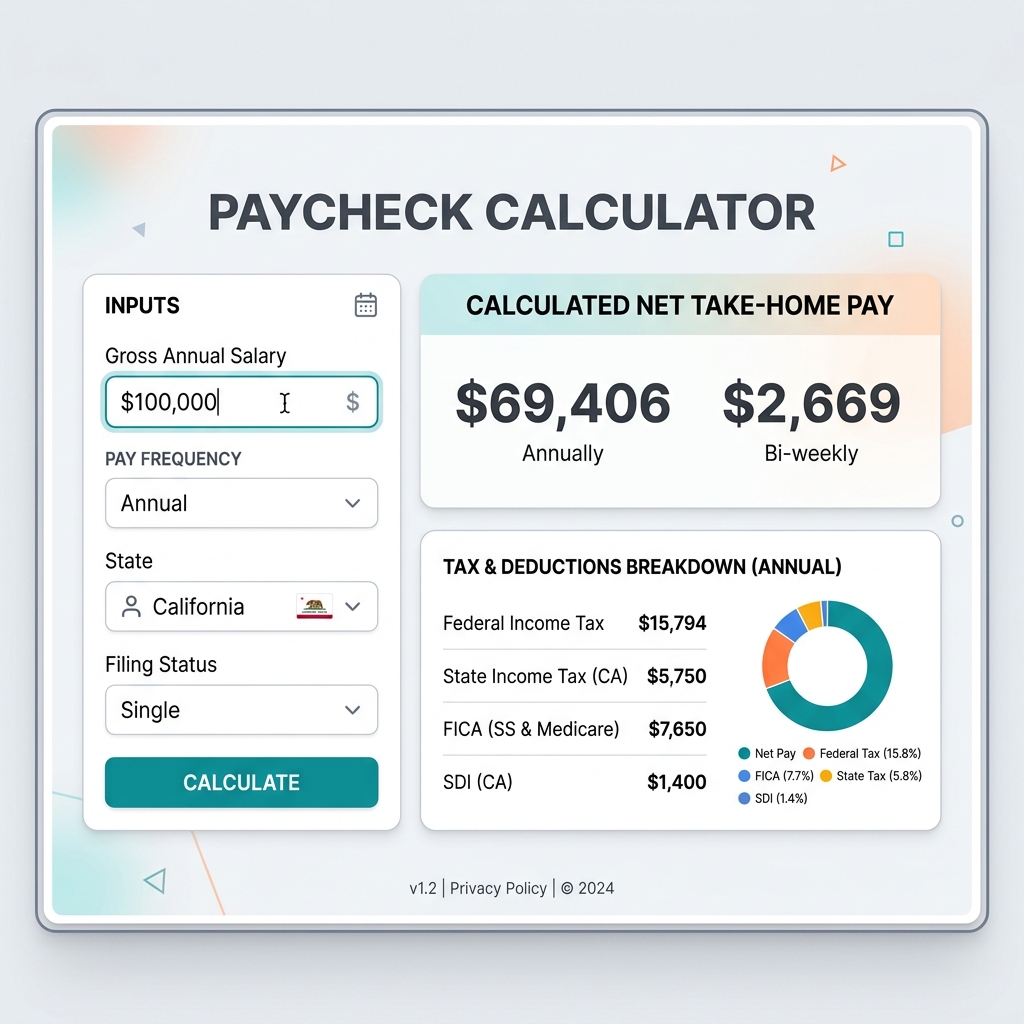
State income tax is the most variable part of your paycheck. On a $100,000 salary, a single filer in California will pay approximately $5,750 in state income tax and another $1,400 in SDI. In Texas, Florida, or Nevada, they will pay $0.

That's over $500 more per month in take-home pay just from living in Texas instead of California. This is why it is so crucial to calculate your exact take-home pay before accepting a job offer in a new state.

Hourly Workers & Overtime

If you are paid by the hour, calculating your annual take-home pay requires multiplying your rate by the actual hours you work (usually 2,080 for a full-time year). If you work overtime, you must calculate that separately at 1.5x. For precise overtime math, use our Time and a Half Calculator or our generic Hourly to Salary Converter.

Related Calculators You Might Find Useful

Explore more tools to calculate smarter and plan better

FAQ

Paycheck & Tax Questions

How much tax is taken out of my paycheck?
For most workers in 2026, total withholdings (federal, state, and FICA) fall between 18% and 35% of gross pay. At $50,000 in a moderate-tax state, expect 20-24% withholding. At $100,000, expect 27-32%.
What is the Social Security wage base for 2026?
The Social Security wage base for 2026 is $184,500. You pay the 6.2% Social Security tax on every dollar up to this amount. Once your wages exceed this in a calendar year, Social Security withholding stops.
What is the 2026 standard deduction?
The 2026 federal standard deduction is $16,100 for single filers, $32,200 for married filing jointly, and $24,150 for head of household.
How does a 401(k) contribution affect my paycheck?
Every dollar you put into a traditional (pre-tax) 401(k) reduces your federal and state taxable income. Contributing $7,500 saves approximately $1,650 in federal income tax (at the 22% bracket) plus state tax savings. Your paycheck decreases, but by less than your contribution amount.
Which states have no income tax in 2026?
Nine states collect no broad-based wage income tax: Alaska, Florida, Nevada, South Dakota, Tennessee, Texas, Wyoming, Washington, and New Hampshire.

100% Free · Accurate Math

Negotiate Better Salaries

Don't get caught off guard by state taxes or FICA withholdings. Calculate exactly what will hit your bank account every two weeks before you sign that offer letter.