2026 Rental Market · 30% Rule · Debt-Adjusted · Free

Rent Affordability Calculator

How Much Rent Can I Afford?

Find your maximum rent budget from salary using three methods: the 30% gross income rule landlords use, the conservative net take-home approach, and a debt-adjusted personal budget. Updated for the 2026 US rental market — average rent $1,800–$2,000/month.

4.8/5 · 9,214 users 3 calculation methods DTI ratio analysis Landlord qualification check 100% free · no login
← Back to Calculators
Housing & Personal Finance Tool

Rent Affordability Calculator 2026

30% Rule · Debt-Adjusted Budget · Conservative Net Income · DTI Analysis · 2026 US Market

Updated for May 2026⚡ Instant Results
2026 US Rental Market · Free · Instant

How Much Rent Can I Afford?

The 30% rule says spend 30% of gross income on rent — but on a $50,000 salary, that's actually 43% of your take-home pay after taxes. This calculator shows all three methods: the 30% gross rule landlords use, the debt-adjusted method financial planners recommend, and a conservative net-income budget.

US Avg Rent (2026):$1,800–$2,000/mo
30% Rule:Landlord standard
3× Income:Qualification rule
36% DTI:Safe debt ceiling

Your Income

Gross = before tax · Net = take-home

$
Monthly gross$6,250/mo
Estimated take-home$4,688/mo

Monthly Debt

Reduces your rent budget

$

Include: car payments, student loans, credit card minimums

Impact: Your $350/mo in debt reduces your safe rent budget by approximately $280/mo compared to zero debt.

The 30% Rule Problem

On a $50,000 salary, the 30% gross income rule says max rent = $1,250/mo. But your actual take-home is ~$3,300/mo after taxes — meaning that $1,250 is actually 38% of your real take-home pay, leaving far less for savings than the rule implies.

This calculator shows all three methods so you can see the real picture, not just what your landlord's application form asks for.

Recommended

30% Rule (Gross)

$1,750/mo

What landlords use. $6,250 × 30%

Conservative (Net)

$1,250/mo

30% of actual take-home pay after tax

Aggressive Stretch

$2,000/mo

40% gross — high risk, only if debt-free

Debt-Adjusted Budget

$1,750/mo

Recommended after accounting for your $350/mo debt load

Monthly gross$6,250
Est. take-home$4,688
Monthly debt$350
Remaining$2,588

What Landlords Require

3× monthly rent rule — the standard qualification benchmark in the US

$1,000/mo$36,000/yr✓ Qualify
$1,500/mo$54,000/yr✓ Qualify
$2,000/mo$72,000/yr✓ Qualify
$2,500/mo$90,000/yr✗ Need more
$3,000/mo$108,000/yr✗ Need more

Debt-to-Income Ratio Analysis

Front-End DTI (rent only)

28% guideline

28.0%

Acceptable

Back-End DTI (rent + all debt)

36% guideline

33.6%

Acceptable

stretchHealthy budget balance

You're slightly above ideal limits. Reducing ~$70 debt improves safety.

Monthly Cashflow Breakdown

Recommended Rent

28.0% of gross

$1,750/mo

Monthly Debt

5.6% of gross

$350/mo

Savings & Living

41.4% of gross

$2,588/mo

Est. Taxes

25.0% of gross

$1,563/mo

Your 50/30/20 Budget — Applied to Your Income

How the 50/30/20 rule allocates your $4,688/mo take-home

50% — Needs (rent, food, transport, utilities)

Rent should be under $1,406/mo to leave room for other needs

$2,344

30% — Wants (dining, entertainment, subscriptions)

If rent exceeds $1,875/mo, this category disappears

$1,406

20% — Savings & debt payoff

$938/mo saved = $11,250/yr

$938

Disclaimer: These are estimates for budgeting and planning purposes only. Actual rent affordability depends on your credit score, landlord requirements, local market conditions, and personal financial circumstances. Tax estimates assume a 25–30% effective rate and may not match your actual take-home. Not financial or legal advice.

The 30% Gross Income Rule

The original standard — set by the US government in 1981 as a public housing benchmark. Landlords still use it because it's on your pay stub. On $5,000/month gross, your max rent is $1,500. Simple, widely accepted, but doesn't account for taxes, debt, or savings goals.

What landlords use on applications

Conservative: 30% of Net Pay

The more realistic method for personal budgeting. After taxes, your take-home is typically 70–80% of gross. Applying 30% to your net income instead of gross keeps rent manageable without sacrificing savings. Better for high-tax states like California, New York, or New Jersey.

Best for personal financial planning

Debt-Adjusted Budget Method

The most accurate method. Start with net take-home, subtract all monthly debt payments, subtract minimum savings target, and the remainder is your true available rent budget. If you have $500/mo in student loans, your rent budget shrinks by approximately that amount.

Most accurate for your real situation

All calculations run locally in your browser • No data stored • For estimation purposes only

2026 US Rental Market — Key Numbers

$1,900
Average US monthly rent (2026 estimate)
$70,000+
Annual income needed at average rent (30% rule)
Monthly rent landlords require as minimum gross income
36%
Back-end DTI ceiling lenders use (rent + all debt)

How Much Rent Can I Afford? — Salary Quick Reference (2026)

30% gross income rule (landlord standard) · Conservative net income method · No pre-existing debt assumed

Annual SalaryMonthly Gross30% Rule Max RentEst. Take-Home/moConservative RentIncome Needed (3× rule)
$25,000$2,083$625/mo$1,700$510–$595/mo$800/mo → needs $28.8K/yr
$30,000$2,500$750/mo$2,050$615–$718/mo$1,000/mo → needs $36K/yr
$40,000$3,333$1,000/mo$2,730$820–$955/mo$1,200/mo → needs $43.2K/yr
$50,000$4,167$1,250/mo$3,400$1,020–$1,190/mo$1,500/mo → needs $54K/yr
$60,000$5,000$1,500/mo$4,050$1,215–$1,418/mo$1,800/mo → needs $64.8K/yr
$75,000$6,250$1,875/mo$4,950$1,485–$1,733/mo$2,000/mo → needs $72K/yr
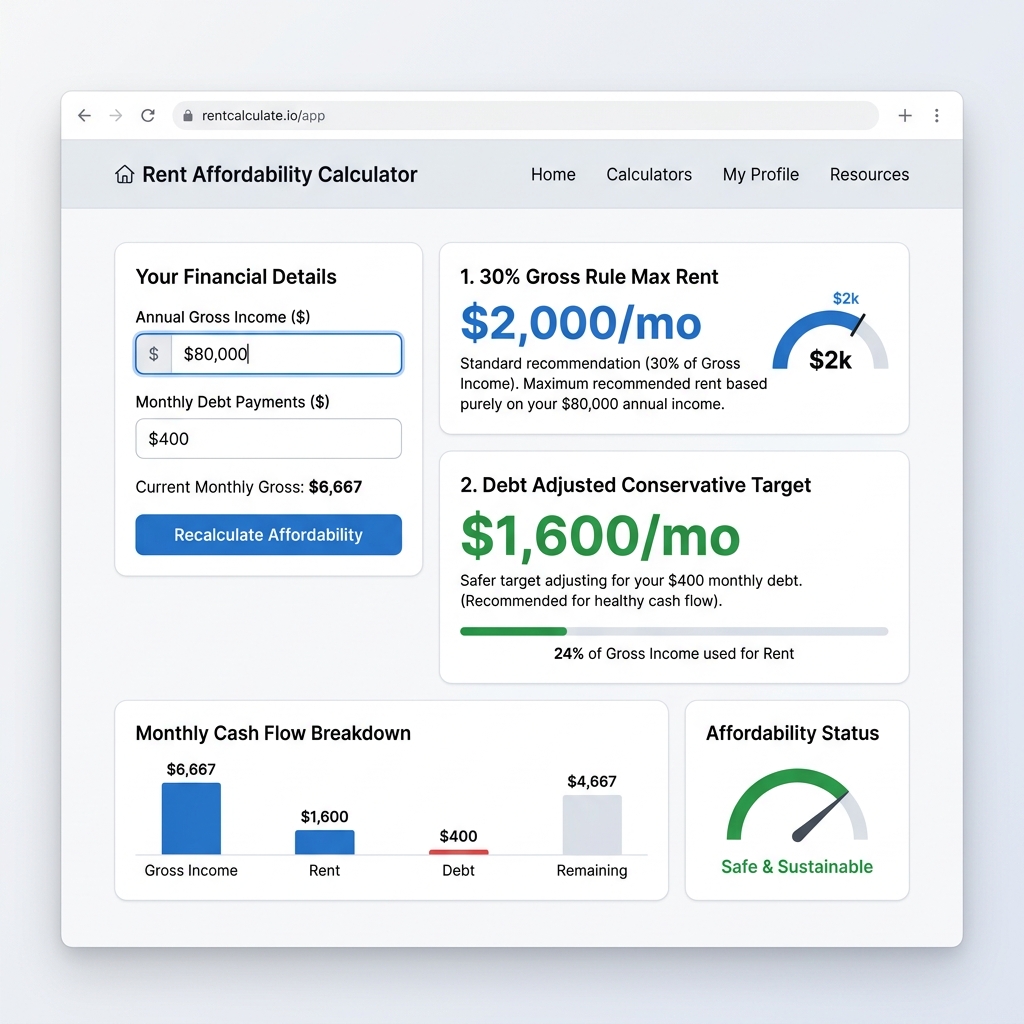
$80,000$6,667$2,000/mo$5,250$1,575–$1,838/mo$2,500/mo → needs $90K/yr
$100,000$8,333$2,500/mo$6,500$1,950–$2,275/mo$3,000/mo → needs $108K/yr
$120,000$10,000$3,000/mo$7,700$2,310–$2,695/mo$3,500/mo → needs $126K/yr
$150,000$12,500$3,750/mo$9,500$2,850–$3,325/mo$4,000/mo → needs $144K/yr

Conservative rent = 30% of estimated net take-home (after federal + average state tax). Income needed uses the 3× monthly rent rule. Use the calculator above for your exact debt and expense situation.

What Rent Can I Afford by Hourly Wage? (2026)

40 hours/week · 52 weeks/year · 30% gross income rule · estimated take-home applied

Hourly WageAnnual IncomeMax Rent (30%)Est. Monthly NetConservative RentMarket Reality
$15/hr (min wage)$31,200$780/mo$2,100$630/moVery limited — Midwest/South only
$18/hr$37,440$936/mo$2,500$750/moAffordable in lower-cost markets
$20/hr$41,600$1,040/mo$2,800$840/moTight in most metros
$22/hr$45,760$1,144/mo$3,050$915/moComfortable in mid-tier cities
$25/hr$52,000$1,300/mo$3,450$1,035/moFeasible in most US cities
$30/hr$62,400$1,560/mo$4,100$1,230/moComfortable in most cities
$35/hr$72,800$1,820/mo$4,750$1,425/moGood flexibility in most markets
$40/hr$83,200$2,080/mo$5,400$1,620/moComfortably affords most 1BR units
$50/hr$104,000$2,600/mo$6,700$2,010/moAffords most 2BR across the US

Average US rent in 2026 is $1,800–$2,000/month. Workers earning under $30/hour face significant affordability challenges in major metros.

What Salary Do You Need to Rent in Major US Cities? (2026)

Based on median 1-bedroom rent · 30% gross income rule · standard 3× landlord qualification

CityMedian 1BR RentIncome Needed (3×)Annual Salary RequiredAffordability on $75K
🌆 New York City, NY$3,400/mo$10,200/mo$122,400/yrUnaffordable
🌉 San Francisco, CA$3,200/mo$9,600/mo$115,200/yrUnaffordable
🌊 Boston, MA$3,400/mo$10,200/mo$122,400/yrUnaffordable
🌴 Miami, FL$2,800/mo$8,400/mo$100,800/yrUnaffordable
☀️ Los Angeles, CA$2,600/mo$7,800/mo$93,600/yrUnaffordable
🌧️ Seattle, WA$2,300/mo$6,900/mo$82,800/yrStretched
🌞 San Diego, CA$2,400/mo$7,200/mo$86,400/yrStretched
🤠 Austin, TX$1,700/mo$5,100/mo$61,200/yrBorderline
🏙️ Chicago, IL$1,800/mo$5,400/mo$64,800/yrBorderline
🏔️ Denver, CO$1,750/mo$5,250/mo$63,000/yrBorderline
🌸 Atlanta, GA$1,600/mo$4,800/mo$57,600/yrAffordable ✓
🌵 Phoenix, AZ$1,400/mo$4,200/mo$50,400/yrAffordable ✓
🌾 Columbus, OH$1,150/mo$3,450/mo$41,400/yrVery Affordable ✓
🎸 Nashville, TN$1,600/mo$4,800/mo$57,600/yrAffordable ✓
🌊 Indianapolis, IN$1,100/mo$3,300/mo$39,600/yrVery Affordable ✓

Affordability assessed against a $75,000 annual salary. "Unaffordable" = exceeds 30% of $75K gross. Median rents from 2026 US rental market data. Source: Rent.com, Zillow, CoStar 2026 estimates.

How to Calculate How Much Rent You Can Afford — 2026 Complete Guide

The 30% rule · Gross income illusion · Debt-to-income ratios · What landlords never tell you · Emergency fund for renters

~13 min readHousing Guide · US Rental Market

The 30% Rent Rule — Where It Came From and What It Really Means

The 30% rule has been the standard benchmark for rent affordability since 1981, when the US government established it as the threshold for "affordable housing" in federal housing assistance programmes. The rule is simple: spend no more than 30% of your gross monthly income on rent. On a $5,000/month gross income, that's $1,500/month.

But here's the problem nobody tells you: the 30% rule uses gross income — the number on your pay stub before taxes are taken out. After federal income tax, FICA (Social Security and Medicare), and state income tax, most workers take home 70–80% of their gross pay. This means that 30% of gross is actually 37–43% of your real take-home money.

The Gross Income Illusion — What the 30% Rule Actually Costs You

$50,000/yr ($4,167/mo gross)

30% rule says: $1,250/mo

Take-home: $3,300–$3,500/mo take-home

Real cost: 36–38% of actual take-home

$75,000/yr ($6,250/mo gross)

30% rule says: $1,875/mo

Take-home: $4,800–$5,200/mo take-home

Real cost: 36–39% of actual take-home

$100,000/yr ($8,333/mo gross)

30% rule says: $2,500/mo

Take-home: $6,000–$7,000/mo take-home

Real cost: 36–42% of actual take-home

$30,000/yr ($2,500/mo gross)

30% rule says: $750/mo

Take-home: $2,050–$2,150/mo take-home

Real cost: 35–37% of actual take-home

This is why the conservative approach — 30% of net take-home, not 30% of gross — leaves you with more financial breathing room. Use our calculator to see both figures.

Three Ways to Calculate Your Rent Budget — Which to Use and When

There is no single "right" answer to how much rent you can afford. Different situations call for different methods:

01

The 30% Gross Income Rule

Use this when: applying for an apartment

This is the standard landlords use. Most rental applications require gross monthly income of at least 3× the monthly rent — equivalent to 33% rent-to-income. The 30% rule is the tenant's version of this threshold. You'll need to meet it to qualify, regardless of your actual budget.

Limitation: doesn't account for taxes, debt, savings goals, or city-specific cost of living.

02

Conservative Net Income Method (30% of take-home)

Use this when: personal budgeting and planning

Calculate your actual monthly take-home pay after all taxes, then apply 30% to that figure. This gives a rent budget that genuinely leaves room for savings, debt repayment, and living expenses without stress. Often $200–$400/month lower than the gross-income rule.

Limitation: landlords may not accept this — they use gross income. Use for your own planning, not your application.

03

Debt-Adjusted Budget Method

Use this when: you have student loans, car payments, or credit card debt

Start with net take-home. Subtract all monthly debt payments. Subtract a minimum savings target (financial planners recommend 20% of net). The remainder, minus a buffer for utilities and necessities, is your true available rent. This is the most accurate method for your real-world situation.

Limitation: requires knowing all your monthly debt obligations accurately — a moving target for many people.

What Landlords Never Tell You About Rent Qualification

The 3× income rule (your gross monthly income must be at least 3 times the rent) is not a law — it's an industry convention. But landlords use it because it reduces their risk: statistically, renters paying more than 33% of gross income have significantly higher rates of late payment and eviction.

What most applicants don't know:

  • In competitive markets, some landlords use 40× annual income: meaning your annual gross income must equal 40× the monthly rent. For $2,000/month rent: 40 × $2,000 = $80,000/year minimum income required. This is stricter than the 3× rule ($72,000/year) and common in New York City, Boston, and San Francisco.
  • Roommates' incomes can be combined: If you're splitting a $3,000/month apartment with a roommate, each person only needs to qualify at $1,500/month rent ($54,000/year individual income under 3× rule), not $3,000/month ($108,000/year).
  • Guarantors can cover income gaps: If your income doesn't meet the threshold, a co-signer (guarantor) with sufficient income — often 5× or 6× the monthly rent — can vouch for your lease. Common for students and recent graduates.
  • Self-employed income is evaluated differently: Freelancers and contractors typically need 2 years of tax returns showing consistent net income. Landlords use net (after-expense) income from Schedule C, not gross revenue.

Debt-to-Income Ratios — The Number That Really Decides Your Budget

Your debt-to-income ratio (DTI) is the most accurate measure of rent affordability. Mortgage lenders use it as their primary qualification metric, and savvy renters should use it too.

There are two DTI figures relevant to renting:

Front-End DTI (Housing Ratio)

Formula: Monthly rent ÷ gross monthly income

✓ Below 28% — Excellent

⚠ 28–33% — Acceptable (landlord threshold)

✗ Above 33% — May not qualify

Example: $1,500 rent ÷ $5,000 gross = 30% front-end DTI ✓

Back-End DTI (All Debt)

Formula: (Rent + all debt) ÷ gross monthly income

✓ Below 36% — Financially healthy

⚠ 36–43% — Stretched but manageable

✗ Above 43% — High stress, reconsider rent

Example: ($1,500 rent + $400 debt) ÷ $5,000 = 38% back-end DTI ⚠

The Rent Emergency Fund — The Rule Nobody Mentions

Financial planning for renters typically focuses on monthly budget. What most guides skip: you need a specific emergency fund sized to your rent, not just a generic "3–6 months of expenses."

A renter's emergency fund should cover:

  • Security deposit + first month: Typically 1–2 months rent upfront before you even move in. At $1,500/month, that's $3,000–$4,500 in cash before moving.
  • Last month buffer: If you lose your job, you need rent covered while job searching. Budget 2 months rent as a dedicated rent buffer, separate from your general emergency fund.
  • Moving costs: Professional movers average $1,000–$2,500 for a local move in 2026, and $4,000–$10,000 for interstate moves.
  • Lease break costs: If you need to exit a lease early, penalties range from 1–2 months rent to the remainder of the lease term. Know this before signing.

Rule of thumb: Before signing any lease, ensure you have at least 4–5 months of rent in liquid savings. This covers the move-in costs, a buffer for job disruption, and minor emergencies without touching your long-term savings.

⏱ 28 min read

Last updated: June 2026

# Rent Affordability Calculator 2026 – How Much Rent Can I Actually Afford?

So you're apartment hunting. Maybe you just got a new job, maybe you're moving to a new city, or maybe you've simply had enough of your current place. Whatever the reason, one question keeps coming up: how much rent can I actually afford without setting myself on fire financially?

This free Rent Affordability Calculator takes your real income, your actual debts, your monthly expenses, and gives you a number you can trust — not a number that looks good on paper but leaves you eating ramen by week three.

Updated with 2026 US and global rental market data, this tool works whether you're renting in New York, London, Toronto, Sydney, Dubai, or anywhere in between.

Last Updated: April 2026

---

What Is a Rent Affordability Calculator — And Why Should You Use One?

A rent affordability calculator is exactly what it sounds like: a tool that tells you the maximum monthly rent you can comfortably pay based on what you actually earn and spend. But the good ones — like this one — go deeper than just multiplying your salary by 30%.

Here's what most people get wrong when apartment hunting: they look at what they can technically pay rather than what they should pay. There's a big difference. You might be able to swing $2,000 a month, but after student loans, car payments, groceries, and a shred of social life, you're drowning.

This calculator uses two methods:

  • The 30% Rule — the most widely used housing guideline in the US, UK, Canada, and Australia
  • The Debt-Adjusted Method — a more realistic calculation that accounts for your actual financial situation
Run both. Compare them. Pick the one that doesn't give you a panic attack.

---

The 30% Rule Explained — Does It Still Hold Up in 2026?

The 30% rule says you should spend no more than 30% of your gross monthly income on rent. It's been the standard housing guideline since the US government formalised it in the early 1980s, and it's still widely used by landlords, lenders, and financial advisors worldwide.

Simple example: if you earn $5,000 a month before taxes, your rent should stay at or below $1,500.

Why does this rule still matter in 2026?

Because it's a tested baseline, not a random number. When you keep rent under 30% of gross income, you have enough breathing room for:

  • Food, utilities, and transport
  • Healthcare and unexpected medical costs
  • Savings and an emergency fund
  • Debt repayments without going backwards
  • Actually enjoying your life occasionally
That said — the 30% rule has real limitations in expensive cities. If you're renting in San Francisco, London, Sydney, or New York, the median rent will blow past that threshold for most people on average salaries. That's not a personal failure; it's a market reality. This is exactly why the debt-adjusted method exists.

Our recommendation: use the 30% rule as your floor (never go above it if you can help it), and use the debt-adjusted method as your ceiling for personal budgeting.

---

Why This Matters More Than Ever — The 2026 Rental Market Reality

Let's talk numbers, because the global rental market in 2026 is genuinely tough.

In the United States, the median monthly rent hit $1,750 in 2026 — up from under $1,000 just a decade ago. That means you technically need a gross annual income of $70,000 just to afford the median US apartment under the 30% rule. The median American household income? Around $62,000. The math doesn't work for a lot of people, and that gap is why "rent-burdened" households (spending over 30% on housing) now make up roughly half of all renters in major US metro areas.

Globally, the picture is mixed:

  • London, UK: Average 1-bed rent £1,800–£2,500/month in Zone 1–2. You'd need £72,000–£100,000 annual income to stay under 30%.
  • Sydney, Australia: Median rent AU$600–$700/week. You'd need AU$125,000/year at the 30% rule.
  • Toronto, Canada: Average 1-bed CAD $2,300–$2,700/month. CAD $92,000+ income required.
  • Dubai, UAE: AED 6,000–10,000/month for a 1-bed in popular areas. AED 240,000–400,000 annual income needed.
  • Berlin, Germany: €1,200–€2,000/month in central areas. Far more affordable relative to incomes than comparable English-speaking cities.
The point isn't to depress you — it's to show why plugging in your actual numbers matters more than following a one-size-fits-all rule.

---

How to Use the Rent Affordability Calculator — Step by Step

It takes about two minutes. Here's exactly what to do:

Step 1: Enter your monthly income Use your gross monthly income (before taxes) for the 30% rule calculation — this is what landlords care about. Also enter your net take-home pay for the debt-adjusted calculation, which is what actually matters for your personal budget.

Step 2: Add your monthly debt payments This is where most calculators fall short. List everything: student loan payments, car loans, credit card minimums, personal loan instalments, any buy-now-pay-later commitments. Every dollar of debt reduces the rent you can sustainably afford.

Step 3: Enter your monthly living expenses Be honest here. Think about groceries, transport, utilities, phone, streaming services, gym membership, haircuts, the occasional dinner out. Underestimating this is the single biggest mistake renters make.

Step 4: Set your savings goal How much do you want to save each month? Emergency fund? Retirement contributions? Down payment someday? Enter a real number, not zero.

Step 5: Read your results The calculator gives you three outputs:

  • Maximum rent under the 30% rule
  • Your personalised debt-adjusted maximum
  • The income you'd need to comfortably afford a specific rent target
Run it multiple times with different rent amounts to find your ideal range.

---

How Much Rent Can I Afford? Quick Reference Table by Salary (2026)

This table uses the 30% gross income rule — the same method most landlords use to qualify tenants.

Annual SalaryMonthly GrossMax Rent (30%)Est. Take-Home/moConservative RentLandlord Income Requirement
$25,000$2,083$625/mo~$1,700$510–$595/moNeed $27K/yr for $750/mo
$30,000$2,500$750/mo~$2,050$615–$718/moNeed $36K/yr for $1,000/mo
$40,000$3,333$1,000/mo~$2,730$820–$955/moNeed $43K/yr for $1,200/mo
$50,000$4,167$1,250/mo~$3,400$1,020–$1,190/moNeed $54K/yr for $1,500/mo
$60,000$5,000$1,500/mo~$4,050$1,215–$1,418/moNeed $65K/yr for $1,800/mo
$75,000$6,250$1,875/mo~$4,950$1,485–$1,733/moNeed $72K/yr for $2,000/mo
$80,000$6,667$2,000/mo~$5,250$1,575–$1,838/moNeed $90K/yr for $2,500/mo
$100,000$8,333$2,500/mo~$6,500$1,950–$2,275/moNeed $108K/yr for $3,000/mo
$120,000$10,000$3,000/mo~$7,700$2,310–$2,695/moNeed $126K/yr for $3,500/mo
$150,000$12,500$3,750/mo~$9,500$2,850–$3,325/moNeed $144K/yr for $4,000/mo
Conservative rent = 30% of estimated net take-home after federal and average state tax. Numbers vary by state and filing status.

---

Specific Salary Scenarios — What Rent Can You Afford?

How Much Rent Can I Afford on a $30,000 Salary?

On $30,000 a year, your gross monthly income is $2,500. The 30% rule gives you a rent ceiling of $750 per month.

After federal taxes and typical state taxes, your take-home is around $2,050–$2,150 per month depending on your state. In practice, if you have any debt at all — student loans, a car payment — your realistic rent budget is probably closer to $600–$700/month.

That's genuinely hard in most major US cities. Columbus, OH, Indianapolis, IN, Memphis, TN, El Paso, TX, and Tulsa, OK are among the few cities where this is workable. In most coastal cities, $30,000 simply doesn't cover solo living without roommates.

Roommate tip: If you split a $1,400/month two-bedroom, your share is $700 — right at the 30% line. This is the most practical move at this income level.

---

How Much Rent Can I Afford on a $40,000 Salary?

At $40,000 annually ($3,333/month gross), the 30% rule puts your max rent at $1,000/month.

After taxes, your take-home is roughly $2,730/month. If you're carrying $400/month in debt (student loans, car payment — very common), your truly affordable rent is probably $800–$900/month to leave breathing room for savings.

At $40,000, you have more options but still need to be strategic about city choice. Smaller metros in the Midwest, South, and Southwest offer genuine livability at this income. Coastal metros are tight without significant lifestyle compromises.

---

How Much Rent Can I Afford on a $50,000 Salary?

$50,000 is the threshold a lot of people hit in their mid-to-late 20s, and it starts to feel workable. Gross monthly is $4,167, giving a 30% rule ceiling of $1,250/month.

Take-home is approximately $3,400–$3,600/month depending on your state. With moderate debt and normal living expenses, a rent of $1,000–$1,150/month leaves a sustainable margin for savings and emergencies. Stretching to $1,250 is doable if you're debt-free, but it's tight.

This income works well in Phoenix, Charlotte, Nashville (though that market has tightened), Kansas City, Pittsburgh, and most secondary US cities. New York, San Francisco, and LA remain extremely difficult on this salary alone.

---

How Much Rent Can I Afford on a $60,000 Salary?

At $60,000 ($5,000/month gross), you're at the 30% ceiling of $1,500/month. Take-home is roughly $4,050–$4,250/month.

With typical debts of $400–$600/month and living expenses of $1,200–$1,500/month, your actual rent sweet spot is probably $1,100–$1,300/month if you want to save meaningfully. At $1,500, you're living life with zero financial cushion.

$60,000 is where a broader range of US cities becomes genuinely accessible — including some neighbourhoods in mid-tier coastal cities.

---

How Much Rent Can I Afford on a $75,000 Salary?

$75,000 is where things start to get comfortable in most non-coastal US cities. Monthly gross is $6,250, putting the 30% rule limit at $1,875/month. Take-home is around $4,950–$5,200/month.

With low to moderate debt, a rent of $1,500–$1,700/month leaves real room to save, build an emergency fund, and not panic every time the car needs maintenance. This income opens up most of the continental US comfortably, and gets you into entry-level apartments in expensive cities (though you'll need to share or sacrifice space).

---

How Much Rent Can I Afford on a $100,000 Salary?

The six-figure mark. Monthly gross is $8,333, giving a 30% rule limit of $2,500/month. Take-home is $6,000–$7,000 depending heavily on your state (California and New York take a serious chunk).

At $100,000, most financial planners actually recommend staying at or below $1,800–$2,200/month in rent — especially if you're in a high-tax state — because after state income tax, federal tax, and any 401(k) contributions, your effective take-home is lower than people expect.

If you're in a no-income-tax state like Texas, Florida, or Nevada, $2,000–$2,500/month is genuinely sustainable. In California or New York, budget conservatively.

---

How Much Rent Can I Afford on a $120,000 Salary?

At $120,000 ($10,000/month gross), the 30% limit is $3,000/month. Take-home is roughly $7,000–$7,700/month after taxes.

This income gives you real options. You can afford a solo 1-bedroom in most expensive US cities — though New York and San Francisco will eat a significant chunk. At this level, the bigger risk is lifestyle inflation: people earning $120K who live in $2,800/month apartments often save less than people earning $75K who rent sensibly.

The recommendation at this income: keep rent at $2,000–$2,500/month and invest the difference.

---

Rent Affordability by Major US City — What Income Do You Actually Need?

This is the table nobody shows you in apartment listings.

CityMedian 1BR RentIncome Needed (3× Rule)Annual Salary RequiredVerdict on $50K
New York City, NY$3,400/mo$10,200/mo$122,400/yrVery difficult
San Francisco, CA$3,200/mo$9,600/mo$115,200/yrVery difficult
Miami, FL$2,800/mo$8,400/mo$100,800/yrVery difficult
Los Angeles, CA$2,600/mo$7,800/mo$93,600/yrVery difficult
Boston, MA$3,400/mo$10,200/mo$122,400/yrVery difficult
Seattle, WA$2,400/mo$7,200/mo$86,400/yrDifficult
Denver, CO$2,000/mo$6,000/mo$72,000/yrTight
Chicago, IL$1,800/mo$5,400/mo$64,800/yrBorderline
Austin, TX$1,700/mo$5,100/mo$61,200/yrBorderline
Nashville, TN$1,600/mo$4,800/mo$57,600/yrBorderline
Phoenix, AZ$1,400/mo$4,200/mo$50,400/yrJust workable
Charlotte, NC$1,350/mo$4,050/mo$48,600/yrWorkable
Columbus, OH$1,150/mo$3,450/mo$41,400/yrComfortable
Indianapolis, IN$1,050/mo$3,150/mo$37,800/yrComfortable
Memphis, TN$900/mo$2,700/mo$32,400/yrVery affordable
Median rents based on 2026 US rental data. "Income needed" uses standard 3× monthly rent landlord requirement.

---

Rent Affordability for International Renters — Global Guide

If you're outside the US, here's how rent affordability looks in other major rental markets. The 30% rule applies globally — it's just the numbers that change.

UK — How Much Rent Can I Afford in London and Beyond?

London is one of the most expensive rental markets in the world. Average 1-bedroom rent in Zones 1–2 runs £1,800–£2,500/month in 2026. To stay under 30% of gross income, you'd need to earn £72,000–£100,000 per year.

Outside London, things become significantly more manageable:

  • Manchester: Average 1-bed ~£1,100/month. Need ~£44,000/year.
  • Birmingham: Average 1-bed ~£950/month. Need ~£38,000/year.
  • Leeds: Average 1-bed ~£900/month. Need ~£36,000/year.
  • Glasgow: Average 1-bed ~£850/month. Need ~£34,000/year.
  • Liverpool: Average 1-bed ~£800/month. Need ~£32,000/year.
UK renters generally use a gross income multiple of 30× annual rent for landlord qualification — meaning for £12,000 annual rent, you'd need to earn £36,000. It's the British equivalent of the US 3× monthly income rule.

---

Canada — Rent Affordability in Toronto, Vancouver, and Beyond

Canada's rental market has tightened dramatically. Toronto and Vancouver are now among the most expensive cities in the English-speaking world on a salary-adjusted basis.

  • Toronto: Average 1-bed CAD $2,300–$2,700/month. Need CAD $92,000–$108,000/year.
  • Vancouver: Average 1-bed CAD $2,500–$3,000/month. Need CAD $100,000–$120,000/year.
  • Montreal: Average 1-bed CAD $1,400–$1,800/month. Need CAD $56,000–$72,000/year. Far more affordable.
  • Calgary: Average 1-bed CAD $1,700–$2,000/month. Need CAD $68,000–$80,000/year.
  • Ottawa: Average 1-bed CAD $1,800–$2,200/month. Need CAD $72,000–$88,000/year.
Canada uses the same 30% gross income guideline, though many Canadian financial planners suggest a tighter 25–28% target to account for higher provincial income taxes.

---

Australia — Rent Affordability in Sydney, Melbourne, and More

Australia measures rent weekly, which trips up a lot of people doing the math.

  • Sydney: Average 1-bed AU$550–$700/week (AU$2,400–$3,000/month). Need AU$115,000–$145,000/year.
  • Melbourne: Average 1-bed AU$450–$600/week (AU$1,950–$2,600/month). Need AU$93,000–$125,000/year.
  • Brisbane: Average 1-bed AU$450–$550/week. Need AU$93,000–$114,000/year.
  • Perth: Average 1-bed AU$500–$600/week. Need AU$104,000–$125,000/year.
  • Adelaide: Average 1-bed AU$380–$480/week. Need AU$79,000–$99,000/year. Most affordable major city.
Australia's rental market has been under severe strain since 2022–2023 and remains tight in 2026. The 30% guideline is used by many lenders and real estate agents when assessing rental applications.

---

UAE/Dubai — Rent Affordability for Expats

Dubai's rental market works differently — most leases are still paid upfront (1–4 cheques per year), which creates a significant cash flow requirement beyond the monthly equivalent.

  • Dubai Marina/JBR: AED 90,000–130,000/year for 1-bed. Monthly equivalent: AED 7,500–10,800. Need AED 300,000–432,000 annual income.
  • Downtown Dubai: AED 100,000–150,000/year for 1-bed. Monthly equivalent: AED 8,300–12,500.
  • JVC/Sports City: AED 50,000–75,000/year for 1-bed. Monthly equivalent: AED 4,200–6,250. Most popular among budget-conscious expats.
  • Deira/Bur Dubai: AED 40,000–60,000/year for 1-bed. Monthly equivalent: AED 3,300–5,000.
Many Dubai expats target a 25% housing ratio (rather than 30%) to account for the upfront payment structure and lack of a savings safety net in a new country.

---

Germany — Rent Affordability in Berlin, Munich, and Frankfurt

Germany has traditionally had one of the more tenant-friendly rental markets in Europe, though prices have climbed significantly.

  • Munich: €1,500–€2,500/month for 1-bed. Need €60,000–€100,000/year gross.
  • Frankfurt: €1,200–€1,900/month for 1-bed. Need €48,000–€76,000/year gross.
  • Berlin: €1,100–€1,800/month for 1-bed. Need €44,000–€72,000/year gross.
  • Hamburg: €1,200–€1,800/month for 1-bed. Need €48,000–€72,000/year gross.
  • Stuttgart: €1,100–€1,600/month for 1-bed. Need €44,000–€64,000/year gross.
Germany uses a "Kaltmiete" (cold rent) system — utilities are almost always separate and can add €150–€300/month. Budget for this when calculating affordability.

---

The 50/30/20 Rule and Where Rent Fits In

You've probably heard of the 50/30/20 budget framework. Here's how rent slots into it:

50% of take-home pay → Needs (Essentials) This bucket covers rent, utilities, groceries, transportation, insurance, minimum debt payments. Everything you have to spend money on.

30% of take-home pay → Wants (Non-Essentials) Dining out, entertainment, subscriptions, hobbies, travel, clothing beyond basics.

20% of take-home pay → Savings and Extra Debt Repayment Emergency fund, retirement contributions, extra loan payments, investments.

Here's the critical implication: if rent alone is 30% of your take-home pay, you've used the entire needs budget just on housing before buying a single grocery item. Something has to give — usually savings.

A healthier target is to keep rent at 20–25% of take-home pay, leaving the rest of the "needs" budget for everything else. This is tighter than the 30% gross rule suggests, but it's more reflective of real-world financial health.

Worked example — take-home pay of $4,000/month:

  • 50% needs = $2,000 total
  • Rent target: $900–$1,000 (25% of take-home)
  • Remaining for utilities, food, transport: $1,000–$1,100
  • 30% wants: $1,200
  • 20% savings: $800
That's a livable, sustainable budget. Stretch rent to $1,400 and suddenly you're cutting into savings every month.

---

What Landlords Actually Look For — The 3× Income Rule

Most landlords and property management companies have their own income requirement, separate from your personal budget math. The standard in the US, UK, Canada, and Australia is that your gross monthly income should be at least 3 times the monthly rent. Some landlords in competitive markets require 3.5× or even 4×.

Monthly RentIncome Needed (3× Rule)Annual Salary
$800/mo$2,400/mo$28,800/yr
$1,000/mo$3,000/mo$36,000/yr
$1,200/mo$3,600/mo$43,200/yr
$1,500/mo$4,500/mo$54,000/yr
$1,800/mo$5,400/mo$64,800/yr
$2,000/mo$6,000/mo$72,000/yr
$2,500/mo$7,500/mo$90,000/yr
$3,000/mo$9,000/mo$108,000/yr
Beyond income, landlords typically check: credit score (650+ minimum, 700+ preferred), rental history, employment verification, and sometimes total debt-to-income ratio. Even if your budget math works, failing one of these can cost you the apartment.

---

Hidden Costs That Kill Your Rent Budget

The sticker price on an apartment listing is rarely the full story. Here are the real extras that inflate your monthly housing cost:

Utilities — Electricity, gas, and water add $100–$250/month for a typical 1-bedroom, depending on climate, building efficiency, and usage. Older buildings in extreme climates (very hot summers, very cold winters) can run $300+.

Internet — $50–$100/month. Not optional for most people in 2026.

Renter's Insurance — Often required by landlords. Budget $15–$30/month. Worth it.

Parking — In urban areas, parking can cost $100–$400/month if it's not included. This is one of the most overlooked expenses when moving to a new city.

Laundry — If there's no in-unit washer/dryer, shared laundry or laundromat use can cost $30–$80/month.

Pet fees — If you have a dog or cat, expect a monthly "pet rent" of $50–$100 plus a non-refundable pet deposit of $200–$500.

Storage — Many modern apartments, especially in cities, are small. Off-site storage units run $50–$200/month.

Moving costs — One-time but significant. Budget $500–$2,000+ depending on distance and volume.

Security deposit — Usually 1–2 months' rent, tied up until you move out. Factor this into your savings calculation when planning a move.

Add all of this up and your true monthly housing cost could easily be $300–$600 more than your listed rent. Always calculate with the total number.

---

10 Real-World Tips for Renting Smarter in 2026

These aren't generic advice. These are the things renters who got it right actually did.

1. Calculate the commute cost, not just the rent. An apartment $200 cheaper that's 45 minutes farther from work costs you roughly $150+ in extra transport and 60+ hours per year in time. Sometimes the pricier apartment closer to work is the better deal.

2. Ask specifically what utilities are included. "Utilities included" sometimes means only water. Always confirm electricity, gas, internet, and what the actual utility bills have been for previous tenants. Ask for a copy of the last 3 months.

3. Check when the lease was last renewed. An apartment that hasn't had a renewal in 3 years is probably about to get a significant rent increase. Ask the landlord about their renewal policy.

4. Negotiate more than you think you can. In slower rental markets (and there are plenty in 2026), landlords often prefer a reliable tenant to a vacant unit. Don't be afraid to ask for one month free, covered parking, reduced deposit, or a longer fixed-term rate.

5. Sign in slower months. November through February is typically slower for rentals in the Northern Hemisphere. You'll have more negotiating power.

6. Read the lease end-to-end. This sounds obvious but most people don't do it. Pay particular attention to: rent increase terms, subletting policy, early termination fees, guest policies, and what counts as damage vs. normal wear and tear.

7. Research the building before viewing it. Check Google reviews for the management company, search the address on local Reddit or neighbourhood Facebook groups, and look up the building's inspection history if your city makes these public. Maintenance responsiveness is enormous.

8. Consider your income trajectory. If you're likely to get a raise or change jobs within the lease term, factor that in. Signing a 12-month lease you can barely afford at the start, when you expect income growth, is a different risk than signing something unaffordable with no income change in sight.

9. Build your emergency fund before signing. Financial advisors recommend 3–6 months of living expenses as an emergency fund. Having this in place before signing a lease means you won't be destroyed by a sudden car repair, medical bill, or period of unemployment.

10. Don't let FOMO drive the decision. The perfect apartment you can't quite afford is not the perfect apartment. The right apartment is the one you can pay comfortably for 12+ months. Stretching for the nicer place almost always creates sustained financial stress.

---

Gross Income vs Net Income — Which One Should You Use?

This trips up a lot of people. Here's the practical answer:

Use gross income (pre-tax) when:

  • Filling out a rental application — landlords use gross income for the 3× rule
  • Applying for a mortgage or loan — lenders use gross income for DTI calculations
  • Following the 30% guideline quoted by financial advisors
Use net income (take-home pay) when:
  • Creating your personal monthly budget
  • Figuring out whether you can actually afford something day-to-day
  • Calculating how much you have left for savings after expenses
Our calculator lets you enter both and compares the results. The 30% of gross rule is what gets you approved. The debt-adjusted calculation from net income is what keeps you solvent.

The gap between these two numbers varies enormously by tax situation. Someone in California earning $100,000 gross takes home roughly $6,200–$6,800/month after federal and state taxes. Someone in Texas earning the same $100,000 takes home approximately $7,200–$7,500/month. Same salary, very different real affordability.

---

Debt-to-Income (DTI) Ratio — The Number Lenders Won't Tell You

Landlords use the 3× income rule. Mortgage lenders use DTI ratio. But your overall debt-to-income ratio affects your rent affordability whether or not the landlord asks about it, because it affects how much of your actual income is available for rent.

How to calculate your DTI: Total monthly debt payments ÷ Gross monthly income = DTI ratio

What the numbers mean:

  • Under 20%: Excellent. Minimal impact on rent budget.
  • 20–35%: Manageable. Still leaves reasonable room for rent.
  • 36–43%: Getting tight. Lenders start to flag applications here.
  • Over 43%: High risk. Rent budget is severely constrained.
Example:
  • $5,000 gross monthly income
  • $800/month in debt (student loans + car payment)
  • DTI from debt alone: 16%
  • Remaining "budget" under 43% DTI: $1,350 for rent ($5,000 × 43% = $2,150 total debt capacity, minus $800 existing = $1,350)
This is different from — and often lower than — what the simple 30% rule would suggest ($1,500). When you have significant existing debt, your real rent affordability is meaningfully lower than the 30% rule implies.

---

Frequently Asked Questions

Is the 30% rent rule still valid in 2026?

Yes — as a starting point. It remains the most widely recognised housing guideline globally, and most landlords still use a version of it (3× monthly income) for application approval.

That said, in high-cost cities like New York, San Francisco, London, Sydney, and Toronto, the median rent makes the 30% rule unachievable for anyone on an average salary. In those markets, many people spend 35–50% of income on housing. That's not ideal but it's reality. If you're in an expensive market, the debt-adjusted method in this calculator gives you a more honest read on your situation.

Where the 30% rule works perfectly: mid-sized US cities, secondary markets in Europe, and most cities outside the top-tier coastal metros.

---

Should I calculate rent based on gross or net income?

For landlord applications: gross income. Landlords use gross. For your personal budget: net (take-home) pay. That's what's actually in your account.

The important thing to understand is that these two numbers can be very different, and the difference grows with income because of progressive taxation. A $100,000 gross salary in a high-tax state might yield only $5,800–$6,200/month in take-home. The 30% rule says $2,500/month max rent. But $2,500 out of $6,000 take-home is 42% — which is a very different picture.

---

Does the 30% rule include utilities?

Technically, the original HUD standard was 30% of income for total housing costs including rent and utilities. In practice, most landlords and financial tools now apply 30% to rent alone, treating utilities as a separate line item.

Our recommendation: use the 30% rule for rent, then add your estimated utilities on top. If rent + utilities exceeds 35% of gross income, your housing is getting into rent-burdened territory.

---

How much rent can I afford with $500 a month in student loans?

This is one of the most common situations, and it matters a lot.

Example: $5,000/month gross income, $500/month student loan payment.

  • 30% rule says: $1,500/month max rent
  • But your DTI from debt alone is already 10%. Add rent of $1,500 and total DTI hits 40%.
  • A more conservative target: $1,000–$1,100/month in rent to keep total housing + debt under 35% of gross
The more debt you carry, the more aggressively you should discount the 30% rule when planning your personal budget.

---

What rent can I afford making $20 an hour?

At $20/hour, assuming 40 hours per week and 52 weeks, gross annual income is $41,600. Monthly gross is approximately $3,467.

  • 30% rule max rent: $1,040/month
  • Take-home: ~$2,800–$2,950/month depending on state
  • Conservative debt-adjusted rent (with modest debt): $750–$900/month
$20/hour is manageable in many Midwest, Southern, and Appalachian cities, but challenging in coastal markets.

---

What rent can I afford making $25 an hour?

At $25/hour, gross annual income is $52,000. Monthly gross is approximately $4,333.

  • 30% rule max rent: $1,300/month
  • Take-home: ~$3,500–$3,750/month
  • Comfortable rent with moderate debt: $950–$1,100/month
$25/hour puts you in a workable position in most of the US outside the most expensive coastal cities.

---

Can two people use this calculator together?

Absolutely. For couples or roommates, add both take-home incomes together and both debt totals together. Run the calculation on combined numbers to get your joint rent ceiling. Most landlords will evaluate a couple's combined income against the 3× rule — so a couple earning $3,000/month each has a combined income of $6,000, qualifying for apartments up to $2,000/month.

---

How often should I recalculate rent affordability?

Recalculate whenever any of these change: you get a raise or change jobs, you pay off a debt, you take on new debt, you're considering a lease renewal, or you're moving to a new city. Rent affordability isn't a one-time calculation — your financial situation evolves and your housing decisions should reflect that.

---

What is the income needed to afford $1,500 a month rent?

Using the 3× rule that most landlords require: $1,500 × 3 = $4,500/month gross, or $54,000/year. Under the 30% rule for personal budgeting: $1,500 ÷ 0.30 = $5,000/month gross, or $60,000/year. The difference is because the 30% rule is more conservative — it says your income should be high enough that rent is only 30%, while the 3× rule just confirms you can cover the monthly amount.

---

What is the income needed to afford $2,000 a month rent?

Landlord 3× rule: $6,000/month gross, or $72,000/year. Personal budget 30% rule: $6,667/month gross, or $80,000/year. In practice, you want to be at or above $72,000 to qualify and feel comfortable.

---

Rent Affordability vs. Mortgage Affordability — Which Is Cheaper?

This is a fair question, especially if you're renting and wondering whether buying makes more sense.

In most US markets in 2026, monthly mortgage payments on a starter home exceed equivalent rental costs when you include property taxes, homeowner's insurance, and maintenance. This is a reversal from the pre-2020 environment when buying was clearly cheaper per month in many markets.

Key differences to understand:

Renting advantages: Flexibility, no maintenance costs, no property tax, no exposure to home price drops, smaller upfront cash requirement.

Buying advantages: Building equity, stable payment (fixed rate), no rent increases, ability to modify the space, potential long-term appreciation.

The rent vs. buy decision is location-specific, income-specific, and life-stage-specific. Neither is universally right. What this calculator does is help you nail the affordability question on the renting side — which is the immediate decision most people face.

---

Once you know your rent budget, these calculators help you fill in the rest of the financial picture:

  • Paycheck Calculator — Find your real take-home pay after all deductions, so your rent calculations are based on actual money rather than gross salary
  • Budget Calculator — Build a complete 50/30/20 monthly budget around your rent number
  • Mortgage Calculator — If you're weighing rent vs. buy, see what a mortgage on a comparable home would actually cost per month
  • Salary to Hourly Converter — Useful if you're paid hourly and want to convert to monthly income for rent planning
  • Cost of Living Calculator — Compare how far your salary goes across different cities before you commit to a move
  • Emergency Fund Calculator — Figure out how much you need saved before signing a lease
---

The Bottom Line

Figuring out how much rent you can afford isn't just about running a percentage calculation. It's about understanding the full picture — your income after taxes, your existing debt load, the real total cost of the apartment you're looking at, and whether the number leaves you financially resilient or one bad month away from a crisis.

The 30% rule is a useful starting point, not an ending point. Use it to understand what landlords expect, then use the debt-adjusted method to understand what your bank account can actually handle.

Run the numbers honestly. Be conservative with your income estimates and generous with your expense estimates. The goal isn't to find the apartment you can just barely afford — it's to find the apartment that lets you sleep well at night.

---

This calculator and guide are for educational and estimation purposes only. Rent affordability depends on your complete financial picture, local rental market conditions, and personal spending habits. Always review your full budget before signing a lease. For personalised financial advice, consult a certified financial planner.

Written by: Anmol Giri | Gig Economy Analyst & Financial Calculator Developer Last Updated: April 2026 | Free Rent Affordability Tools | FreeUSCalculator.in

Three Rent Formulas — Quick Reference

30% Gross Rule (Landlord Standard)

Max rent = Gross monthly income × 0.30

$5,000/mo × 0.30 = $1,500/mo max

Conservative Net Method

Max rent = Net take-home × 0.30

$3,800/mo take-home × 0.30 = $1,140/mo

Debt-Adjusted Method

Max rent = Net income − monthly debt − savings target − fixed expenses

$3,800 − $400 debt − $760 savings − $500 expenses = $2,140 left → rent from this

2026 US rental market data · 30% rule + debt-adjusted methods · Not financial advice. Rent figures sourced from Zillow, Rent.com, CoStar 2026 estimates.

More Housing & Finance Calculators

Explore more tools to calculate smarter and plan better

Frequently Asked Questions

Rent Affordability — Common Questions Answered

30% rule · salary-specific answers · gross vs net · city affordability · hourly wage

The 30% rule says you should spend no more than 30% of your gross (pre-tax) monthly income on rent. For a $5,000/month gross income, that's $1,500/month maximum rent. The rule was established by the US government in 1981 as a public housing standard and is still used by most landlords for qualification. However, because it uses gross income before taxes, the 30% of gross often equals 38–43% of actual take-home pay — far more than most renters realise.

On a $50,000 annual salary ($4,167/month gross), the 30% rule gives a maximum rent of $1,250/month. After federal and average state taxes, your estimated take-home is approximately $3,300–$3,500/month. A conservative approach would put your comfortable rent at $990–$1,050/month (30% of net pay). If you have $400/month in student loan or car payments, your debt-adjusted safe rent is approximately $800–$1,000/month.

On a $75,000 salary ($6,250/month gross), the 30% rule gives $1,875/month maximum rent. Your estimated take-home is approximately $4,800–$5,200/month depending on your state. Conservative net-income rent budget: $1,440–$1,560/month. With no significant debt, $1,500–$1,875/month is financially sustainable. In high-tax states like California or New York, stay closer to $1,400/month for genuine financial comfort.

On a $100,000 salary ($8,333/month gross), the 30% rule gives $2,500/month maximum rent. After taxes, take-home is approximately $6,000–$7,000/month. Conservative net-income budget: $1,800–$2,100/month. Most financial planners recommend keeping rent below $2,000–$2,200/month at this income level to maintain a 20% savings rate, especially if you're also paying student loans or building an emergency fund.

Landlords use gross (pre-tax) income because it appears on your pay stub and tax returns. For personal budgeting, net (take-home) income is far more accurate. Applying 30% to gross income on a $60,000 salary ($1,500/month rent) looks affordable, but your take-home is only $4,050/month — meaning rent is actually 37% of your real available money. This is why using net income gives a more honest picture of what you can truly afford without stress.

In expensive markets, largely yes. The rule was designed in 1981 when US median rent was $243/month and median household income was $19,900. In 2026, average US rent is $1,800–$2,000/month, requiring an income of $72,000–$80,000/year just to meet the 30% threshold. In cities like New York ($3,400+), San Francisco ($3,200+), Miami ($2,800+), and Boston ($3,400+), renters commonly spend 35–50% of income on rent. The 30% rule is useful as a landlord qualification standard but should not be your sole personal budgeting guide.

Most landlords in the US require gross monthly income of at least 3 times the monthly rent — commonly called the 3× or 40× rule. For $1,500/month rent: minimum $4,500/month gross ($54,000/year). For $2,000/month: minimum $6,000/month ($72,000/year). For $2,500/month: minimum $7,500/month ($90,000/year). Some landlords in competitive markets use a stricter 40× annual rule, meaning annual income ≥ 40 × monthly rent.

Every dollar of monthly debt reduces your available rent budget dollar-for-dollar. Using the 36% back-end DTI guideline: at $5,000/month gross income with $500/month in debt (car + student loans), your maximum total debt including rent is $1,800 (36% of $5,000). Subtract $500 debt from $1,800 and your maximum rent is $1,300 — not the $1,500 the 30% front-end rule suggests. High debt loads are the most common reason renters' budgets are tighter than the 30% rule implies.

At $20/hour working 40 hours/week, your gross income is $41,600/year ($3,467/month). The 30% rule gives $1,040/month maximum rent. After taxes, take-home is approximately $2,800–$2,950/month. Conservative net-income rent: $840–$885/month. With even modest debt ($300/month), a comfortable rent budget falls to $700–$850/month. At $20/hour, affording apartments in major US cities is genuinely difficult — Columbus ($1,150/mo median), Indianapolis ($1,100/mo), and Memphis ($900/mo) are among the most accessible markets.

At $25/hour working 40 hours/week, gross income is $52,000/year ($4,333/month). The 30% rule gives $1,300/month maximum rent. After taxes, take-home is approximately $3,400–$3,650/month. A conservative net-income budget puts comfortable rent at $1,020–$1,095/month. At $25/hour, you can qualify for apartments in most mid-tier US markets: Phoenix ($1,400/mo median), Nashville ($1,600/mo), Chicago ($1,800/mo), though the last would be a stretch without additional income.