How Compound Interest Works — 2026 Guide
Formula · HYSA rates · Rule of 72 · Starting early
The Compound Interest Formula
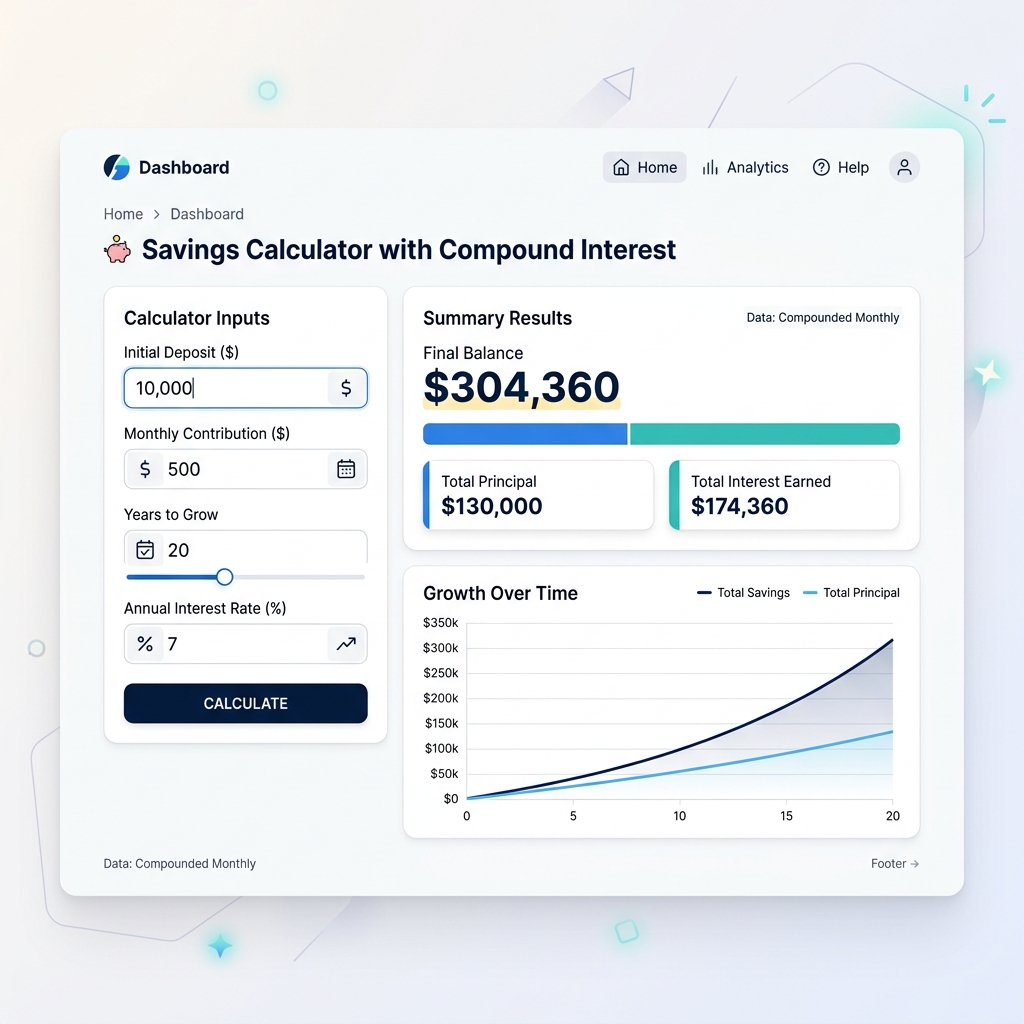
Compound interest is calculated as: FV = P × (1 + r/n)^(nt) + PMT × [((1 + r/n)^(nt) − 1) ÷ (r/n)]. Where P = initial deposit, r = annual rate, n = compounding periods per year (12 for monthly), t = years, PMT = monthly contribution. What this means practically: your interest earns interest. A $10,000 deposit at 5% for 10 years earns $6,289 in compound interest — while the same $10,000 at simple interest earns only $5,000. The difference grows dramatically over longer periods.
Why HYSA Rates Matter in 2026
High-yield savings accounts in 2026 offer 4–5% APY — the highest rates since 2007. This is a significant opportunity: a traditional savings account at 0.5% on $20,000 earns $100/year. The same $20,000 in a HYSA at 4.5% earns $900/year — 9× more. The key difference: HYSA accounts are FDIC insured (safe up to $250,000), liquid (no lockup period), and currently yielding competitive returns. For emergency funds and short-term goals (under 5 years), HYSA is the best savings vehicle in 2026.
The Power of Starting Early
Time is the most powerful variable in compound interest — more important than rate or contribution amount. Consider two savers: Alex starts at 25 saving $300/month at 7% and stops at 35 (contributes for 10 years = $36,000 total). Jordan starts at 35 saving $300/month at 7% until retirement at 65 (contributes for 30 years = $108,000 total). At 65, Alex has $338,000. Jordan has $340,000. Same ending balance — despite contributing 3× less money, simply by starting 10 years earlier. This is the power of compound interest and time.
The 50/30/20 Rule and How Much to Save
The standard budgeting guideline: 50% of take-home pay for needs (housing, food, transport), 30% for wants, 20% for savings and debt repayment. On $5,000/month take-home, that's $1,000/month to savings. Of that, financial planners recommend: 6 months emergency fund first (typically $15,000–$30,000), then 15% of gross salary to retirement accounts (401k, IRA), then additional savings for specific goals. Use our calculator to see exactly what $1,000/month at 7% grows to over 30 years — the result ($1.2M) makes the math clear.
Rule of 72 — Doubling Time at a Glance
3% APY
Doubles in
24 years
5% APY
Doubles in
14.4 years
7% APY
Doubles in
10.3 years
10% APY
Doubles in
7.2 years
Formula: 72 ÷ annual rate = years to double your money
Planning your financial future?
Share this with anyone working toward a savings goal.
Share this calculator
Results are projections based on constant monthly compounding at the specified rate. Actual returns vary. Past performance does not guarantee future results. Not financial advice. See disclaimer.