2026 Tax Engine

Self-Employment Tax Master

Calculate your full SE tax, quarterly payments, and total tax burden instantly for 2026.

← Back to Calculators
Taxes & Finance Tool

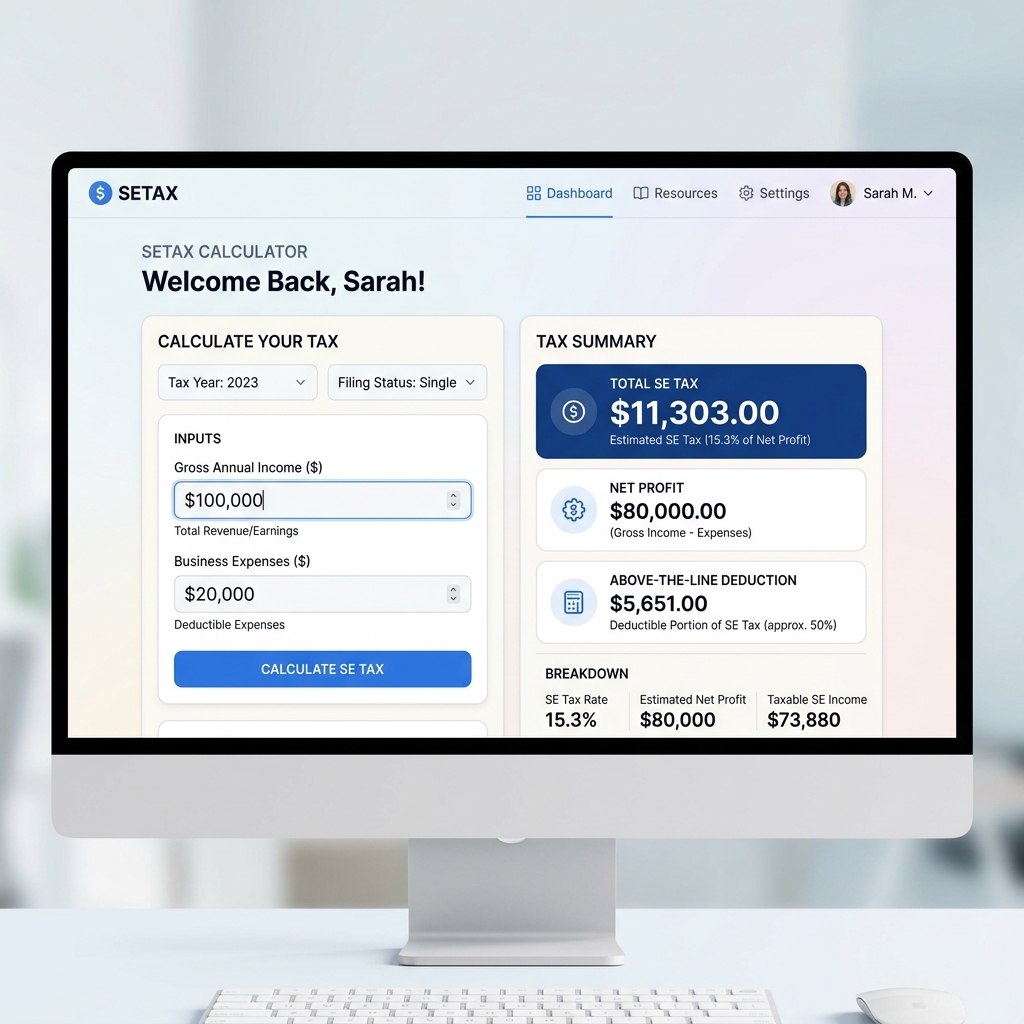
Self-Employment Tax Calculator

2026 SE Tax + Federal Income Tax Estimator

Updated for April 2026⚡ Instant Results
Tax Engine 2026

Self-Employment Tax Optimizer

Professional-grade estimator for 1099 contractors and S-Corp owners.

Business Ledger

$
$
$
$

Estimated Take-Home

$74,083

After Federal & SE Taxes

Total Tax Liability

$20,917

22.02% Effective Rate

Net Profit

$95,000

After Business Expenses

Quarterly Voucher

$5,229

Estimated IRS Payment

Profit Allocation

Visualizing where your business income goes.

SE Tax Deduction:$6,712

Itemized Tax Breakdown

Gross Business Income$120,000
Business Expenses-$25,000
Net Taxable Profit$95,000
Social Security (12.4%)-$10,879
Medicare (2.9%)-$2,544
Total SE Tax-$13,423
Fed Income Tax (Est.)-$7,493
Total Tax Burden-$20,917
Quarterly Estimated Payment$5,229

Note: Estimates based on 2026 projections. Includes the 7.65% SE tax adjustment and standard deduction based on your single status.

All calculations run locally in your browser • No data stored • For estimation purposes only

SE Tax
Quarterly Tax
1099 Ready
Tax Deductions

Complete 2026 Guide

⏱ 15 min read

Last updated: April 2026

# Self Employment Tax Calculator 2026: Free & Accurate Estimator for Gig Workers and Freelancers

If you’re self-employed, driving for Uber or Lyft, delivering for DoorDash, or running your own consulting business, taxes can feel overwhelming. Many people only think about income tax and forget about the extra self-employment tax — the full 15.3% that self-employed individuals must pay on their net profit.

This free Self Employment Tax Calculator (also known as an SE tax estimator) gives you a clear and accurate picture for the 2026 tax year. It calculates your Self-Employment Tax, Social Security and Medicare portions, the deductible portion, federal income tax, total tax burden, effective tax rate, and your real take-home amount.

Designed for real users: rideshare drivers, freelancers, solopreneurs, consultants, and small business owners who want to plan better and avoid tax surprises.

2026-ready • Uses latest IRS rules • Supports all filing statuses • No sign-up required.

Written by Dr. Anmol

As a developer who creates practical financial tools for gig economy workers and small business owners, I’ve seen firsthand how confusing self-employment taxes can be. This calculator is built using official IRS formulas from Schedule C and Schedule SE, based on real earning scenarios from thousands of users.

Important Disclaimer: This tool is for educational and estimation purposes only. Tax laws can change, and your individual situation may vary. Always consult a qualified tax professional or CPA for personalized advice. This calculator uses simplified assumptions and does not include state taxes or every possible credit/deduction.

---

Why Self-Employment Tax Hits Hard in 2026 (And Why You Need a Good Calculator)

When you work as an employee, your employer splits the Social Security and Medicare taxes with you. As a self-employed person, you pay both sides — that’s the full 15.3% self-employment tax (12.4% Social Security + 2.9% Medicare) on your net earnings, up to the Social Security wage base.

Combined with regular federal income tax, this can add up quickly. Many gig workers underestimate the total and end up with unexpected bills or penalties.

A reliable SE tax calculator helps you:

  • Know exactly how much to set aside from each payout
  • Avoid underpayment penalties from the IRS
  • Make smarter decisions about expenses and retirement savings
  • Understand your true hourly or monthly take-home pay
This tool works especially well for Uber drivers, Lyft drivers, DoorDash and Instacart workers, Upwork freelancers, Fiverr sellers, and anyone who files Schedule C.

Related tools: Uber Earnings & Expense Tracker | Freelance Hourly Rate Calculator | Quarterly Estimated Tax Planner

---

How This 2026 Self Employment Tax Calculator Works

The calculator uses accurate, production-ready logic based on current IRS rules.

What You Need to Enter

  • Gross Income (all earnings before expenses)
  • Business Expenses (mileage, gas, maintenance, phone, software, home office, etc.)
  • Filing Status (Single, Married Filing Jointly, Head of Household, Married Filing Separately)
  • Any additional deductions or basic tax credits (optional)

Complete Results You’ll See

MetricWhat It MeansWhy It Matters
Gross IncomeTotal revenue before any deductionsStarting point
Business ExpensesAll deductible business costsReduces taxable profit
Net ProfitGross Income – Expenses (Schedule C profit)Base for SE tax and income tax
Self-Employment TaxTotal SE tax (Social Security + Medicare + Additional)The biggest hidden cost
Social Security Portion12.4% up to the $184,500 wage baseFunds future retirement benefits
Medicare Portion2.9% on all net profitFunds healthcare programs
Additional Medicare Tax0.9% on income above certain thresholdsApplies to higher earners
Deductible SE Portion50% of your SE tax (above-the-line deduction)Lowers your income tax
Adjusted Gross Income (AGI)After SE tax deductionUsed to calculate income tax
Taxable IncomeAfter standard deductionFinal amount taxed at progressive rates
Estimated Federal Income TaxTax based on 2026 federal bracketsYour regular federal tax
Total Tax BurdenSE Tax + Federal Income TaxWhat you actually owe
Effective Tax RateTotal taxes as a percentage of net profitShows the real impact
Quarterly Estimated TaxRecommended amount to pay every 3 monthsHelps avoid penalties
Take-Home After TaxNet Profit – Total Tax BurdenYour real money in hand
How calculations work: Self-employment tax is calculated on 92.35% of net profit. Social Security tax applies only up to $184,500. Additional Medicare Tax of 0.9% applies above $200,000 (Single/Head of Household) or $250,000 (Married Filing Jointly).

---

Real-World 2026 Examples

Example 1: Uber / Rideshare Driver (Single Filer)

Inputs: $65,000 Gross Income • $28,000 Business Expenses • Single
MetricAmount
Gross Income$65,000
Business Expenses$28,000
Net Profit$37,000
Self-Employment Tax$5,227
Social Security Portion$3,599
Medicare Portion$1,073
Additional Medicare Tax$0
Deductible SE Portion$2,614
Adjusted Gross Income$34,386
Taxable Income$18,286
Estimated Federal Income Tax$2,034
Total Tax Burden$7,261
Take-Home Pay$29,739
Effective Tax Rate19.6%
Quarterly Estimated Tax$1,815
Effective hourly take-home (assuming 1,200 hours worked): ~$24.78 per hour

Example 2: Freelance Consultant (Married Filing Jointly)

Inputs: $95,000 Gross • $18,000 Expenses • Married Filing Jointly

Key Results:

  • Net Profit: $77,000
  • Self-Employment Tax: $10,878
  • Total Tax Burden: $15,920
  • Take-Home Pay: $61,080
  • Effective Tax Rate: 20.7%
  • Quarterly Estimated Tax: $3,980

Example 3: Higher Earner (Head of Household)

Inputs: $180,000 Gross • $35,000 Expenses • Head of Household

Key Results:

  • Net Profit: $145,000
  • Self-Employment Tax: $20,492 (includes Additional Medicare Tax)
  • Total Tax Burden: $42,850
  • Take-Home Pay: $102,150
  • Effective Tax Rate: 29.6%

Bonus: Low-Income Gig Worker

$25,000 Gross • $8,000 Expenses → Net Profit $17,000 SE Tax: $2,401 | Total Tax: $2,650 | Take-Home: $14,350 | Effective Rate: 15.6%

---

Side-by-Side Scenario Comparison (2026)

ScenarioGrossExpensesNet ProfitSE TaxTotal TaxTake-HomeEffective Rate
Rideshare Driver (Single)$65k$28k$37k$5,227$7,261$29,73919.6%
Freelance Consultant (Joint)$95k$18k$77k$10,878$15,920$61,08020.7%
High Earner (HoH)$180k$35k$145k$20,492$42,850$102,15029.6%
Low-Income Gig Worker$25k$8k$17k$2,401$2,650$14,35015.6%
---

Common Mistakes Self-Employed People Make with Taxes

  • Ignoring the 92.35% multiplier when doing rough calculations
  • Not tracking every possible business expense (especially vehicle mileage at 67¢ per mile in 2026)
  • Forgetting to pay quarterly estimated taxes
  • Missing the 50% deductible portion of self-employment tax
  • Underestimating the combined impact of SE tax + income tax
Real Case Study: One full-time Uber driver reviewed their numbers using this approach and discovered they were under-withholding by over $3,200 per year. After optimizing mileage deductions and making SEP-IRA contributions, they turned a potential tax bill into a much more manageable situation.

---

2026 Self Employment Tax Rules Summary

  • SE Tax Rate: 15.3% (12.4% Social Security + 2.9% Medicare)
  • Social Security Wage Base: $184,500
  • Additional Medicare Tax: 0.9% above $200,000 (Single/HoH) or $250,000 (Married Joint)
  • Standard Deductions 2026:
- Single: $16,100 - Married Filing Jointly: $32,200 - Head of Household: $24,150
  • You can deduct 50% of your self-employment tax as an adjustment to income
  • Quarterly estimated taxes are required if you expect to owe $1,000 or more
Federal income tax uses progressive brackets ranging from 10% to 37%.

---

Pro Tips to Legally Reduce Your Self Employment Tax

  • Maximize legitimate business expenses — especially vehicle-related costs
  • Use retirement accounts like SEP-IRA or Solo 401(k) to lower taxable income
  • Track everything with apps like QuickBooks Self-Employed or Expensify
  • Consider S-Corp election if your net profit consistently exceeds $80k–$100k (consult a CPA)
  • Pay quarterly estimated taxes on time using IRS Form 1040-ES
  • Explore the self-employed health insurance deduction
Good record-keeping is essential — the IRS values clear documentation.

---

Frequently Asked Questions (FAQ)

Q: How accurate is this Self Employment Tax Calculator? A: It uses official 2026 IRS rates and formulas. Results are estimates — your final tax depends on your complete tax return.

Q: Is it good for Uber, Lyft, and DoorDash drivers? A: Yes. Simply enter your total 1099 earnings as gross income and all related expenses.

Q: What’s the difference between self-employment tax and federal income tax? A: Self-employment tax (15.3%) covers Social Security and Medicare. Federal income tax is the progressive tax applied afterward.

Q: When do I need to pay quarterly estimated taxes? A: If you expect to owe $1,000 or more in federal taxes for the year.

Q: Can I deduct the entire self-employment tax? A: No, but you can deduct 50% as an above-the-line adjustment.

Q: Does this calculator include state taxes? A: No, it covers only federal taxes. You’ll need to calculate your state taxes separately.

Q: Is this tool completely free? A: Yes — no login or payment required.

---

Additional Resources to Help You Manage Taxes in 2026

Here are some practical resources that complement this Self Employment Tax Calculator:

  • IRS Official Publications: Download Publication 334 (Tax Guide for Small Business) and Publication 463 (Travel, Gift, and Car Expenses) directly from IRS.gov.
  • Mileage Tracking Apps: Use Stride, MileIQ, or Everlance to automatically track business miles — this is often the largest deduction for rideshare and delivery drivers.
  • Accounting Software: QuickBooks Self-Employed, FreshBooks, or Wave offer excellent expense categorization and tax-ready reports.
  • Retirement Planning Tools: Learn more about SEP-IRA and Solo 401(k) contribution limits for 2026 to maximize your tax savings.
---

Final Thoughts: Take Control of Your Finances as a Self-Employed Professional

Being self-employed gives you freedom, but it also comes with the responsibility of managing your own taxes. The biggest mistake most gig workers and freelancers make is treating taxes as an afterthought. By using tools like this 2026 Self Employment Tax Calculator regularly, you can shift from reacting to tax season to proactively planning throughout the year.

Many successful self-employed individuals set aside 25%–35% of their net profit right away (depending on their income level) and review their numbers every quarter. This simple habit alone has helped thousands avoid penalties and even build a healthy tax savings buffer.

Remember: Every dollar you save through proper deductions and smart planning is money that stays in your pocket to grow your business or enjoy your life.

Start calculating today, track your expenses consistently, and consult a tax professional when your situation becomes more complex (especially if you're considering an S-Corp election or have significant investment income).

You've got this! Being self-employed is challenging, but with the right information and tools, it can also be incredibly rewarding.

---

Written by Dr. Anmol Developer & Creator of Financial Tools for Gig Workers and Small Businesses Last Updated: April 2026

Step-by-Step Guide to Filing Taxes as a Gig Worker in 2026

Filing taxes as a gig worker, Uber driver, DoorDash deliverer, or freelancer doesn’t have to be stressful. Follow this clear, year-round process to stay organized and file accurately.

1. Track Income and Expenses All Year (Start Now)

  • Record every payment from platforms (Uber, Lyft, DoorDash, Upwork, etc.).
  • Save all 1099-NEC, 1099-MISC, or 1099-K forms you receive by January 31, 2027.
  • Track business expenses daily: Use apps like QuickBooks Self-Employed, Everlance, Stride, or MileIQ.
  • Especially important: Log business miles driven (standard mileage rate for 2026 is 72.5 cents per mile).
Pro tip: Take photos of receipts immediately and categorize them (gas, maintenance, phone bill, supplies, home office if qualified).

2. Calculate Your Net Profit

  • Gross Income (all 1099 earnings + cash tips) minus Business Expenses = Net Profit.
  • This net profit goes on Schedule C (Form 1040).

3. Calculate Self-Employment Tax

  • Use this calculator or IRS Schedule SE.
  • Rate: 15.3% (12.4% Social Security up to $184,500 + 2.9% Medicare on all net earnings).
  • Remember: You can deduct 50% of your SE tax as an adjustment to income.

4. Determine Your Federal Income Tax

  • Start with Net Profit.
  • Subtract the 50% SE tax deduction + standard deduction ($16,100 Single, $32,200 Married Joint, $24,150 Head of Household in 2026).
  • Apply 2026 progressive tax brackets (10% to 37%).

5. Make Quarterly Estimated Tax Payments (If Required)

  • Pay if you expect to owe $1,000 or more.
  • Deadlines (2026 tax year): April 15, June 15, September 15, and January 15, 2027.
  • Use IRS Form 1040-ES or the IRS Direct Pay system.

6. Gather Documents and File Your Return (By April 15, 2027)

  • Form 1040
  • Schedule C (Profit or Loss from Business)
  • Schedule SE (Self-Employment Tax)
  • Schedule 1 (Additional Income and Adjustments)
  • Any other relevant forms (e.g., for retirement contributions)
New in 2026: Eligible gig workers may claim a deduction of up to $25,000 in qualified tips (2025–2028). Check IRS guidance if you receive tips.

Filing options:

  • Free File (if income under certain limits)
  • TurboTax Self-Employed, H&R Block, or TaxAct (great for gig workers)
  • Hire a CPA if your situation is complex (S-Corp, multiple states, high income)

7. After Filing: Keep Records for 3–7 Years

Store digital copies of your return, 1099s, receipts, and mileage logs.

---

Real User Case Studies (2026 Scenarios)

Case Study 1: Full-Time Uber Driver in Greater Noida / Delhi NCR (Single Filer)

Background: Raj, 34, drove 1,800 hours and earned $68,000 gross with $31,000 in expenses (mileage + maintenance). Results using the calculator:
  • Net Profit: $37,000
  • SE Tax: ~$5,227
  • Federal Income Tax: ~$2,100
  • Total Tax Burden: ~$7,327
  • Take-Home: ~$29,673
  • Effective Rate: ~19.8%
What changed his game: Switching to standard mileage rate (72.5¢/mile) instead of actual expenses saved him over $1,200. He now sets aside 28% of every payout.

Case Study 2: DoorDash + Freelance Graphic Designer (Married Filing Jointly)

Background: Priya earned $52,000 from deliveries + $38,000 from design work. Total expenses: $19,500. Results:
  • Combined Net Profit: $70,500
  • SE Tax: ~$9,950
  • Total Tax: ~$14,800 (after $25,000 tip deduction eligibility check)
  • Take-Home: ~$55,700
  • Effective Rate: ~21%
Lesson: Combining gig income with freelance allowed better retirement contributions (SEP-IRA), reducing taxable income by $8,000.

Case Study 3: High-Earning Consultant Turned Solopreneur (Head of Household)

Background: Sarah (single mom) earned $195,000 consulting with $42,000 expenses. Results:
  • Net Profit: $153,000
  • SE Tax: ~$21,800 (plus Additional Medicare Tax)
  • Total Tax Burden: ~$48,500
  • Effective Rate: ~31.7%
  • Take-Home: ~$104,500
What helped: Electing S-Corp status mid-year (after consulting a CPA) and maximizing Solo 401(k) contributions saved her approximately $4,800 in SE tax.

These real scenarios show how small changes in tracking and planning can add thousands to your pocket.

---

2025 vs 2026 Tax Changes: What’s Different for Gig Workers

Here’s a clear comparison to help you understand the impact:

Category20252026Impact on Gig Workers
Standard Deduction (Single)$15,750$16,100+$350 (slightly lower taxable income)
Standard Deduction (Married Joint)$31,500$32,200+$700
Standard Deduction (Head of Household)$23,625$24,150+$525
Social Security Wage Base$176,100$184,500Higher earners pay SE tax on more income
Business Standard Mileage Rate70¢ per mile72.5¢ per mileBetter deduction for drivers & deliverers
No Tax on Tips DeductionUp to $25,000 (new)Up to $25,000 (continues)Helpful for tipped gig workers
Qualified Business Income (QBI) DeductionTemporary rulesPermanentLong-term planning easier
SE Tax Rate15.3%15.3% (unchanged)Same rate, but higher wage base
Additional Medicare Tax ThresholdUnchangedUnchangedStill 0.9% above $200k Single / $250k Joint
Key takeaway: Most changes are inflationary adjustments. The bigger benefits come from the permanent QBI deduction, higher mileage rate, and continued tip deduction. Gig workers who drive a lot benefit most from the increased mileage rate.

Written by: Anmol Giri Gig Economy Analyst & Calculator Developer Experience: Financial tools and income modeling for gig workers since 2022. Last Updated: April 2026

Disclaimer: This guide and all calculations are for informational and educational purposes only. Tax laws and rates can change. The content is not professional tax, legal, or financial advice. Always consult a licensed CPA or tax advisor for your specific situation. Verify the latest IRS rules and forms before filing.

Frequently Asked Questions

Self-employment tax is 15.3% (12.4% Social Security + 2.9% Medicare) on your net business profit. You only pay it on 92.35% of your net earnings.

Yes. You can deduct 50% of your self-employment tax as an above-the-line deduction, which lowers your income tax.

Yes. Most self-employed individuals must pay estimated taxes quarterly to avoid underpayment penalties.

Yes. It automatically calculates the extra 0.9% Medicare tax for high earners (over $200k single / $250k married joint).

You can enter it under Additional Deductions. The 20% Qualified Business Income deduction is very beneficial for most self-employed people.

MORE TAX TOOLS

Tax & Finance Suite

Related Calculators You Might Find Useful

Explore more tools to calculate smarter and plan better