In This Guide — Jump to Any Section
- 01The real hourly rate — gross vs. net
- 02How DoorDash actually pays you
- 03Full expense breakdown
- 04IRS mileage deduction: $0.725/mile
- 05Self-employment tax explained simply
- 06Every deduction you can claim
- 07When & where to dash for max pay
- 08Strategies top earners actually use
- 09DoorDash vs. Uber Eats comparison
- 10Is DoorDash worth it? By situation
- 11Realistic monthly income projections
- 12Frequently asked questions
The Real Hourly Rate: Gross vs. What You Actually Keep
Let's start with what nobody on DoorDash's website wants you to see. According to Gridwise — which tracked 115,771 active Dashers through 2025 — the median gross hourly rate is $11.26 per hour. Not $18. Not $25. Eleven dollars and change.
The top earners are real too. The top 25% of Dashers gross $13.49+/hr, and the top 10% clear $15.63+/hr. But those people are working strategic hours, filtering orders aggressively, and tracking every mile. They are not the average person who opens the app and starts driving.
Bottom 25%
Gross/hr
$7.80–$9.50
Est. Net/hr
$4–$6
Off-peak, no order filtering
Median (50th)
Gross/hr
$11.26
Est. Net/hr
$7–$12
Average Dasher, mixed hours
Top 25%
Gross/hr
$13.49+
Est. Net/hr
$9–$15
Peak hours, some filtering
Top 10%
Gross/hr
$15.63+
Est. Net/hr
$12–$20
Strategic, multi-apping
Top 5% (elite)
Gross/hr
$18–$22+
Est. Net/hr
$14–$22
All strategies + hybrid
| Dasher Percentile | Gross $/hr | Est. Net $/hr | Profile |
|---|---|---|---|
| Bottom 25% | $7.80–$9.50 | $4–$6 | Off-peak, no order filtering |
| Median (50th) | $11.26 | $7–$12 | Average Dasher, mixed hours |
| Top 25% | $13.49+ | $9–$15 | Peak hours, some filtering |
| Top 10% | $15.63+ | $12–$20 | Strategic, multi-apping, peak only |
| Top 5% (elite) | $18–$22+ | $14–$22 | All strategies + hybrid vehicle |
The jump from $9/hr to $18/hr is not luck or a better market. It's three or four decisions applied every shift: which hours to work, which orders to accept, and whether you're tracking your miles.
How DoorDash Actually Pays You (All Three Sources)
Every completed delivery pays you from three separate components. Understanding how each one works — and which one you control most — changes how you approach every shift.
1. Base Pay ($2–$10+ per order)
Base pay is DoorDash's guaranteed floor for each order, calculated from estimated delivery time, distance, and "desirability" — basically how many drivers have already passed on it. An unclaimed order gets its base pay bumped automatically over time. A long rural drive might start at $7–$10 base; a quick downtown hop could be $2–$3. Base pay alone won't make dashing profitable.
2. Tips — 100% goes to you
Tips are where real income comes from. DoorDash takes zero cut — 100% passes directly to you. The Gridwise median tip is $3.66 per delivery, roughly 49% of total order pay. This is also why experienced drivers treat a no-tip order as a red flag: the customer has already signalled what they intend to pay, and completing the delivery won't change that. DoorDash shows you the tip upfront — use that information.
3. Peak Pay & Promotions ($1–$5 extra per order)
When demand outpaces drivers in a zone, DoorDash adds Peak Pay on top of base. It stacks directly on tips — not averaged in. DoorDash also runs "Challenges" (complete X deliveries by Y time for a $20–$75 bonus). These are worth planning your schedule around when they align with your normal hours.
The Full Expense Breakdown: Where Gross Pay Becomes Net Pay
A Dasher working 30 hours per week grosses about $338 at the median rate. Here is what it actually costs to earn that money.
⛽ Fuel — gas sedan (28 MPG)
Weekly
$43–$57
Annual
$2,240–$2,960
$3.50/gal avg
⛽ Fuel — hybrid (52 MPG)
Weekly
$23–$31
Annual
$1,200–$1,600
Best ROI upgrade
🔧 Oil changes + maintenance
Weekly
$14–$24
Annual
$730–$1,250
Every 3k–5k miles
📉 Vehicle depreciation
Weekly
$48–$90
Annual
$2,500–$4,700
Hidden — hits at sale
🛡️ Insurance rider
Weekly
$10–$30
Annual
$120–$360
Required for coverage
📱 Phone plan (80% biz use)
Weekly
$7–$12
Annual
$84–$144
Deductible portion
Total (gas sedan)
Weekly
$122–$213
Annual
$5,674–$9,414
| Expense | Weekly (400 mi) | Annual | Notes |
|---|---|---|---|
| ⛽ Fuel — gas sedan (28 MPG) | $43–$57 | $2,240–$2,960 | $3.50/gal national avg |
| ⛽ Fuel — hybrid (52 MPG) | $23–$31 | $1,200–$1,600 | Best ROI upgrade |
| 🔧 Oil changes + maintenance | $14–$24 | $730–$1,250 | Every 3k–5k miles |
| 📉 Vehicle depreciation | $48–$90 | $2,500–$4,700 | Hidden — hits at sale |
| 🛡️ Insurance rider | $10–$30 | $120–$360 | Required for coverage |
| 📱 Phone plan (80% biz use) | $7–$12 | $84–$144 | Deductible portion |
| Total (gas sedan) | $122–$213 | $5,674–$9,414 | Before SE tax |
Real-world net pay: one 30-hour week
That's sobering — $5.38/hr. But this is a driver making no smart decisions: no order filtering, no peak hours, and not claiming the IRS mileage deduction. Fix those three things and the math changes completely.
Stop estimating — know your actual net pay
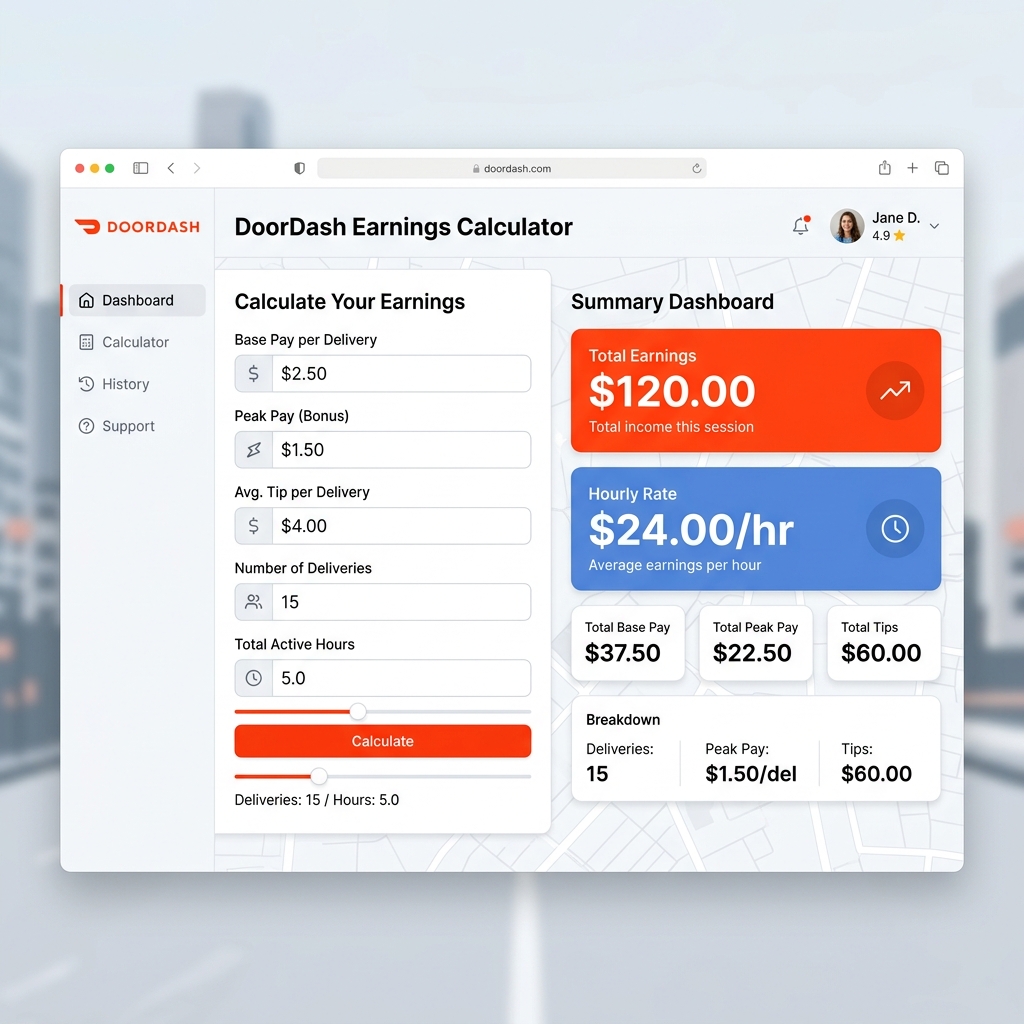
Enter your hours, orders, and miles. Get your true net hourly rate, quarterly tax reserve, and full expense breakdown instantly.
The IRS Mileage Deduction: $0.725/Mile in 2026
The IRS standard mileage rate for 2026 is $0.725 per mile, confirmed in IRS Revenue Procedure 2025-18. This single deduction bundles fuel, oil changes, tire wear, depreciation, and insurance — all in one number you claim on Schedule C. Multiply total business miles by $0.725 and that's your deduction — reducing taxable net profit dollar for dollar.
Part-time Dasher
10,000 mi/yr
$7,250
~$2,000 saved
Regular part-time
15,000 mi/yr
$10,875
~$3,000 saved
Full-time Dasher
20,000 mi/yr
$14,500
~$4,000 saved
Which miles are deductible?
Deductible
- ✓Home → first pickup after accepting an order
- ✓Restaurant → customer (every delivery)
- ✓Between orders while logged in and active
- ✓Customer → next restaurant if you accept another
- ✓Business errands: mechanic, car wash, supply store
Not Deductible
- ✗Home → anywhere before you accept an order
- ✗Miles after you log off for the day
- ✗Personal trips mixed into a shift
- ✗Commuting to a staging area before dashing
- ✗Miles in a vehicle you don't own or lease
Best mileage tracking apps
Stride — Free
Best for most Dashers. Automatic tracking, built-in tax deduction summary. Start it before you leave home.
Everlance — $8/month Pro
Better for full-time or multi-app drivers. IRS audit-ready exports and vehicle cost tracking.
MileIQ — $5.99/month
Clean UI, reliable auto-detection. Good if you're also tracking a separate business.
Self-Employment Tax: The 15.3% Most New Dashers Forget
At a regular job your employer pays half your Social Security and Medicare. As an independent contractor you pay both halves yourself — that's the 15.3% self-employment tax applied to your net profit before income tax. The good news: you deduct half of it from taxable income, and the mileage deduction directly reduces the SE tax base.
Full tax calculation on $25,000 gross earnings
2026 Quarterly Tax Deadlines
Q1 2026
January – March
April 15, 2026
Q2 2026
April – May
June 16, 2026
Q3 2026
June – August
September 15, 2026
Q4 2026
September – December
January 15, 2027
| Quarter | Income Covered | Due Date | Status |
|---|---|---|---|
| Q1 2026 | January – March | April 15, 2026 | Passed |
| Q2 2026 | April – May | June 16, 2026 | ⚡ Coming up |
| Q3 2026 | June – August | September 15, 2026 | Upcoming |
| Q4 2026 | September – December | January 15, 2027 | Upcoming |
Every Deduction DoorDash Drivers Can Claim in 2026
Most drivers leave $1,500–$4,000 in unclaimed deductions every year — not because they don't exist, but because nobody told them to track from day one.
IRS Mileage ($0.725/mile)
Your biggest deduction. Covers fuel, maintenance, and depreciation in one rate. Track every business mile with a dedicated app.
Phone & Plan (business %)
Deduct 75–90% of your phone and monthly plan. Active Dashers commonly use 80–90% business-use percentage.
Delivery Bags & Equipment
Insulated bags, phone mounts, car chargers, and other delivery gear are 100% deductible.
Tolls & Parking
Every toll and parking fee paid during a delivery is fully deductible. Keep timestamped screenshots from your app.
App Subscriptions
Stride, Everlance, QuickBooks Self-Employed — any app for tracking earnings or expenses is deductible.
Health Insurance Premiums
If you're self-employed and pay your own health insurance, premiums are deductible from gross income.
Qualified Tips Deduction
New for 2026: deduct up to $25,000 in qualifying tip income from federal taxable income (through 2028).
Self-Employed Retirement
SEP-IRA or Solo 401(k) contributions are deductible and reduce your SE tax base — often overlooked.
When and Where to Dash for Maximum Pay
Timing is the most underrated variable in DoorDash earnings. A driver working 25 strategic peak hours will often out-earn someone working 40 random hours — while putting fewer miles on their car.
Sun 6–8 PM
$18.28/hr
Highest nationally — families ordering in
Fri–Sat 6–9:30 PM
$15–$17/hr
High tip culture, peak restaurant volume
Mon–Fri 11 AM–2 PM
$13–$15/hr
Lunch rush, office orders, lower traffic
Mon–Fri 5–8 PM
$14–$16/hr
Dinner rush, consistent Peak Pay zones
Off-peak hours
$7–$10/hr
Low order volume, bad $/mile ratio
| Time Window | Avg Gross/hr | Why It Works |
|---|---|---|
| Sun 6–8 PM | $18.28/hr | Highest nationally — families ordering in |
| Fri–Sat 6–9:30 PM | $15–$17/hr | High tip culture, peak restaurant volume |
| Mon–Fri 11 AM–2 PM | $13–$15/hr | Lunch rush, office orders, lower traffic |
| Mon–Fri 5–8 PM | $14–$16/hr | Dinner rush, consistent Peak Pay zones |
| Sat–Sun 10 AM–1 PM | $11–$13/hr | Brunch orders, decent for experienced drivers |
| Off-peak hours | $7–$10/hr | Low volume, long wait times, bad $/mile |
Strategies Top Dashers Use to Earn $20+/Hour
The $2/mile rule — never break it
Decline any order paying less than $2 for every mile driven. A $6 order requiring 4 miles is $1.50/mile — skip it. Applied consistently, this filter adds $3–$6/hr net. Top earners use $2.50/mile as their floor. DoorDash does not deactivate drivers for low acceptance rates as of 2026.
Multi-apping: run DoorDash + Uber Eats simultaneously
Running both apps fills dead time and lets you take the better offer from either platform. A 2024 Gridwise study found multi-apping drivers earned 31% more per hour. Over 65% of full-time gig workers now use two or more apps at once. Rule: never accept a second order if it will make you late on the first.
Stack Challenges with your natural schedule
DoorDash Challenges (complete X deliveries by Y time for $Z bonus) are worth $20–$75 each. Don't alter your schedule to chase them — check weekly if any challenge aligns with what you'd already be doing during peak hours. Stack, don't chase.
Switch to a hybrid — saves $1,200+/year
A gas sedan at 25 MPG costs $50–$60/week in fuel on 400 miles. A hybrid at 50 MPG cuts that to $25–$30/week — $1,200–$1,500/year extra take-home. Many Dashers finance a used hybrid specifically for delivery work, and the fuel savings often cover the payment.
Track miles from the second you leave home
Accept an order before leaving your driveway and those home-to-restaurant miles are deductible. At $0.725/mile, every extra 100 miles tracked = $72.50 in deductions = ~$20 in real tax savings. Over a year this habit is worth $200–$600 for most Dashers.
DoorDash vs. Uber Eats Pay in 2026
Neither is categorically better. The right answer for most drivers is both simultaneously — which is exactly what top earners do.
Median gross/hr
DoorDash
$11.26/hr
Uber Eats
$15–$22/hr (dense urban)
US market share
DoorDash
~68%
Uber Eats
~23%
Order volume
DoorDash
Very high everywhere
Uber Eats
High in cities only
Tip shown upfront
DoorDash
✓ Yes, always
Uber Eats
✗ Hidden for first hour
Best market
DoorDash
Suburban / mid-tier
Uber Eats
Dense metro areas
Multi-apping friendly
DoorDash
✓ Yes
Uber Eats
✓ Yes
| Category | DoorDash | Uber Eats |
|---|---|---|
| Median gross/hr | $11.26/hr | $15–$22/hr (dense urban) |
| US market share | ~68% | ~23% |
| Order volume | Very high, everywhere | High in cities only |
| Tip shown upfront | ✓ Yes, always | ✗ Hidden for first hour |
| Best market | Suburban / mid-tier | Dense metro areas |
| Multi-apping | ✓ Yes | ✓ Yes |
| Weekly bonuses | ✓ Challenges | ✓ Quests |
Is DoorDash Worth It in 2026? By Driver Situation
Side income ($600–$1,200/month)
Clearly worth itWorking 15–25 peak hours per week reliably delivers this in most US markets. The flexibility is real. Tax management is simple with a free tracking app and a consistent 26% set-aside rule.
Temporary full-time income replacement
Workable with disciplineYou need 35–45 hours/week, multi-apping from day one, and strict tax habits from week one. In a decent market $2,200–$2,900/month net is achievable. Treat it as a real business.
Long-term full-time career
Possible, with real limitsThe ceiling for a strategic full-time Dasher is roughly $3,000–$3,500/month net. No employer benefits. Vehicle depreciation accelerates. Income subject to algorithm changes.
International drivers (UK, Canada, Australia)
Yes — adjust the rateThe logic applies globally. UK: HMRC 45p/mile. Canada: CRA 70¢/km. Australia: ATO 88¢/km. The 25–28% tax set-aside principle is roughly consistent across these markets.
Realistic Monthly Income Projections
What a driver with average efficiency in a mid-tier US market can realistically expect to net per month. "Average" means using the $2/mile filter and working primarily peak hours.
10 hrs/wk
Light side hustleGross/mo
$450–$550
Expenses
$120–$160
Net/mo
$290–$390
20 hrs/wk
Solid side incomeGross/mo
$900–$1,100
Expenses
$240–$320
Net/mo
$580–$780
30 hrs/wk
Heavy part-timeGross/mo
$1,350–$1,650
Expenses
$360–$480
Net/mo
$870–$1,170
40 hrs/wk
Full-time (basic)Gross/mo
$1,800–$2,200
Expenses
$480–$640
Net/mo
$1,160–$1,560
40 hrs + multi-app
Full-time (optimized)Gross/mo
$2,300–$3,000
Expenses
$500–$680
Net/mo
$1,620–$2,320
| Hours/Week | Gross/Month | Expenses | Net/Month | Tier |
|---|---|---|---|---|
| 10 hrs/wk | $450–$550 | $120–$160 | $290–$390 | Light side hustle |
| 20 hrs/wk | $900–$1,100 | $240–$320 | $580–$780 | Solid side income |
| 30 hrs/wk | $1,350–$1,650 | $360–$480 | $870–$1,170 | Heavy part-time |
| 40 hrs/wk | $1,800–$2,200 | $480–$640 | $1,160–$1,560 | Full-time (basic) |
| 40 hrs + multi-app | $2,300–$3,000 | $500–$680 | $1,620–$2,320 | Full-time (optimized) |
What's your real take-home number?
Enter your hours, orders, and miles. Get your real net hourly rate after gas, the IRS mileage deduction, and self-employment tax — in 30 seconds.
Frequently Asked Questions
Does DoorDash take a percentage of my tips?
No. DoorDash passes 100% of customer tips directly to drivers. The platform charges restaurants a commission on orders, but that's separate from your earnings. Whatever a customer tips, you keep entirely.
What happens if I don't pay quarterly taxes?
The IRS charges an underpayment penalty — typically around 8% annualised on the amount you should have paid. If you owe more than $1,000 for the year you're technically required to pay quarterly. The 26% set-aside rule and paying each quarter eliminates this risk entirely.
Can I claim the mileage deduction and also deduct my actual gas receipts?
No — you pick one method for the year. The standard mileage rate ($0.725/mile) already covers fuel, maintenance, and depreciation. For most Dashers, the mileage rate wins over tracking actual expenses.
Do I need a special insurance policy for DoorDash?
Most standard auto insurance policies do not cover commercial delivery use. You need either a commercial policy or a rideshare/delivery endorsement on your personal policy. Without it you're personally liable for any accident during a delivery. This typically costs $10–$30/month extra.
How does Earn by Time work vs. Earn by Order?
Earn by Time guarantees a minimum hourly rate ($14–$19/hr depending on market) plus 100% of tips, with the clock running from order acceptance to drop-off. Most experienced Dashers prefer Earn by Order during peak windows — but Earn by Time is better for slow markets or off-peak hours.
Is the $25,000 Qualified Tips Deduction automatic?
No — your tax software or accountant must apply it. Most major tools (TurboTax Self-Employed, FreeTaxUSA, TaxSlayer) have been updated for it. If you use a CPA, mention it explicitly. It's a relatively new provision for tax year 2025 and some tools haven't fully caught up.
Anmol Giri
Gig Economy Analyst · Updated May 15, 2026
Sources: Gridwise 2025–2026 · IRS Rev. Proc. 2025-18 · IRS Pub. 463