Updated for 2026 Tax Brackets

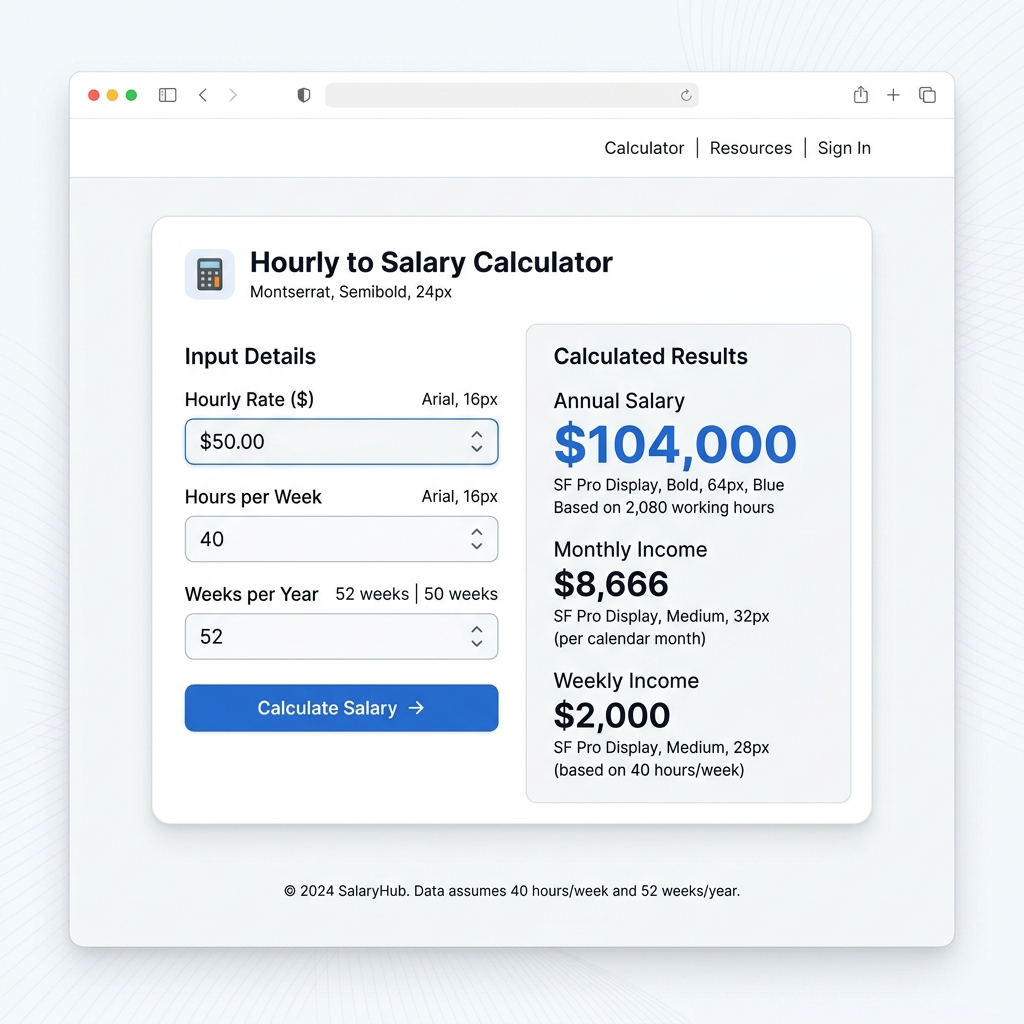
Hourly to Salary Calculator (US 2026)

Convert $20, $25, $30 or any hourly wage to annual, monthly & weekly salary — with overtime and after-tax take-home pay.

2026 federal tax brackets · Overtime at 1.5× or custom · Biweekly & weekly breakdowns

← Back to Calculators
Finance Tool

Updated for 2026⚡ Instant Results

All calculations run locally in your browser • No data stored • For estimation purposes only

Instant ConversionHourly → Annual in seconds
Overtime Ready1.5× or custom multiplier
After-Tax Estimate2026 federal brackets
Live SyncResults update as you type

Common Hourly Wages to Annual Salary — 2026 Quick Reference

Based on 40 hours/week, 52 weeks/year (2,080 hours). Gross figures before tax.

Hourly RateWeekly PayBiweekly PayMonthly PayAnnual Salary
$10 / hr$400$800$1,733$20,800
$12 / hr$480$960$2,080$24,960
$15 / hr$600$1,200$2,600$31,200
$17 / hr$680$1,360$2,947$35,360
$20 / hr$800$1,600$3,467$41,600
$22 / hr$880$1,760$3,813$45,760
$25 / hr$1,000$2,000$4,333$52,000
$28 / hr$1,120$2,240$4,853$58,240
$30 / hr$1,200$2,400$5,200$62,400
$35 / hr$1,400$2,800$6,067$72,800
$40 / hr$1,600$3,200$6,933$83,200
$45 / hr$1,800$3,600$7,800$93,600
$50 / hr$2,000$4,000$8,667$104,000
$60 / hr$2,400$4,800$10,400$124,800
$75 / hr$3,000$6,000$13,000$156,000
$100 / hr$4,000$8,000$17,333$208,000

How to Convert Hourly Wage to Annual Salary (2026 Guide)

The Simple Formula Everyone Gets Wrong

Converting hourly pay to annual salary sounds easy — and it mostly is. The standard formula every US worker should know is: Hourly Rate × 40 hours × 52 weeks = Annual Salary. That gives you $41,600 for a $20/hour job, $52,000 for $25/hour, and $62,400 for $30/hour — all gross figures before federal income tax and FICA hit your paycheck.

Where US workers go wrong is assuming they'll work exactly 40 hours every week, 52 weeks straight. Real life has overtime, slow weeks, unpaid leave, and federal holidays. This calculator lets you plug in your actual hours so the number you see matches the number your bank account sees.

$20 an Hour is How Much a Year After Tax? (US 2026)

At a standard 40-hour week, $20 an hour equals $41,600 per year in gross income. For most US workers at this income level, the effective federal tax rate lands around 10–12%, putting your estimated after-tax take-home at roughly $36,600–$37,400 per year — or about $3,050–$3,117 per month.

That's the federal picture only. Add state income tax (0% in Texas, Florida, and Nevada — up to 13.3% in California) and FICA (7.65% flat), and your actual United States take-home will vary significantly by where you live. Use the tax rate field in the calculator above to plug in your combined rate. Need to reverse this? Use our salary to hourly calculator to work backwards from any annual figure.

$25 an Hour Monthly Salary — US 2026 Breakdown

$25 per hour comes to $52,000 per year at full-time US hours. Breaking that down for monthly budgeting:

  • Weekly pay: $1,000
  • Biweekly pay: $2,000
  • Monthly gross: $4,333
  • Annual gross: $52,000
  • Estimated after-tax (US, ~15% effective rate): ~$44,200/year or $3,683/month

$52,000/year sits right around the US median household income for a single earner. It's a comfortable starting point in most mid-cost US cities, though high-cost metros like New York, San Francisco, or Boston will stretch it thin.

$30/hr Weekly and Biweekly Pay Breakdown (2026)

$30 an houris one of the most searched salary conversions in the United States — and for good reason. It sits just above the $60,000/year mark that many US workers use as a financial milestone. Here's the full breakdown:

  • Weekly pay (40 hrs): $1,200
  • Biweekly pay: $2,400
  • Monthly gross: $5,200
  • Annual gross: $62,400
  • After federal + FICA (~22% combined): ~$48,700/year or $4,058/month

If you're evaluating a $30/hr contract offer against a salaried position, also check our overtime pay calculator — at 5 hours of weekly overtime (1.5×), your annual earnings jump to $74,100, not $62,400.

Overtime Changes Everything

Under the Fair Labor Standards Act (FLSA), most non-exempt US employees must be paid at least 1.5× their regular rate for any hours worked beyond 40 per week. That's time-and-a-half — and it adds up fast for hourly workers across the United States.

A US worker earning $20/hour who regularly does 5 hours of overtime weekly earns an extra $150/week at 1.5× — that's $7,800 extra per year compared to someone working the same base rate without overtime. Use the overtime fields in the calculator above to see your real number. You can also visit our dedicated overtime pay calculator for a more detailed breakdown.

Gross Salary vs. Take-Home Pay: What's the Actual Difference?

Your annual salary figure is gross income — what you earn before federal income tax, FICA (Social Security + Medicare at 7.65%), state taxes, and any pre-tax deductions hit it. For most US workers in 2026, the gap between gross and net is significant:

  • $20/hour ($41,600/year gross): Effective federal rate ~10–12%. US take-home ~$36,600–$37,400/year.
  • $25/hour ($52,000/year gross): Effective rate ~13–15%. US take-home ~$44,000–$45,200/year.
  • $30/hour ($62,400/year gross): Effective rate ~15–17%. US take-home ~$51,800–$53,000/year.

These are estimates using 2026 federal tax brackets for single filers in the United States. Your actual number depends on your filing status, state, and deductions. Enter your estimated tax rate in the calculator for a closer figure. For state-specific calculations, check our take-home pay calculator.

How Many Hours in a US Work Year — Really?

The standard is 2,080 hours per year (40 hrs × 52 weeks). But if your US employer gives you 10 paid vacation days and 6 federal holidays, your actual working hours drop to 1,952 hours. Your salary stays the same — but your effective hourly rate goes up, which matters when comparing a salaried offer against an hourly contract role.

Hourly vs Salary Pay – Which is Better for US Workers in 2026?

This is one of the most common career decisions US workers face — especially when switching jobs or negotiating offers. Here's an honest breakdown:

Hourly Pay Advantages

You get paid for every hour worked in the United States, including overtime at 1.5× under federal FLSA rules. Ideal if your hours vary or you regularly work extra shifts. More transparent — you know exactly what each hour of your time is worth, and your employer can't quietly extend your workday without paying for it.

Salaried Pay Advantages

Predictable paycheck regardless of slow weeks — important for budgeting fixed US expenses like rent, mortgage, and car payments. Often comes with better benefits, PTO accrual, health insurance contributions, and career advancement tracks at US companies. Better for high-earners who can negotiate their package upfront.

The Real Test: Convert Both to Hourly

Before accepting any US job offer, convert everything to an effective hourly rate. A $75,000/year salary sounds great — but if the role realistically expects 55-hour weeks, your effective hourly rate is just $26.22/hr, not the $36.06 a 40-hour week implies. That $25/hr hourly role with no overtime might actually pay better in real terms. Use our salary to hourly calculator to run this comparison before you sign anything.

⏱ 31 min read

Last updated: June 2026

# Salary Calculator India 2026 — CTC to In-Hand, Hourly Rate, Tax Comparison (₹ + USD + GBP + AED)

Updated: May 2026 · Covers New Income Tax Act 2025 (effective April 1, 2026) · Built for Indian Salaried Employees, NRIs, Freelancers, and Foreign Employers

You just got an offer letter. It says ₹8.5 LPA. Or your US client is proposing $1,500/month for a remote contract role. Or you're an NRI in Dubai staring at a Bangalore return offer wondering if the numbers actually work.

Every situation has the same problem: the headline figure tells you almost nothing until you break it down into what actually hits your bank account every month, what it costs your employer in total, and what it looks like against salaries in other countries on a real apples-to-apples basis.

This calculator and guide exist to eliminate that confusion with real numbers. Not estimates from 2019. Not the CTC your employer quotes. Your actual in-hand salary — after EPF, professional tax, and income tax under the regime that saves you more money.

The Core Problem: Why Indian Salary Numbers Confuse Everyone

In the US or UK, your salary offer is reasonably close to what you earn. A $70,000 offer in the US means roughly $5,833/month before income tax — and most Americans have a working intuition for what their tax bill looks like. Straightforward.

India has several layers that most people — including many Indians themselves — don't fully account for.

The CTC illusion: CTC stands for Cost to Company. It is not your salary. It is the total annual expenditure the company incurs to employ you — including things you will never see in your bank account. Employer PF contribution (12% of your basic), gratuity provision (~4.8% of basic), and group health insurance premiums are all counted inside your "salary." A ₹12 LPA CTC does not mean ₹1,00,000 per month in your account. It means somewhere between ₹83,000 and ₹90,000 depending on your tax choices and city.

Variable working hours: In India, a "standard" working week depends entirely on your industry and employer. IT companies in Bengaluru or Hyderabad often run 45–50 hour weeks without calling it overtime. Manufacturing and factory roles operate on a statutory 48-hour week under the Factories Act. Some startups run genuine 40-hour cultures. Your effective hourly rate changes dramatically across these scenarios.

Two competing tax systems, one new law: Since 2020, India has operated two parallel income tax regimes. The New Income Tax Act 2025 took effect from April 1, 2026, replacing the Income Tax Act 1961 — but critically, it did not change tax slab rates or deduction amounts. Section numbers changed (80C is now Section 123, 87A is now Section 157), but the financial impact is identical. The choice between Old and New Regime still determines your take-home pay far more than most people realise.

The new HRA metro expansion: Under Income Tax Rules 2026, four new cities — Bengaluru, Pune, Hyderabad, and Ahmedabad — now qualify for the 50% HRA exemption limit previously available only to Delhi, Mumbai, Chennai, and Kolkata. This is one of the most practically significant changes for the millions of IT professionals in these cities, and most salary calculators have not yet updated for it.

State-level professional tax: Maharashtra charges ₹2,500/year. Karnataka charges ₹2,400/year. Delhi charges nothing. Small numbers, but they affect every calculation differently.

Understanding all these layers is what separates an accurate salary calculation from a guess.

Indian Tax Slabs FY 2026-27 (AY 2027-28) — Complete Reference

Important clarification for FY 2026-27: The Union Budget 2026 made no changes to income tax slabs. The rates introduced in Budget 2025 continue unchanged. The New Income Tax Act 2025, effective April 1, 2026, simplifies the law but does not alter rates or deduction limits.

New Tax Regime Slabs — FY 2026-27 (Default Regime)

Taxable IncomeTax Rate
Up to ₹4,00,0000%
₹4,00,001 – ₹8,00,0005%
₹8,00,001 – ₹12,00,00010%
₹12,00,001 – ₹16,00,00015%
₹16,00,001 – ₹20,00,00020%
₹20,00,001 – ₹24,00,00025%
Above ₹24,00,00030%
Standard deduction (New Regime): ₹75,000 for salaried individuals.

Section 157 Rebate (formerly Section 87A): Resident individuals with taxable income up to ₹12,00,000 pay zero tax due to a full rebate of up to ₹60,000. For salaried employees, the effective zero-tax limit is ₹12,75,000 after the ₹75,000 standard deduction. Note: NRIs are not eligible for this rebate and pay tax from the first rupee at slab rates.

Old Tax Regime Slabs — FY 2026-27

Taxable IncomeTax Rate
Up to ₹2,50,0000%
₹2,50,001 – ₹5,00,0005%
₹5,00,001 – ₹10,00,00020%
Above ₹10,00,00030%
Standard deduction (Old Regime): ₹50,000. Major deductions available: Section 123 (formerly 80C) up to ₹1.5L, Section 80D health insurance, HRA exemption, home loan interest up to ₹2L, NPS extra ₹50,000.

Key rule: The New Regime is now the default. You must actively opt for the Old Regime when filing your ITR. If you do nothing, New Regime applies.

Indian Salary to Hourly Rate — Complete Reference Table 2026

This table covers the salary range where 85% of formal-sector Indian workers sit. All figures are gross — your take-home will be 15–25% lower depending on deductions and tax regime. USD column uses ₹84/$ (May 2026 rate — always verify before using in contracts).

Monthly Gross (₹)Annual CTCHourly @ 40 hrsHourly @ 45 hrsHourly @ 48 hrsEst. Monthly In-Hand (New Regime)USD/Month
₹15,000₹1.8 LPA₹87₹77₹72₹13,500–₹14,200~$179
₹20,000₹2.4 LPA₹115₹103₹96₹17,800–₹18,600~$238
₹25,000₹3 LPA₹144₹128₹120₹22,000–₹23,100~$298
₹35,000₹4.2 LPA₹202₹179₹168₹30,000–₹31,500~$417
₹50,000₹6 LPA₹288₹256₹240₹42,500–₹44,800~$595
₹66,667₹8 LPA₹385₹342₹321₹56,000–₹59,000~$793
₹75,000₹9 LPA₹433₹385₹360₹60,000–₹64,000~$893
₹83,333₹10 LPA₹481₹427₹401₹67,000–₹71,000~$992
₹1,00,000₹12 LPA₹577₹513₹481₹83,000–₹90,000~$1,190
₹1,25,000₹15 LPA₹721₹641₹601₹99,000–₹1,07,000~$1,488
₹1,50,000₹18 LPA₹865₹769₹721₹1,15,000–₹1,25,000~$1,786
₹2,00,000₹24 LPA₹1,154₹1,026₹962₹1,48,000–₹1,60,000~$2,381
₹2,91,667₹35 LPA₹1,683₹1,496₹1,403₹2,02,000–₹2,20,000~$3,471
₹4,16,667₹50 LPA₹2,404₹2,137₹2,003₹2,75,000–₹2,98,000~$4,960
₹6,25,000₹75 LPA₹3,606₹3,205₹3,004₹3,95,000–₹4,25,000~$7,440
In-hand estimates use New Tax Regime with ₹75,000 standard deduction, 12% employee EPF on 50% basic, and professional tax at Maharashtra rate. Old Regime with HRA (50% city) + full Section 123 investments typically increases in-hand by ₹4,000–₹18,000 at mid-to-senior levels.

₹50,000 Per Month — The Most Searched Indian Salary

₹50,000/month (₹6 LPA) is the benchmark salary for millions of junior IT professionals, experienced BPO team leaders, mid-level bank officers, and government employees at the 3–5 year stage. Here is the complete, honest picture.

What ₹50,000/month looks like per hour:

  • Standard 40 hrs/week: ₹288/hour
  • Typical IT/corporate 45 hrs/week: ₹256/hour
  • Manufacturing 48 hrs/week: ₹240/hour
What actually reaches your account each month:

Scenario — New Tax Regime, no additional deductions, 50% basic (₹25,000):

  • Gross monthly: ₹50,000
  • Employee EPF (12% of ₹25,000 basic): −₹3,000
  • Professional tax (Maharashtra): −₹200
  • TDS under New Regime: −₹2,500
  • Monthly in-hand: approximately ₹44,300
Scenario — Old Tax Regime, paying rent ₹12,000/month, 80C investments ₹1.5L/year:

  • Tax savings from HRA + 80C deductions: TDS drops to ~₹800/month
  • Monthly in-hand: approximately ₹46,000
What this looks like in USD for foreign employers: ₹50,000/month ≈ $595/month or $3.40–$3.60/hour gross. That looks low to anyone based in the US or Europe. To be direct: for an Indian professional with 3–5 years of experience, ₹50,000/month is a genuine mid-level salary — not entry level, not premium. Treat it accordingly when setting contractor rates or evaluating candidates.

₹1 Lakh Per Month — India's Most Aspirational Salary Target

₹1,00,000/month (₹12 LPA) carries real cultural weight in India. It is the milestone most salaried professionals are working toward at the 5–8 year experience mark. Here is exactly what it looks like once the government takes its share — under both regimes, with real numbers.

Scenario A — New Tax Regime (standard deduction only):

  • Monthly gross: ₹1,00,000
  • Employee EPF (12% of ₹50,000 basic): −₹6,000
  • Professional tax (Maharashtra): −₹200
  • TDS: approximately −₹7,200
  • Monthly in-hand: ₹86,600
Scenario B — Old Tax Regime (paying ₹20,000/month rent in Bengaluru/Mumbai + ₹1.5L 80C investments):

  • HRA exemption now at 50% for Bengaluru, Pune, Hyderabad, Ahmedabad (new from April 2026)
  • TDS drops to approximately −₹3,800
  • Monthly in-hand: ₹90,000
The ₹3,400/month difference between regimes is ₹40,800/year in your pocket. That is real money — roughly a month's extra salary — simply by choosing correctly and declaring your HRA and 80C investments to your employer at the start of the financial year.

Hourly rate at ₹12 LPA:

  • 40 hours/week: ₹577/hour
  • 45 hours/week: ₹513/hour
  • 48 hours/week: ₹481/hour
For foreign employers — your all-in cost for a ₹12 LPA hire: Add employer PF (~₹6,000/month), gratuity provision (~₹2,400/month accruing), and group health insurance (~₹2,000/month). Total monthly expenditure: approximately ₹1,10,400 or ₹13.25 LPA annually — roughly $15,775/year. Through a PEO/EOR (Deel, Remofirst, Multiplier), add their 10–15% fee — your real all-in annual cost becomes $17,500–$18,200/year. Still a significant cost advantage versus equivalent US or UK hiring.

New Income Tax Act 2025 — What Actually Changed from April 2026

The Income Tax Act 2025 replaced the Income Tax Act 1961 effective April 1, 2026. Most coverage has either overstated or understated the impact. Here is what genuinely changed for salaried individuals.

What Changed

Section renumbering: Every section got a new number. Section 80C is now Section 123. Section 87A (rebate) is now Section 157. Section 10(13A) (HRA) is now Section 26. The financial impact of these provisions is identical — only the numbers changed. Your tax software and CA will handle this automatically.

HRA metro city expansion (significant change): From FY 2026-27, the 50% HRA exemption limit applies to 8 cities instead of the original 4. The full list:

  • 50% exemption cities: Delhi, Mumbai, Chennai, Kolkata, Bengaluru, Pune, Hyderabad, Ahmedabad (last four newly added)
  • 40% exemption cities: All other cities including Gurgaon, Noida, Jaipur, Surat, Lucknow, Chandigarh, Kochi
This change only applies under the Old Regime. Employees who have opted for the New Regime cannot claim HRA exemption regardless of their city.

Practical impact for a Bengaluru IT professional (Old Regime): If your basic is ₹60,000/month and you receive ₹30,000/month HRA while paying ₹22,000/month rent, the upgrade from 40% to 50% city classification increases your annual HRA exemption — potentially saving an additional ₹7,200–₹24,000/year in tax depending on your bracket and actual rent.

Mandatory landlord disclosure: Under the new rules, employees claiming HRA must now disclose their relationship with the landlord. Rent paid to immediate family members (spouse, parents) is under higher scrutiny. Keep all rent agreements and payment receipts.

What Did Not Change

  • Tax slab rates: identical to FY 2025-26
  • Standard deduction: ₹75,000 (New Regime), ₹50,000 (Old Regime)
  • Section 123 (formerly 80C) limit: ₹1.5 lakh
  • Section 157 (formerly 87A) rebate: ₹60,000, applicable up to ₹12L taxable income
  • EPF contribution rules: unchanged at 12% of basic
  • New Regime remains the default — old regime opt-in required annually

CTC to In-Hand: Every Deduction Explained

Employee Provident Fund (EPF)

12% of your basic salary is deducted every month and credited to your EPFO account. Your employer contributes another 12% at their own cost. Of the employer's 12%, approximately 8.33% goes to the Employee Pension Scheme (EPS) and 3.67% to your EPF account.

The EPFO account earns approximately 8.15–8.25% interest per year — tax-free and compounding. It is locked until you leave the job or meet specific withdrawal criteria (unemployment of 2+ months, specific medical or housing needs). Treat it as forced, tax-efficient retirement savings rather than accessible cash.

EPF wage ceiling: Statutory EPF contribution is calculated on basic salary up to ₹15,000/month. Many companies voluntarily calculate EPF on the full basic — ask your HR. If your basic exceeds ₹15,000 and your company uses the statutory cap, your employer's PF cost is capped at ₹1,800/month regardless of your actual basic.

Professional Tax — State by State

StateAnnual Professional TaxMonthly Deduction
Maharashtra₹2,500₹200–₹300
Karnataka₹2,400₹200
Tamil Nadu₹1,440₹120
Telangana₹2,400₹200
West Bengal~₹2,500₹200–₹300
Andhra Pradesh₹2,400₹200
Gujarat₹2,400₹200
DelhiNilNil
HaryanaNilNil
RajasthanNilNil
Uttar PradeshNilNil

Gratuity — The Money That Takes Five Years to Unlock

Your employer provisions approximately 4.81% of your basic salary every year as a gratuity accrual. This amount never appears in your monthly in-hand; it accumulates in a notional fund. After 5 years of continuous service with the same employer, you become eligible to receive this lump sum when you leave. Formula: (Basic + DA) × 15/26 × number of years served.

At ₹12 LPA with a ₹50,000 basic, your annual gratuity accrual is approximately ₹28,860. Leave before 5 years and you forfeit it entirely — one of the most financially significant and least-discussed aspects of Indian employment.

New vs Old Tax Regime — Which Saves More in 2026?

This is the single decision with the biggest impact on your monthly take-home. There is no universally correct answer — it depends entirely on your deduction profile.

Quick Decision Guide

Your SituationBetter Regime
Earning under ₹12.75 LPA, minimal deductionsNew Regime (zero tax)
Paying significant rent in Bengaluru, Mumbai, Delhi, Pune, Hyderabad, Ahmedabad, Chennai, KolkataOld Regime often wins
Active home loan (interest above ₹1.5L/year)Old Regime likely better
Consistently maxing Section 123 (₹1.5L) + NPS (₹50K)Old Regime at mid-salary levels
Earning ₹30 LPA+, limited deductionsNew Regime often wins
Earning ₹15–25 LPA with rent + 80C + home loanOld Regime typically saves ₹40K–₹1.2L/year
Breakeven rule of thumb: If your total eligible deductions under Old Regime exceed ₹3,75,000 — Old Regime likely wins. Under ₹2,00,000 — New Regime wins. Between those, calculate both.

Side-by-Side at ₹12 LPA

New RegimeOld Regime (Metro HRA + 80C)
Annual gross₹12,00,000₹12,00,000
Standard deduction−₹75,000−₹50,000
HRA exemptionNot available−₹1,44,000 (₹20K rent, metro)
Section 123 (80C)Not available−₹1,50,000
Taxable income₹11,25,000₹8,56,000
Tax before rebate~₹87,500~₹70,900
Rebate (Section 157)Full (income ≤ ₹12L)Partial
Estimated annual tax~₹0~₹14,000
Monthly in-hand~₹86,600~₹85,500
At exactly ₹12 LPA, New Regime wins because of the Section 157 full rebate. At ₹15 LPA and above with full deductions, the comparison reverses. Use the calculator above for your specific numbers.

Indian Salaries Converted to USD, GBP, AED, CAD and AUD (2026)

This section is specifically for NRIs comparing Indian offers to what they earn abroad, foreign employers budgeting for Indian hires, and Indian freelancers setting international rates.

Annual CTC (India)Monthly Gross ₹USD/year (~₹84/$)GBP/year (~₹107/£)AED/year (~₹22.8/AED)CAD/year (~₹62/CAD)AUD/year (~₹55/AUD)
₹3 LPA₹25,000~$3,571~£2,804~AED 13,158~CAD 4,839~AUD 5,455
₹5 LPA₹41,667~$5,952~£4,673~AED 21,930~CAD 8,065~AUD 9,091
₹8 LPA₹66,667~$9,524~£7,477~AED 35,088~CAD 12,903~AUD 14,545
₹12 LPA₹1,00,000~$14,286~£11,215~AED 52,632~CAD 19,355~AUD 21,818
₹20 LPA₹1,66,667~$23,810~£18,692~AED 87,719~CAD 32,258~AUD 36,364
₹30 LPA₹2,50,000~$35,714~£28,037~AED 1,31,579~CAD 48,387~AUD 54,545
₹35 LPA₹2,91,667~$41,667~£32,710~AED 1,53,509~CAD 56,452~AUD 63,636
₹50 LPA₹4,16,667~$59,524~£46,729~AED 2,19,298~CAD 80,645~AUD 90,909
₹75 LPA₹6,25,000~$89,286~£70,093~AED 3,28,947~CAD 1,20,968~AUD 1,36,364
Exchange rates as of May 2026. USD/INR moved approximately 4.2% in Q1 2026 alone — always verify before finalising international contracts.

The Purchasing Power Reality Foreign Employers Miss

A ₹12 LPA = $14,286/year looks impossibly low to someone based in the US. That reaction misunderstands purchasing power parity.

In Pune or Hyderabad, ₹12 LPA supports a lifestyle broadly comparable to $45,000–$55,000/year in a US mid-tier city — after accounting for drastically lower rent, food, transport, and domestic help costs. An Indian professional at ₹12 LPA can comfortably afford a decent apartment, a car EMI, regular savings, and discretionary spending in most Indian cities without financial stress.

This is not a justification for underpaying Indian talent. The sweet spot for foreign employers hiring for long-term contracts is 15–25% above local market rate for the role type and experience level. That premium costs you less than a 15% raise at US rates but meaningfully differentiates your offer in the candidate's view — and dramatically improves retention.

NRI Salary Comparison: India vs UAE, US, UK, Singapore, Canada, Australia (2026)

The table NRIs actually need — not generic cost-of-living comparisons, but real salary ranges for an experienced professional with 5 years in tech or finance across the most common Indian diaspora destinations.

LocationTypical Annual GrossMonthly In-Hand (Approx.)Income Tax RateRealistic Savings Rate
Bengaluru, India₹20–28 LPA (~$24K–$33K)₹1,10,000–₹1,52,00010–20%20–35%
Dubai, UAEAED 14,000–20,000/mo (~$46K–$65K/yr)AED 14,000–20,000 (0% tax)0%30–45%
London, UK£45,000–£70,000/yr (~$57K–$89K)£2,700–£3,900/mo after tax20–40%10–20%
New York / San Francisco, USA$90,000–$140,000/yr$5,500–$8,500/mo after tax25–35%15–25%
Toronto, CanadaCAD 80,000–120,000/yrCAD 4,800–6,800/mo after tax20–33%15–25%
Sydney, AustraliaAUD 95,000–140,000/yrAUD 5,500–8,000/mo after tax19–37%15–25%
SingaporeSGD 75,000–110,000/yr (~$55K–$81K)SGD 4,800–7,000/mo7–17%25–35%
The honest NRI return calculus: Dubai wins on paper — zero income tax, strong AED, high nominal salaries. But a 2BHK in a decent Dubai neighbourhood runs AED 7,000–12,000/month in rent. International school fees: AED 4,000–8,000/month per child. Your actual savings often look less impressive than the gross number suggests.

Meanwhile, an NRI returning to Bengaluru at ₹35 LPA — living in Whitefield or Sarjapur Road — can have an excellent lifestyle, domestic help, good schools, proximity to family, and save 30–40% of income. The quality-of-life gap between India and the Gulf or Western countries has narrowed considerably for senior professionals in the last five years. Run your specific numbers with this calculator before making a return decision based on exchange rates alone.

How Indian Salary Structure Works — A Guide for Foreign Employers

If you're a company based in the US, UK, Australia, Canada, or anywhere outside India hiring Indian talent — whether as employees through a PEO or as contractors — the structure of Indian compensation will feel unfamiliar. Here is what you actually need to know.

The Anatomy of an Indian Offer Letter

ComponentTypical % of CTCWhat It Means for Your Budget
Basic Salary40–50%Foundation for PF, gratuity, overtime calculations
HRA (House Rent Allowance)15–40%Tax-exempt for employees paying rent — valuable benefit, costs you nothing extra if structured well
Special / Other Allowance20–35%Fully taxable cash; some companies add meal vouchers and fuel allowances here
Employer PF Contribution12% of BasicMandatory. Goes to EPFO. Part of CTC, never in employee's bank account
Gratuity Provision~4.8% of BasicAccrues annually, paid on exit after 5+ years of service
Group Health Insurance₹15,000–₹30,000/yearValuable to employees, relatively inexpensive; include it in every offer

Hidden Benefit Value — What Employees Are Really Getting

A ₹12 LPA salaried role at 45 hours/week pays ₹513/hour gross. But it also delivers:

  • Employer PF: ₹6,000/month (₹72,000/year in free retirement savings at 8.15% interest)
  • Gratuity accrual: ₹2,400/month (paid as a lump sum after 5 years)
  • Group health insurance: ₹1,500–₹2,500/month value
  • Paid leave: 18–24 days/year (worth ₹16,000–₹25,000 at this salary)
  • Total hidden benefit value: approximately ₹10,000–₹13,000/month
An Indian freelancer or contractor charging ₹600–₹700/hour and feeling like they're beating their salaried equivalent is often leaving money on the table. A freelance rate needs to exceed ₹800–₹900/hour to genuinely beat a ₹12 LPA salaried role on total compensation once all benefits are accounted for.

Overtime Pay in India — What the Law Actually Says

Overtime is one of the most misunderstood areas of Indian employment law — both by employees who don't know their rights and foreign employers who don't know their obligations.

Factories Act, 1948: Covers all workers in factories (manufacturing, processing, mining). Overtime is mandatory at 2× the ordinary wage rate for all hours beyond 48 per week or 9 per day. Maximum working hours including overtime: 60 per week, 50 per quarter.

Shops and Establishments Acts (State Level): Cover retail, hospitality, offices, and service businesses. Most states require 1.5×–2× for hours beyond the standard working day as defined by the state Act.

IT and Knowledge Worker Reality: Most Indian IT companies classify developers, analysts, project managers, and team leads as "executive" or "managerial" employees — which exempts them from mandatory overtime payment under most state Acts. In practice, 50-hour weeks in IT typically earn you compensatory off (extra leave), not cash overtime. This is legal under current law. It is also why you should always negotiate your base salary accounting for actual expected hours worked, not a 40-hour week assumption.

Overtime Pay Reference Table

Base Monthly SalaryBase Hourly (48-hr week)OT Rate (2×)Extra Income at 8 OT hrs/week
₹20,000₹96₹192₹6,144/month
₹30,000₹144₹288₹9,216/month
₹50,000₹240₹480₹15,360/month
₹75,000₹360₹720₹23,040/month
₹1,00,000₹481₹962₹30,784/month
Calculated on 48-hour standard week, 4.33 weeks/month, 2× multiplier per Factories Act. IT employees are typically exempt from cash overtime — confirm your classification in your appointment letter.

Indian Freelancer Rates for International Clients — What to Charge in 2026

Setting your rate correctly for US, UK, Canadian, Australian, or UAE clients is one of the highest-ROI decisions you will make as an Indian freelancer. Too low and you signal inexperience and erode long-term earning potential. The right rate depends on your role, experience, and ability to deliver independently.

RoleExperience LevelUSD Rate RangeEquivalent ₹/month (45 hrs/wk)
Content Writer1–3 years$8–$15/hr₹1,21,000–₹2,27,000
Web Developer (React / Vue / Next.js)2–5 years$18–$35/hr₹2,72,000–₹5,29,000
Full-Stack / Backend Engineer4–8 years$30–$60/hr₹4,54,000–₹9,07,000
Data Analyst / BI Developer3–6 years$20–$40/hr₹3,02,000–₹6,05,000
Product Manager5–10 years$35–$70/hr₹5,29,000–₹10,58,000
DevOps / Cloud Engineer4–8 years$30–$55/hr₹4,54,000–₹8,32,000
Digital Marketing Manager2–5 years$15–$30/hr₹2,27,000–₹4,54,000
UI / UX / Graphic Designer2–6 years$15–$35/hr₹2,27,000–₹5,29,000
Chartered Accountant / Finance3–7 years$20–$45/hr₹3,02,000–₹6,80,000
Currency buffer: Build a 3–5% buffer into your USD rate. USD/INR moved approximately 4 rupees in Q1 2026 alone. On a $3,000/month invoice, the difference between converting at ₹84 and ₹80 is ₹12,000 per month. Specify in your contract that you invoice in USD at the conversion rate on invoice date.

Tax on foreign income: All income earned by Indian residents — including USD freelance income — is fully taxable in India under Schedule FSI of your ITR. India has DTAAs with the US, UK, Canada, Australia, and UAE preventing double taxation. Consult a CA for ITR filing if your foreign income exceeds ₹5 lakhs/year.

What Is a Good Salary in India in 2026? City-by-City Reality Check

"Good salary" is relative — anyone giving you a single national number is oversimplifying. Here is a more useful breakdown by city and experience level.

Bengaluru and Mumbai (Highest Cost, Highest Salaries)

  • Fresher (0–2 yrs): ₹4–7 LPA reasonable; ₹8+ LPA is strong for tier-1 colleges
  • Mid-level (3–6 yrs): ₹12–22 LPA is the realistic range for tech and finance
  • Senior (7–12 yrs): ₹25–50 LPA for individual contributors; ₹50–90 LPA for engineering managers
  • Director and above: ₹60 LPA – ₹1.5 crore+ depending on company type and function
  • Rent burden: A decent 2BHK in Bengaluru (Koramangala, HSR Layout) costs ₹25,000–₹45,000/month. At ₹12 LPA this is a significant portion of in-hand salary.

Hyderabad and Pune (Strong Markets, Better Cost-of-Living Ratio)

  • Fresher: ₹3.5–6 LPA
  • Mid-level: ₹10–18 LPA
  • Senior: ₹20–40 LPA
  • Why they often beat Bengaluru on lifestyle: Equivalent 2BHK rents are ₹15,000–₹28,000/month — 25–40% lower than Bengaluru. Net lifestyle quality at equivalent CTC is often meaningfully better.
  • HRA benefit from April 2026: Both cities now qualify for 50% HRA exemption under the new metro classification.

Chennai, Kolkata, Ahmedabad (Established Metros, Moderate Costs)

  • Fresher: ₹3–5 LPA
  • Mid-level: ₹8–16 LPA
  • Senior: ₹18–35 LPA
  • Ahmedabad joins the 50% HRA metro list from April 2026

NCR (Delhi, Gurgaon, Noida) — Special Case

  • Important: Despite Delhi having 50% HRA treatment, Gurgaon and Noida are classified as non-metro (40% HRA) under Income Tax Rules 2026 — even though they are functionally Delhi's suburbs. Many tech professionals in these cities are losing HRA exemption they do not realise they could partially recover by structuring their rent in Delhi rather than Noida/Gurgaon.
  • Mid-level: ₹12–22 LPA in tech and BFSI

Tier 2 Cities (Jaipur, Lucknow, Indore, Coimbatore, Nagpur, Kochi)

  • Salaries typically 20–35% lower than Bengaluru equivalents
  • Cost of living 30–50% lower — net lifestyle quality often comparable or better
  • Growing remote and hybrid opportunity means more Tier-1 salaries are reaching Tier-2 cities
  • For remote workers earning Bengaluru-level salaries while living in Tier-2: this is the highest quality-of-life arbitrage available in India right now

Tax-Saving Strategies That Actually Work in 2026

New Regime — Zero Tax up to ₹12.75 LPA

If your annual gross CTC is ₹12.75 LPA or below and you are on the New Regime, you pay zero income tax — not just a low rate, but literally nil — due to the ₹75,000 standard deduction plus the Section 157 rebate eliminating up to ₹60,000 of tax. This is one of the most underappreciated facts in Indian personal finance.

Old Regime — Stack Your Deductions Strategically

For anyone above ₹13 LPA with meaningful deductions, the Old Regime can still save significantly. The deductions that actually move the needle:

  • Section 123 (formerly 80C) — ₹1,50,000: EPF employee contribution usually covers ₹36,000–₹72,000 of this automatically. Top up with ELSS mutual funds (tax-saving with equity returns) or PPF. Do not waste this on endowment insurance policies with poor returns.
  • HRA exemption: If you pay rent in any of the 8 metro cities (see list above), declare it to your employer immediately. At ₹15 LPA with ₹25,000/month rent in Bengaluru, your annual HRA exemption can reduce taxable income by ₹1.8–₹3 lakhs.
  • Section 80D health insurance — ₹25,000: Premium for yourself, spouse, and children. If you pay health insurance for parents aged 60+, the limit is ₹50,000 for their premium alone.
  • Home loan interest — ₹2,00,000: If you have a home loan, the interest component of your EMI (typically high in the first 5–7 years) is fully deductible up to ₹2 lakhs per year. This alone can tip the Old Regime calculation in its favour for mid-to-senior professionals.
  • NPS extra deduction — ₹50,000: Over and above the ₹1.5L Section 123 limit, contributions to NPS Tier I get an additional ₹50,000 deduction. Useful for anyone maxing 80C who wants to reduce tax further while building retirement savings.

Salary Benchmarks by Role — India 2026

Technology and Engineering

RoleFresher (0–2 yr)Mid-Level (3–6 yr)Senior (7–12 yr)
Software Engineer (Java / Python)₹5–9 LPA₹14–25 LPA₹28–50 LPA
Frontend Developer (React / Angular)₹4–8 LPA₹12–22 LPA₹25–45 LPA
Full-Stack Developer₹5–10 LPA₹15–28 LPA₹30–55 LPA
Data Scientist / ML Engineer₹6–12 LPA₹16–30 LPA₹32–60 LPA
DevOps / Cloud Engineer₹5–9 LPA₹14–28 LPA₹30–55 LPA
Product Manager₹7–12 LPA₹18–35 LPA₹40–80 LPA
Engineering Manager₹25–45 LPA₹50–1.2 Cr

Finance, Banking, and Professional Services

RoleFresherMid-LevelSenior
CA / Chartered Accountant₹6–10 LPA₹14–25 LPA₹30–60 LPA
Investment Banking Analyst₹8–14 LPA₹18–35 LPA₹40–80 LPA
Finance Manager₹6–10 LPA₹15–28 LPA₹30–55 LPA
HR Business Partner₹4–7 LPA₹10–18 LPA₹20–40 LPA
All figures are CTC. In-hand is typically 70–80% of CTC depending on regime and deduction profile.

Frequently Asked Questions

How much is ₹50,000 monthly salary per hour in India?

At 40 hours/week: ₹288/hour. At 45 hours/week: ₹256/hour. At 48 hours/week: ₹240/hour. In USD at May 2026 rates: approximately $3.05–$3.43/hour gross before Indian taxes. Monthly in-hand after EPF and tax (New Regime): approximately ₹43,000–₹44,500.

How do I convert Indian CTC to in-hand salary?

Step 1: Subtract employer PF (12% of basic × 12 months) and gratuity provision (4.81% of basic × 12) from annual CTC to get annual gross. Step 2: Divide by 12 for monthly gross. Step 3: Subtract employee EPF (12% of basic), professional tax, and TDS. Quick shortcut for New Regime: multiply annual CTC by 0.73–0.76 to estimate annual in-hand, divide by 12 for monthly.

Is ₹1 lakh per month (₹12 LPA) a good salary in India in 2026?

Yes — comfortably. ₹12 LPA puts you in the top 10–12% of Indian formal-sector earners. In Bengaluru or Mumbai it is solid mid-level. In Pune, Hyderabad, or Chennai it goes meaningfully further. Under the New Tax Regime in FY 2026-27, your tax liability may be zero due to the Section 157 rebate, making your monthly in-hand approximately ₹86,000–₹90,000 depending on EPF structure.

What changed in the New Income Tax Act 2025 effective April 2026?

The Act replaced the Income Tax Act 1961 from April 1, 2026. Tax slabs, rates, and deduction limits are unchanged. Key practical changes: section numbers were renumbered (80C → Section 123, 87A → Section 157), and HRA metro cities were expanded to include Bengaluru, Pune, Hyderabad, and Ahmedabad for the 50% exemption (Old Regime only). Mandatory landlord relationship disclosure was also introduced for HRA claims.

How much is ₹10 LPA in monthly salary and hourly rate?

₹10 LPA = ₹83,333/month gross. Hourly rate at 45 hours/week: ₹427/hour. Monthly in-hand (New Regime, FY 2026-27): ₹67,000–₹71,000. In USD: approximately $992/month or $5.55–$5.90/hour. At ₹10 LPA with the Section 157 rebate and standard deduction, your effective income tax under New Regime may be zero or near-zero.

What is the Indian salary equivalent of $2,000 per month?

At ₹84/$, $2,000/month = ₹1,68,000/month or approximately ₹20 LPA annual CTC — placing you in the top 5% of formal sector Indian earners. For a foreign employer paying this rate for full-time engagement, it is fair-to-premium compensation that should attract strong, experienced candidates.

Do NRIs get the Section 157 (87A) tax rebate in India?

No. The Section 157 rebate — which makes income up to ₹12 lakh effectively tax-free under the New Regime — is available only to resident individuals. NRIs pay income tax from the first rupee of Indian-sourced taxable income at slab rates, without the rebate benefit.

Can NRIs use this calculator to compare a return offer to their overseas salary?

Yes — and the NRI comparison table in this guide is specifically designed for that decision. Enter the Indian CTC to get the in-hand number, then use the currency conversion table to compare against your current salary. Remember that purchasing power differences mean a straight currency comparison is misleading: ₹1,00,000/month in Pune has significantly more practical purchasing power than $1,190/month in London or Toronto.

How does HRA exemption work after the April 2026 metro expansion?

From FY 2026-27, the 50% HRA exemption limit applies to 8 cities: Delhi, Mumbai, Chennai, Kolkata, Bengaluru, Pune, Hyderabad, and Ahmedabad. All other cities use the 40% limit. HRA exemption is only available under the Old Tax Regime. The exemption is the lowest of: (a) actual HRA received, (b) 50%/40% of basic salary depending on city, or (c) rent paid minus 10% of salary. Employees in Bengaluru, Pune, Hyderabad, and Ahmedabad should update their declarations with HR to reflect the new 50% classification.

What platform do foreign companies use to pay Indian contractors?

Most common options in 2026: Deel (most widely used, strong India compliance), Remofirst, Multiplier, and Papaya Global for PEO/EOR arrangements. For straightforward freelance invoicing, Indian contractors most commonly receive USD via Wise or Payoneer — both offer competitive INR conversion rates well below traditional bank wire fees.

What is a good salary for a software engineer in India in 2026?

A software engineer with 3–5 years of experience in Bengaluru or Hyderabad should expect ₹14–22 LPA as a reasonable market range. Above ₹25 LPA at this experience level is strong, typically reflecting specialisation in high-demand areas like ML/AI, distributed systems, or specific fintech domains. Freshers from tier-1 colleges typically receive ₹6–12 LPA; tier-2 college graduates ₹3.5–7 LPA.

This guide is for estimation and planning purposes. Actual take-home pay depends on your specific tax regime election, city of employment, employer's CTC structure, and individual deduction profile. Exchange rates fluctuate — verify current INR/USD, INR/GBP, and INR/AED rates before using currency figures in contracts. For precise income tax calculations, use the Income Tax Department's official calculator at incometax.gov.in or consult a Chartered Accountant. Section references are to the Income Tax Act 2025 (effective April 1, 2026).

Last Updated: May 2026 · Covers Income Tax Act 2025 · FY 2026-27 (AY 2027-28)

Hourly to Salary — Frequently Asked Questions

Exact answers to the most searched hourly wage questions for 2026.

$20/hr × 40 hrs × 52 weeks = $41,600 gross per year. After a roughly 12% effective federal tax, take-home is around $36,600/year (~$3,050/month). Use the calculator above to adjust for your actual hours and tax rate.

$25 an hour comes to $52,000 per year at full-time hours. After taxes (~15% effective rate), estimated take-home is about $44,200 annually or $3,683/month.

$30/hour equals $62,400 per year working 40 hours a week for 52 weeks. At a ~15% effective tax rate, your after-tax income is roughly $53,000/year or $4,416/month.

Multiply: Hourly Rate × Hours Per Week × 52. For $20/hr at 40 hrs/week = $41,600/year. For part-time (30 hrs/week) = $31,200/year. Our calculator handles this instantly.

Yes — enter your overtime hours and pick 1.5× (standard FLSA time-and-a-half) or a custom multiplier. Your overtime earnings are added to regular pay for an accurate weekly, monthly, and annual total.

The main figure is gross. Enter your estimated federal tax rate (typically 10–22% for most US workers in 2026) to see an approximate net take-home amount.

A standard full-time job is 40 hours/week × 52 weeks = 2,080 hours per year. This is the industry standard for all salary-to-hourly conversions.

Divide your annual salary by 2,080 (standard 40-hr year). Example: $60,000 ÷ 2,080 = $28.85/hr. If you regularly work 45 hrs/week, divide by 2,340 for a truer hourly rate.

More Free Calculators

Related Salary & Pay Calculators

Salary to hourly · Overtime pay · Annual to monthly · Take-home pay after tax

Related Calculators You Might Find Useful

Explore more tools to calculate smarter and plan better