2026 IRS Rates Updated · $0.725/mile

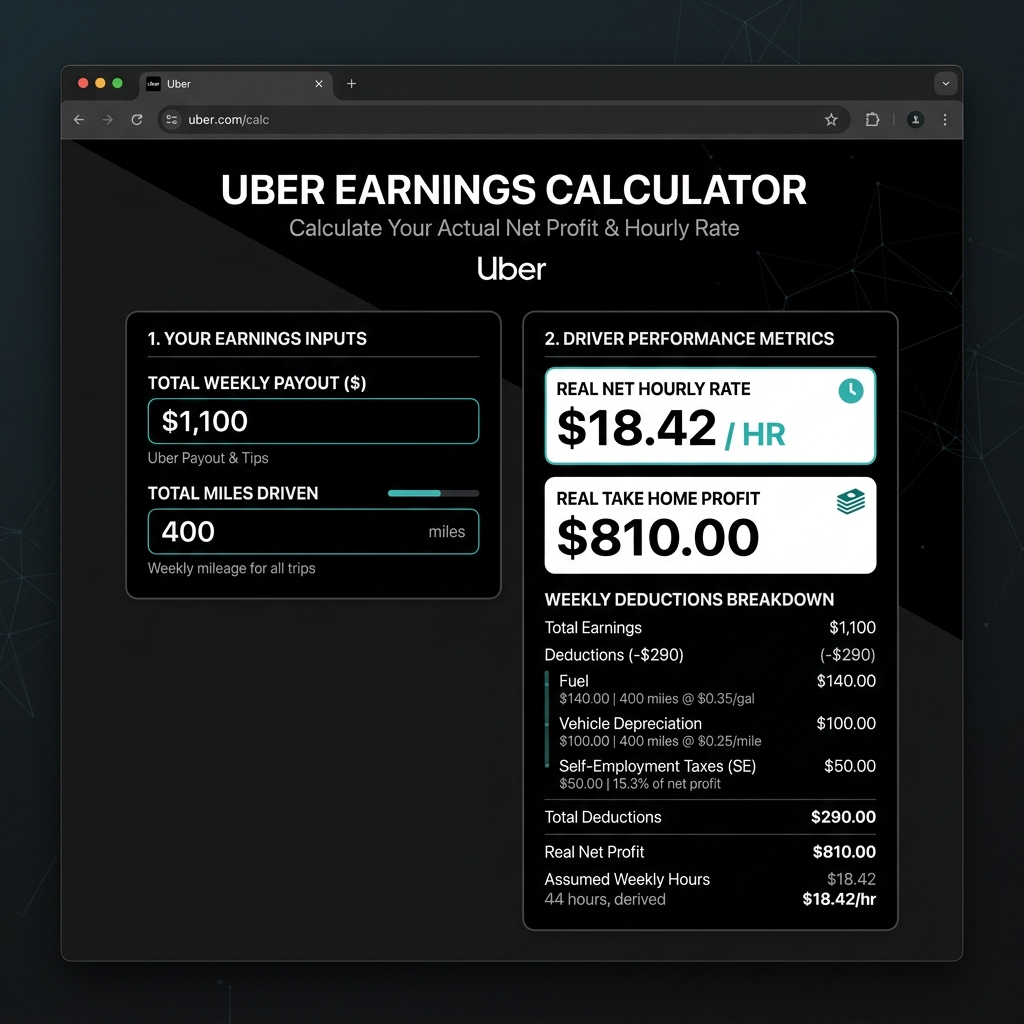
Uber Earnings Calculator

Find your real take-home pay after gas, expenses, and taxes. Uses the 2026 IRS mileage rate ($0.725/mile) and actual federal tax brackets.

100% Free · No Sign-Up Works for Uber, Lyft & DoorDash Updated April 2026
← Back to Calculators
Logistics Tool

Uber & Rideshare Earnings Calculator

Net Profit, Hourly Rate & Tax Estimate · 2026 IRS Rules

Updated for April 2026⚡ Instant Results
Rideshare Intelligence

Uber Earnings

Estimated Take Home

$0

Drive Parameters

hrs
$
$
$

All calculations run locally in your browser • No data stored • For estimation purposes only

What This Uber Driver Calculator Measures

Most online tools only show gross pay. This one shows the four numbers that actually matter.

Net Hourly Rate

Your real wage per hour after every expense and tax deduction. The number to benchmark against minimum wage.

Tax Reserve Amount

Exact quarterly estimated tax to set aside so you never face an IRS penalty at year-end.

Expense Breakdown

See exactly how much gas, maintenance, and Uber's commission eat into every dollar you earn.

Profit Margin %

What percentage of your gross earnings you actually keep. Healthy drivers target 35%+ after everything.

2026 Average Uber Driver Earnings — United States

$15–$25/hr
Gross before expenses
$10–$18/hr
Net after all costs & tax
$0.725/mi
2026 IRS mileage deduction
15.3%
Self-employment tax rate

The Real Guide to Uber Driver Earnings in 2026

What the app shows you — and what it hides

⏱ 23 min read

Last updated: June 2026

# Uber Earnings Calculator 2026: Your Real Take-Home Pay After Gas, Taxes & Every Hidden Cost

By Anmol Giri — Gig Economy Analyst & Financial Tools Developer Last updated: April 2026 · 12 min read · Updated for IRS $0.725/mile mileage rate

There's a specific kind of disappointment that hits Uber drivers around their fourth week on the platform. The app is showing decent weekly payouts. The schedule feels flexible. And then someone — maybe a spouse, maybe just a quiet Sunday afternoon — makes you actually sit down and do the math. Real math. Gas receipts, the oil change you paid for two weeks ago, the tyre rotation before that.

The number you land on is usually somewhere between uncomfortable and genuinely alarming.

This isn't a scare piece. Plenty of drivers in the right markets, working the right hours, with the right car, genuinely do earn a living from Uber. But the ones who do it profitably know something the others don't: your weekly Uber deposit is revenue, not income. What you actually keep — after fuel, wear, taxes, and Uber's cut — is a different and smaller number. And you only find it when you calculate it yourself.

That's the job of this page. Let's go through all of it.

What Uber Actually Pays You (And What They Keep)

Before anything else, understand the fee structure. Uber takes a service fee on every ride — this isn't a fixed percentage, which surprises a lot of drivers. It varies by market, ride type, and sometimes by individual trip characteristics.

The general range in 2026 is 20–28% of the total fare. Uber Black and premium services typically sit at the lower end of that range. Standard UberX in competitive markets often runs 25–27%. Some drivers in heavily saturated cities have reported effective take rates closer to 30% when all adjustments are calculated.

Here's what a single trip actually looks like when you break it down:

What the Rider PaysWhat Happens to It
Base fare + time + distance rateCalculated by Uber's algorithm
Booking/marketplace feeGoes straight to Uber (varies by city)
Surge pricing additionSplit — portion goes to driver
Tip (if any)100% goes to driver
Driver payoutTypically 72–80% of fare, plus 100% of tip
So if a rider pays $28 for a trip, you might receive $20.16 (72%) plus any tip they add. That $7.84 went to Uber before the money even hit your account. Every week, you're starting the profitability calculation from a number that's already 20–28% smaller than what riders actually paid.

The True Cost of Driving — Every Expense You Need to Track

This is where most drivers lose money without realising it. The expenses that hurt you most are the ones that don't feel like expenses in the moment.

Fuel Costs — The Variable You Watch Every Day

Fuel is the most visible cost, which means it's also the one most drivers actually track. But even here, the numbers are bigger than they seem at annual scale.

Vehicle TypeAvg MPG (City)Cost per Mile @ $3.50/galAnnual Cost (20,000 mi)
Large SUV (Suburban, Expedition)14 MPG$0.25/mile$5,000
Mid-size Sedan (Camry, Accord)28 MPG$0.125/mile$2,500
Compact Sedan (Civic, Corolla)35 MPG$0.10/mile$2,000
Hybrid (Prius, Camry Hybrid)52 MPG$0.067/mile$1,340
Electric Vehicle~$0.04/mi (charging)$0.04/mile$800
A Prius driver and an SUV driver doing the same shifts in the same city will net roughly $3,660 more per year just from fuel. That's before any other difference. Vehicle choice is a financial decision first and a comfort decision second.

Maintenance — The Expense That Sneaks Up on You

High mileage means accelerated maintenance. The schedule that made sense for your personal driving doesn't apply anymore.

Maintenance ItemNormal IntervalHigh-Mileage Uber IntervalEstimated Annual Cost
Oil change (synthetic)7,500 milesEvery 5,000–6,000 miles$240–$360
Tyre rotation8,000 milesEvery 6,000 miles$120–$200
New tyres (set of 4)40,000–60,000 milesEvery 25,000–35,000 miles$500–$900/yr prorated
Brake pads (front)30,000–50,000 milesEvery 20,000–30,000 miles$200–$400/yr prorated
Air filter15,000–30,000 milesEvery 12,000–15,000 miles$30–$60
Cabin air filter15,000–25,000 milesEvery 12,000 miles$20–$50
Wiper blades12 months6–8 months$30–$60
Total estimated annual maintenance$1,140–$2,030/yr
That works out to roughly $0.057–$0.10 per mile in maintenance alone. Combined with fuel, you're looking at $0.17–$0.35 per mile in pure operating costs — before tax, before insurance, before Uber's fee.

Vehicle Depreciation — The Invisible Killer

This one doesn't appear in your bank statement, but it's real. Every mile you put on your car is a mile that reduces its resale value.

The IRS 2026 mileage rate of $0.725/mile exists precisely because the government recognises this cost is real and significant. Of that 72.5 cents, approximately 35 cents is allocated to depreciation alone. On 20,000 annual Uber miles, that's $7,000 in vehicle value quietly disappearing each year.

Most drivers never feel this cost until the day they try to trade in and the dealer quotes them a number that stings. At that point, years of untracked depreciation hits all at once.

Other Deductible Business Expenses

These are smaller individually, but they compound over twelve months:

ExpenseMonthly EstimateAnnual TotalDeductible?
Rideshare insurance premium add-on$25–$45$300–$540Yes
Phone bill (business portion, ~80%)$40–$64$480–$768Yes
Car washes (weekly, $15 average)$60$720Yes
Parking fees$20–$80$240–$960Yes
Toll costs (net of rider reimbursement)$10–$40$120–$480Yes
Phone mount, accessoriesOne-time ~$30$30Yes
Dash camOne-time ~$80$80Yes
Total additional deductible expenses$1,170–$2,598/yr
These aren't huge on their own. Together, they're often $100–$200 per month coming out of your earnings that most drivers never formally track.

The 2026 IRS Mileage Rate Explained — $0.725 Per Mile

The single most powerful tax tool available to Uber drivers in 2026 is the IRS standard mileage deduction. Let's be very direct about how this works and why it matters so much.

The 2026 standard mileage rate is $0.725 per mile — up from $0.67 in 2024 and $0.655 in 2023. Each year the IRS adjusts this rate based on fuel costs, vehicle operating costs, and depreciation data. The upward trend in recent years reflects higher vehicle purchase prices and insurance costs.

How the Deduction Actually Works

You multiply your total business miles by $0.725. That total is deducted from your gross profit before you calculate taxes. It covers fuel, oil, maintenance, insurance, and depreciation — all in one number.

Annual Miles Driven for UberMileage Deduction ($0.725/mi)Tax Saved (at ~27% combined rate)
10,000 miles$7,250~$1,958
15,000 miles$10,875~$2,936
20,000 miles$14,500~$3,915
25,000 miles$18,125~$4,894
30,000 miles$21,750~$5,873
A driver doing 20,000 annual miles saves nearly $4,000 in taxes just from the mileage deduction alone. That's not a small number.

Standard Mileage vs. Actual Expenses — Which Is Better?

ScenarioStandard Mileage RateActual Expense Method
Fuel-efficient car (Prius, hybrid)Usually betterMay underperform
High-MPG sedan, moderate mileageUsually betterRoughly equal
Luxury vehicle with high operating costsMay be equalCan be better
SUV with poor fuel economyCan be comparableWorth calculating
Ease of useVery simpleRequires receipts for everything
FlexibilityFixed once chosen for that vehicleMore variables
The honest answer: for 85–90% of Uber drivers, the standard mileage rate produces a larger deduction and requires less record-keeping. Take it unless you drive an expensive vehicle with documented high costs.

What Miles Count?

This is where drivers commonly leave money on the table. Deductible miles include:

  • Miles driven while a passenger is in the car
  • Miles driven from your home to the first pickup of the day (if you're starting a business session)
  • Miles driven between trips while you're in driver mode looking for rides
  • Miles driven to a car wash for a business-related cleaning
  • Miles driven to a mechanic for a business-related repair
Miles that do not count: personal errands, commuting home after you've logged off the app, personal trips.

Track all of these. Apps like Stride, Everlance, or MileIQ do this automatically and cost less than a single tank of gas per month.

Self-Employment Tax in 2026 — The Full Breakdown

This is the tax that catches new gig drivers completely off guard. When you work a traditional job, your employer pays 7.65% of your wages toward Social Security and Medicare, and you pay another 7.65% through payroll deductions. You never see the employer half — it just happens.

When you're self-employed, you pay both halves. All 15.3%.

How Self-Employment Tax Is Calculated

StepCalculationExample ($20,000 net profit)
Start with net profitGross earnings minus all deductions$20,000
Apply 92.35% adjustmentNet profit × 0.9235$18,470
Calculate SE tax$18,470 × 15.3%$2,825.91
Deduct half of SE tax from income$2,825.91 ÷ 2 = $1,412.96Reduces taxable income
Effective SE tax on original profit$2,825.91 / $20,000~14.13%
So your effective self-employment tax rate is approximately 14.13% of net profit after deductions. This calculator applies every one of those steps automatically.

2026 Federal Income Tax Brackets (Single Filer)

Taxable IncomeTax Rate
$0 – $11,92510%
$11,926 – $48,47512%
$48,476 – $103,35022%
$103,351 – $197,30024%
$197,301 – $250,52532%
Over $250,52535–37%
Most full-time Uber drivers with no other income land in the 12% federal bracket after deductions. Part-time drivers supplementing another income may find their Uber profits pushed into 22%. That's why the filing status input in this calculator matters — your marginal bracket determines how hard each additional dollar gets taxed.

2026 Standard Deduction (Reduces Your Taxable Income Further)

Filing Status2026 Standard Deduction
Single$15,000
Married Filing Jointly$30,000
Head of Household$22,500
Married Filing Separately$15,000
A single filer with $20,000 in net profit after all deductions pays federal income tax only on the amount above $15,000 — so just $5,000 at 10%. That's $500. Combined with $2,826 in SE tax, total federal tax burden is roughly $3,326 on $20,000 net profit. Manageable — but only if you set it aside.

Uber Driver Earnings by City — 2026 Real Data

Location matters more than almost any other variable. Here's what drivers are actually reporting in major US markets in 2026:

CityAvg Gross/HourAvg Net After ExpensesNotes
New York City$28–$38$18–$25High fares, high costs, complex insurance
San Francisco$26–$35$16–$23Strong demand, high fuel costs
Chicago$22–$30$14–$20Good surge during events
Los Angeles$20–$28$13–$19Long dead-head miles, heavy traffic
Seattle$21–$29$14–$20Airport demand, weather surges
Miami$19–$27$12–$18Tourism-driven, seasonal
Austin$17–$24$11–$16Growing market, moderate fuel costs
Phoenix$15–$22$9–$14High heat = higher AC costs
Denver$17–$23$11–$16Event-driven surges
Nashville$16–$22$10–$15Tourism, weekend surge
Mid-size cities (avg)$14–$20$9–$13Lower rates, lower competition
Rural markets$12–$17$7–$11Low demand, high dead-head miles
These figures are before federal or state income tax. After SE tax and federal income tax, subtract another 20–25% from the net after expenses column depending on your total annual income and filing status.

Uber vs. Lyft vs. DoorDash — Which Platform Pays More After Expenses?

This calculator works for all gig platforms. Here's how the economics compare at a high level:

PlatformAvg CommissionTips Common?Peak DemandBest For
Uber (UberX)22–27%Yes, moderateRush hours, events, bad weatherDrivers in dense urban areas
Lyft20–25%Yes, similar to UberOverlaps with Uber, slightly less surgeMarkets where Lyft has higher user base
Uber Eats15–25%Yes, often higher % of orderLunch/dinner, weekendsDrivers wanting shorter trips
DoorDash15–30% (varies)Yes, very commonMeal times, late nightSuburbs, medium-density cities
Amazon FlexFlat rate blocksNoVaries by route blocksOrganised drivers, early mornings
InstacartVariableYes, often generousWeekends, grocery peaksDrivers comfortable with shopping
The most profitable strategy many full-time gig drivers use in 2026 is multi-apping — running Uber and Lyft simultaneously, switching to DoorDash or Uber Eats during slow rideshare periods. This keeps utilisation high and dead time low. The calculator handles combined income from multiple platforms — just add your total gross from all apps.

The Weekly Tracking System That Actually Works

The gap between profitable drivers and breaking-even drivers usually isn't hours worked or city. It's whether they track their numbers consistently.

Here's a simple weekly system that takes less than 10 minutes:

Step 1 — Pull Your Weekly Summary

Open your Uber Driver app → Earnings → Weekly. Note: gross earnings, total trips, total active miles (Uber logs this for you).

Step 2 — Log Your Cash Expenses

This week's gas total (check your bank statement or receipts). Any maintenance paid. Car wash total.

Step 3 — Run the Calculator

Enter your figures here. Note three numbers: effective hourly rate, quarterly tax reserve, profit margin.

Step 4 — Transfer Your Tax Reserve

Move the quarterly tax figure divided by 13 (weeks in a quarter) to a separate savings account. Right now, before you use any of that payout.

Step 5 — Compare to Last Week

Is your hourly rate improving or declining? If it dropped, which variable changed — fewer hours, lower demand, higher gas price, different driving area?
WeekGross EarnedMiles DrivenExpensesNet Hourly RateTax Set Aside
Apr 7$620380 mi$92$13.40/hr$78
Apr 14$710420 mi$105$14.20/hr$89
Apr 21$540510 mi$118$9.80/hr$62
Apr 28$680390 mi$98$13.90/hr$85
Week 3 in this example is a warning sign — more miles, less money, lower hourly rate. That's a shift worth examining. Did they chase surge into areas with heavy traffic? Did they do long trips to suburbs with empty returns? The data tells you where to look.

Quarterly Estimated Tax Calendar — 2026

Don't let this catch you by surprise. The IRS doesn't send reminders. These dates are fixed:

QuarterIncome PeriodPayment DueForm
Q1 2026January–MarchApril 15, 2026Form 1040-ES
Q2 2026April–MayJune 16, 2026Form 1040-ES
Q3 2026June–AugustSeptember 15, 2026Form 1040-ES
Q4 2026September–DecemberJanuary 15, 2027Form 1040-ES
Miss these and the IRS charges an underpayment penalty — roughly 8% annualised in 2026 on the amount you should have paid. On $3,000 in taxes, that's around $240 in avoidable penalties per quarter missed. Small, but pointless to pay.

Pay online at IRS Direct Pay (irs.gov). Takes four minutes. No account needed.

Platform-Specific Tax Tips for 2026

The New Qualified Tips Deduction (Effective from 2025 Tax Year)

Starting with income earned in 2025 (filed in 2026), Congress introduced a qualified tips deduction for workers in tipped service industries. This is new, not widely publicised, and potentially significant for Uber drivers who receive substantial tip income.

The deduction allows eligible workers to exclude a portion of tip income from federal income tax. The specific limits and phase-outs are still being clarified by IRS guidance, but drivers who receive significant tips should specifically ask their tax preparer about this deduction — or check IRS Publication 531 for 2026 guidance.

Uber's 1099 Forms — What You Receive and What to Do With Them

FormWhen You Get ItWhat It Reports
1099-KIf gross payments exceed $5,000Total trip payments processed
1099-NECIf promotions/bonuses exceed $600Referral bonuses, quests, promotions
Annual Tax SummaryAlways, regardless of amountDetailed breakdown for Schedule C
Important: the 1099-K reports gross fares — before Uber's commission. You deduct Uber's fees as a business expense on Schedule C. Many drivers panic when they see the 1099-K number because it's higher than what they were actually paid. This is normal. The fees are a legitimate deduction.

Filing Your Taxes — The Simple Version

As an Uber driver, you file:

  • Schedule C (Profit or Loss from Business) — where you report income and deduct expenses
  • Schedule SE (Self-Employment Tax) — where you calculate SE tax
  • Form 1040-ES (Quarterly Estimated Tax) — what you pay throughout the year
  • Form 8995 (if eligible) — the Qualified Business Income deduction, which can reduce taxable income by up to 20% for qualifying self-employed workers
Most drivers with straightforward situations can use TurboTax Self-Employed, H&R Block Premium, or similar software and file correctly without a CPA. If you have significant income, multiple platforms, a home office deduction, or a vehicle lease, a CPA for one year is worth the cost to set up your system correctly.

Honest Answers to the Questions Drivers Actually Search For

"Is Uber driving worth it in 2026?"

It depends on four things: your city, your vehicle, your hours, and your discipline with expenses. In a high-demand metro with a fuel-efficient car during peak hours, tracking every mile — yes, it can be worth $14–$20/hr after everything. In a rural market with an SUV during base-rate hours, you may not be covering your costs.

Use the break-even hourly rate from this calculator. If your area consistently can't support rates above that threshold, Uber isn't the right fit as a primary income source. As a side hustle filling specific peak windows, the calculus changes.

"How much should I set aside for taxes as an Uber driver?"

The standard guidance is 30–35% of every payout. This covers self-employment tax (~14%) and federal income tax (10–22% for most drivers). If you're in a high-tax state (California, New York, New Jersey, Oregon), add another 5–9% for state income tax and set aside 35–40% total.

Set it aside immediately, every week. Not at the end of the quarter. Weekly.

"Does Uber track my mileage or do I need to do it myself?"

Uber logs your miles while passengers are in the car, and this appears in your annual tax summary. But this number is almost always less than your actual deductible miles. You can also deduct miles driven between trips while you're in driver mode, miles to the first pickup, and miles for business-related errands.

Use a dedicated mileage tracking app from day one. Stride is free. Everlance and MileIQ have free tiers that cover most drivers. The deductible miles you miss by relying only on Uber's summary often translate to $500–$1,500 in additional tax savings per year.

"Can I deduct my car payment?"

No — not under the standard mileage method. The mileage rate already includes a depreciation component. If you use the actual expense method, you can deduct a portion of lease payments, but you cannot deduct loan payments on a purchased vehicle (you deduct depreciation instead).

"What if I drive for both Uber and Lyft?"

Combine everything on a single Schedule C — it's all "rideshare driving" as one business activity. Combined gross earnings, combined miles, combined expenses. The IRS doesn't require separate filings per platform.

UK, Canada, and Australia — How to Adapt This Calculator

The expense logic, hourly rate calculation, and break-even analysis in this tool work exactly the same everywhere. What changes is the tax side.

United Kingdom

UK Uber drivers are self-employed and pay:

  • Income Tax: 20% on profits between £12,570–£50,270 (basic rate, 2025/26)
  • National Insurance (Class 4): 6% on profits between £12,570–£50,270 (reduced from 9% in 2024)
  • National Insurance (Class 2): Abolished from April 2024 — no longer payable
  • HMRC mileage rate: 45p per mile for the first 10,000 miles, 25p per mile thereafter
Use this calculator to find your net profit figure, then apply UK rates manually. Your effective UK tax rate on gig profit typically runs 26–28% combined (income tax + NI) for basic rate taxpayers.

Canada

Canadian Uber drivers file as self-employed on their T1 return:

  • Federal income tax: Starts at 15% on the first $55,867 (2026 rates)
  • CPP contributions: 11.9% on net self-employment income up to the Year's Maximum Pensionable Earnings
  • Provincial tax: Varies by province — Ontario is ~9.15% at lower brackets, BC ~7.7%
  • GST/HST: Register for GST/HST immediately upon starting. You can claim input tax credits on business expenses.
  • CRA mileage rate: 70 cents per kilometre for 2026 (first 5,000 km), 64 cents thereafter
Total effective rate for most Canadian Uber drivers: 35–45% including CPP. Higher than US, but healthcare is covered.

Australia

Australian Uber drivers must register for GST from day one of driving — the standard $75,000 threshold does not apply to rideshare.

  • GST: Add 1/11th of earnings to ATO quarterly through Business Activity Statement
  • ATO mileage rate: 88 cents per kilometre for 2025/26 (up from 85 cents)
  • Income tax: Starts at 19% on income between $18,201–$45,000 (2025/26)
  • Medicare levy: Additional 2% on most income
  • GST input credits: Claim back GST on fuel and business expenses

The Bottom Line — Real Numbers, Real Decisions

Here's the thing nobody in the gig economy space wants to say plainly: Uber driving is a business. The flexibility is real. The income potential is real. But so is the cost structure — and that cost structure is more complex and significant than the app's weekly summary suggests.

Driver TypeGross/WeekExpenses/WeekTaxes/Week (est.)Real Take-Home/Week
Casual (10 hrs, suburban)$180$55$35$90
Part-time (20 hrs, mid-city)$380$95$72$213
Serious (30 hrs, urban)$650$140$120$390
Full-time (45 hrs, major city)$1,100$210$198$692
Top earner (45 hrs, NYC/SF, peak hours)$1,600$230$290$1,080
The "top earner" in that table is working 45 hours, knows their surge patterns inside out, drives a hybrid, multi-apps between Uber and Lyft, and tracks every deductible mile. They're not lucky. They're running a real small business with real discipline.

The casual driver taking home $90 on 10 hours isn't making $9/hr. They're making $9/hr if they tracked their depreciation and tax obligation — and most don't. Add those back and they might be closer to $7/hr or below minimum wage in some states.

Use this calculator with your actual numbers. Not estimates from articles. Not what your friend says they make. Your car, your city, your hours, your tax situation. The result will tell you whether the shifts you're working are building something or slowly costing you.

That's information worth having before you drive another mile.

About the Author

Anmol Giri is a gig economy analyst and financial tools developer who has been building income calculators for independent contractors since 2022. His tools are used by Uber, Lyft, DoorDash, and Amazon Flex drivers across the United States, United Kingdom, Canada, and Australia to understand their real take-home income.

He focuses specifically on the gap between what gig platforms report and what drivers actually keep — a gap that costs the average driver hundreds to thousands of dollars per year in missed deductions and under-saved taxes.

All calculators on this site are updated quarterly to reflect current IRS rates, federal tax brackets, and platform commission structures. Tax information is for planning purposes and does not constitute professional tax advice. For complex tax situations, consult a licensed CPA or enrolled agent familiar with gig economy taxation.

Sources: IRS Notice 2026-10 (standard mileage rate), IRS Revenue Procedure 2025-32 (2026 tax brackets), IRS Publication 463 (vehicle deductions), IRS Schedule SE instructions (self-employment tax), IRS Form 1040-ES (estimated tax), Gridwise 2026 Driver Earnings Report, Wealthvieu 2026 Uber Driver Salary Analysis, Salary.com April 2026 Uber Driver Compensation Data.

Last updated: April 2026. IRS mileage rate: $0.725/mile. This content is reviewed and updated when IRS rates or federal tax brackets change.

Frequently Asked Questions

Uber Driver Earnings —
Common Questions Answered

Real answers, not the vague stuff Uber puts in its help centre.

It's your final take-home pay after deducting every operating expense — gas, maintenance, phone, cleaning — plus self-employment tax and estimated federal income tax, divided by total hours worked. This is the only number that tells you whether driving is actually worth your time.

The IRS standard mileage rate for 2026 is $0.725 per mile (72.5 cents). This is up from $0.67 in 2024. For every 1,000 miles you drive for Uber, you can deduct $725 from your taxable income — covering fuel, maintenance, insurance, and depreciation in a single calculation.

For accuracy, include: gas, oil changes, tire rotations, brake work, rideshare insurance premiums, your phone bill (business portion), car washes, tolls, parking, and a vehicle depreciation estimate. Many drivers forget depreciation — driving 1,000 miles costs roughly $150–$200 in hidden vehicle wear.

Yes. The calculator applies the full 15.3% SE tax (Social Security + Medicare) using 2026 IRS rules. It also automatically applies the 7.65% deduction adjustment that reduces your taxable income before calculating SE tax — the same method your CPA would use.

Absolutely. The self-employment tax, IRS mileage deduction, and federal income tax logic is identical for all gig platforms. Just enter your earnings from any platform — or combine them if you multi-app.

Weekly is ideal. Gas prices fluctuate, surge income varies, and your expenses change. Drivers who check their real hourly rate weekly make better decisions about when and where to drive — and catch unprofitable shifts before they become a habit.

The expense and hourly rate calculations apply universally. The tax section specifically models US federal tax rules (IRS). UK, Canadian, and Australian drivers should use the net profit figure and apply their own local tax rates for a final take-home number.

More Free Calculators

More Tools for Gig Drivers

Lyft, DoorDash, Instacart, Amazon Flex — the same tax rules apply.

Related Calculators You Might Find Useful

Explore more tools to calculate smarter and plan better