US · UK · Canada · Australia · 2026 Law

Overtime Pay Calculator

1.5× Time and a Half · 2× Double Time · Custom Rate · Gross & Net Pay

Calculate your exact overtime pay for any hourly rate — standard FLSA time and a half (1.5×), California daily double time (2×), or your custom contract rate. Get gross and estimated net take-home pay in seconds. Covers US, UK, Canada, and Australia.

4.9/5 · 8,412 users 1.5× & 2× & Custom Net after-tax estimate California daily OT rules OBBBA deduction guide 100% free · no sign-up
← Back to Calculators
Earnings Tool

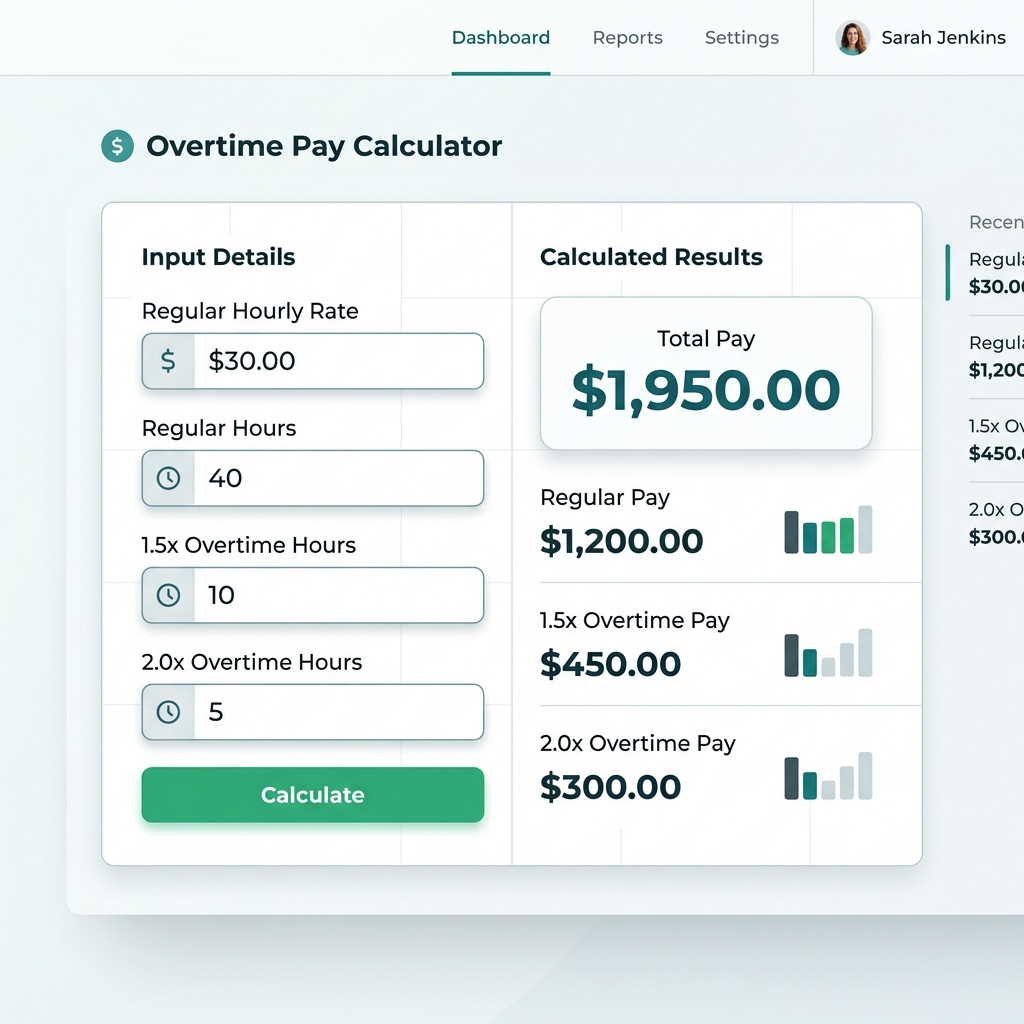
Overtime Pay Calculator 2026

1.5× Time and a Half · 2× Double Time · Custom Rate · Gross & Net Pay · FLSA · Fair Work · UK · Canada

Updated for May 2026⚡ Instant Results

All calculations run locally in your browser • No data stored • For estimation purposes only

Overtime Pay Quick Reference — Common Hourly Rates at 1.5× and 2×

Based on a standard 40-hour workweek · 10 overtime hours worked · before tax

Regular Rate1.5× OT Rate2× Double TimeRegular Pay (40hr)10hr OT Pay (1.5×)Weekly Total
$12/hr$18.00/hr$24.00/hr$480$180$660
$15/hr$22.50/hr$30.00/hr$600$225$825
$17/hr$25.50/hr$34.00/hr$680$255$935
$18/hr$27.00/hr$36.00/hr$720$270$990
$20/hr$30.00/hr$40.00/hr$800$300$1,100
$22/hr$33.00/hr$44.00/hr$880$330$1,210
$25/hr$37.50/hr$50.00/hr$1,000$375$1,375
$30/hr$45.00/hr$60.00/hr$1,200$450$1,650
$35/hr$52.50/hr$70.00/hr$1,400$525$1,925
$40/hr$60.00/hr$80.00/hr$1,600$600$2,200
$50/hr$75.00/hr$100.00/hr$2,000$750$2,750
$75/hr$112.50/hr$150.00/hr$3,000$1,125$4,125

All figures before tax. Use the calculator above for your exact hours, rate, and net take-home pay.

2026 Overtime Law — Key Numbers at a Glance

40 hrs/wk
US FLSA weekly overtime threshold (federal)
$35,568/yr
Federal salary OT exemption threshold (2026)
38 hrs/wk
Australia Fair Work standard weekly hours
£12.21/hr
UK National Minimum Wage floor across all OT hours

Overtime Pay Rules by Country & State — 2026

This calculator applies the correct threshold for your selected country. State-specific rules override federal FLSA where more favourable to the worker.

JurisdictionWeekly OT ThresholdDaily OT ThresholdStandard RateDouble Time?Governing Law
🇺🇸 US Federal (FLSA)40 hrsNone1.5×Not requiredFLSA 1938
🇺🇸 California40 hrs8 hrs/day1.5× (daily & weekly)2× over 12hrs/dayCA Labor Code §510
🇺🇸 Alaska40 hrs8 hrs/day1.5×Not requiredAS 23.10.060
🇺🇸 Nevada40 hrs8 hrs/day*1.5×Not requiredNRS 608.018
🇺🇸 Colorado40 hrs12 hrs/day1.5×Not requiredCOMPS Order #39
🇺🇸 Washington40 hrsNone1.5×Not requiredRCW 49.46
🇺🇸 New York40 hrsNone1.5×Not requiredNY Labor Law §160
🇨🇦 Ontario44 hrsNone1.5×Not mandatedOntario ESA 2000
🇨🇦 British Columbia40 hrs8 hrs/day1.5× (daily & weekly)2× over 12hrs/dayBC Employment Standards
🇨🇦 Quebec40 hrsNone1.5×Not mandatedAct re Labour Standards
🇬🇧 United KingdomContractualNone mandatedContract-basedContractual onlyWorking Time Regs 1998
🇦🇺 Australia (Fair Work)38 hrsNone statutory1.5× first 2 OT hrs2× after 2 OT hrsFair Work Act 2009
🇳🇿 New Zealand~40 hrsNone mandatedContract-based (1.5×)ContractualEmployment Relations Act

*Nevada daily OT applies only to employees earning less than 1.5× the state minimum wage. Always verify with your state labor board — rules may be updated mid-year.

Overtime Exemption Salary Thresholds by State — 2026

Employees earning below the threshold in their state must receive overtime pay regardless of job title. The higher of federal or state threshold applies.

State / FederalWeekly ThresholdAnnual ThresholdApplies to
Federal (FLSA)$684/week$35,568/yearAll covered non-exempt employees
California$1,352/week$70,304/yearAll CA employees (2× state min wage)
Washington State$1,541.70/week$80,168/yearWA white-collar exemption
Colorado$1,111.23/week$57,784/yearCO COMPS Order employees
New York (NYC)$1,275/week$66,300/yearNYC & Nassau/Suffolk/Westchester counties
Alaska$684/week$35,568/yearMirrors federal threshold (no higher state threshold)
Nevada$684/week$35,568/yearMirrors federal threshold

Sources: US DOL FLSA regulations · California DIR · WA L&I · CO CDLE · NY DOL (2026 figures).

How Overtime Pay Works in 2026 — Complete Guide for Employees & Employers

FLSA formula · Salaried OT · California daily rules · OBBBA deduction · Commission workers · Industry-specific rules

~12 min readEarnings Guide · Worldwide

How Overtime Pay is Calculated — The FLSA Formula

In the United States, the Fair Labor Standards Act (FLSA) requires employers to pay covered, non-exempt employees overtime at a rate of at least one and one-half times (1.5×) their regular rate of pay for every hour worked beyond 40 in a single workweek. This threshold has remained at 40 hours since the FLSA was enacted in 1938.

The Standard Overtime Formula (used by all FLSA-covered employers)

Step 1: Overtime Rate = Regular Hourly Rate × 1.5

Step 2: Overtime Pay = Overtime Rate × Overtime Hours

Step 3: Regular Pay = Regular Rate × 40

Step 4: Weekly Total = Regular Pay + Overtime Pay

Example: $20/hr · 50 hours worked → OT rate: $30/hr · OT pay: $300 (10hrs × $30) · Regular: $800 · Weekly: $1,100

1.5× Time and a Half vs 2× Double Time — When Each Rate Applies

Federal FLSA law only mandates the 1.5× rate. Double time (2×) is not a federal requirement but applies in California by state law, in certain other states by regulation, and in many workplaces through union collective bargaining agreements or individual employment contracts.

Time and a Half (1.5×) applies when:

  • US federal FLSA: hours over 40 per workweek
  • California: hours over 8 in a single workday
  • Alaska: hours over 8 in a single workday
  • British Columbia: hours over 8/day or 40/week
  • Canada (Ontario): hours over 44 per week
  • Australia: first 2 overtime hours per day (most awards)
  • Most UK contracts: standard overtime rate
  • 7th consecutive workday in CA (first 8 hours)

Double Time (2×) applies when:

  • California: hours over 12 in a single workday
  • California: hours over 8 on the 7th consecutive workday
  • British Columbia: hours over 12 in a single workday
  • Australia: after the first 2 overtime hours (most awards)
  • Many union agreements: Sundays and public holidays
  • Some UK contracts: bank holidays and extreme hours
  • Some US retail contracts: holiday trading periods
  • Healthcare sector: some collective agreements

3 Real Overtime Calculation Examples — Step by Step

The fastest way to understand overtime is to walk through real scenarios. Below are three common situations workers face, calculated exactly.

1Standard FLSA overtime — $20/hr · 50 hours worked

Regular hours: 40 × $20 = $800.00

Overtime hours: 10 (hours 41–50)

OT rate: $20 × 1.5 = $30.00/hr

OT pay: 10 × $30 = $300.00

Weekly gross pay

$1,100

($800 regular + $300 overtime)

2California daily overtime — $25/hr · 13 hours in one day

Hours 1–8: 8 × $25 = $200.00 (regular)

Hours 9–12: 4 × $37.50 = $150.00 (1.5×)

Hour 13: 1 × $50 = $50.00 (2×)

Daily gross pay

$400

vs $325 under federal rules only

3Salaried non-exempt — $600/week salary · 50 hours worked

Effective hourly: $600 ÷ 40 = $15.00/hr

OT rate: $15 × 1.5 = $22.50/hr

OT pay: 10 × $22.50 = $225.00

Total: $600 + $225 = $825.00

Weekly gross pay

$825

Salary $600 + OT $225

Salaried Employees and Overtime — The Most Misunderstood Rule

The single most common and costly overtime misconception is that being paid a salary automatically means no overtime. Under federal FLSA, this is only true if you meet all three conditions of an exemption test:

  1. Salary basis test: you are paid a fixed predetermined salary
  2. Salary level test: your salary is at least $684/week ($35,568/year) under federal law — or the higher state threshold if applicable
  3. Duties test: your primary job duties meet the definition of executive, administrative, or professional work

All three must be satisfied. A high salary alone does not create an exemption. An employee titled "manager" who earns $700/week but primarily performs non-exempt work may still be owed overtime if the duties test fails.

For non-exempt salaried employees: divide weekly salary by 40 to get the effective hourly rate, then multiply by 1.5 to find the overtime rate. The calculator above handles this conversion automatically.

The 2025 OBBBA Overtime Tax Deduction — What Most Workers Don't Know

The One Big Beautiful Bill Act (P.L. 119-21), signed in 2025, introduced a new federal tax deduction specifically for overtime workers — effective for tax years 2025 through 2028, meaning it will appear on your 2026 tax return for the first time.

OBBBA Overtime Deduction — Key Rules (P.L. 119-21)

What is deductibleThe overtime premium only — the extra 0.5× portion of OT pay
Single filersDeduct up to $12,500/year from federal taxable income
Married filing jointlyDeduct up to $25,000/year from federal taxable income
Who qualifiesFLSA non-exempt hourly workers with W-2 overtime income
Does NOT apply toCalifornia state-law double time, contractual OT, self-employed
Tax saving example$12,500 deduction at 22% bracket = $2,750 federal tax saved
Where to claimForm 1040, Schedule 1 — ask your tax preparer
Runs untilDecember 31, 2028 — may not be renewed after that

Source: P.L. 119-21 (One Big Beautiful Bill Act, 2025). IRS official guidance published 2025. Consult a qualified tax professional before claiming.

Overtime for Commission and Bonus Workers — The Regular Rate of Pay

When an employee earns commissions, non-discretionary bonuses, or piece-rate pay in addition to hourly wages, overtime cannot simply be calculated on the base hourly rate. The FLSA requires overtime to be based on the employee's regular rate of pay— which includes all remuneration except the specific exclusions listed in FLSA §7(e).

The correct calculation method for mixed-compensation employees:

  1. Add all compensation for the week (wages + commission + non-discretionary bonus)
  2. Divide by total hours worked (including overtime hours) to get the regular rate
  3. Multiply the regular rate by 0.5 (not 1.5) — this "half-time" additional pay covers the overtime premium. The straight-time portion was already included in the total compensation figure
  4. Multiply by overtime hours

Commission worker example:

Worker earns $600 base + $200 commission = $800 total compensation, working 50 hours.

Regular rate = $800 ÷ 50 hours = $16.00/hr

Overtime premium = $16 × 0.5 = $8.00/hr additional for overtime hours

Additional OT pay = $8 × 10 OT hours = $80.00

Weekly total = $800 + $80 = $880.00

Note: Using a straight $600 × 1.5 method would underpay this employee under FLSA.

Industry-Specific Overtime Rules — Healthcare, Trucking & Retail

While most non-exempt workers follow the standard FLSA 40-hour-per-week rule, several industries have unique provisions that change when and how overtime is calculated.

Healthcare and Hospital Workers — The 14-Day Work Period (FLSA §7(j))

Hospitals and residential care establishments may, by prior agreement with employees, use a 14-day work period instead of a 7-day workweek for overtime purposes. Under this arrangement, overtime is owed only for hours over 8 in a single day or 80 in a 14-day period — whichever produces more overtime pay. This is commonly misapplied in hospital settings, and many healthcare employers have faced class-action suits for failing to pay overtime correctly under §7(j).

Trucking — Motor Carrier Act Exemption

Interstate truck drivers whose employer is subject to the Motor Carrier Act are generally exempt from FLSA overtime (Section 13(b)(1)). This applies to drivers operating vehicles over 10,001 lbs GVWR on interstate routes. However:

  • Intrastate drivers (operating within a single state) are not covered by the MCA exemption and may be entitled to state overtime
  • Drivers of vehicles under 10,001 lbs GVWR (small package delivery, etc.) are generally not exempt
  • California does not recognise the MCA exemption for state overtime purposes

Retail and Commissioned Sales — The §7(i) Retail Exemption

Retail or service establishment employees may be exempt from overtime under FLSA §7(i) if: (1) their regular rate exceeds 1.5× the federal minimum wage, and (2) more than half of their compensation in a representative period comes from commissions. If both conditions are met, the employer can pay without the normal 1.5× overtime premium. This is separate from the standard white-collar exemptions.

California Anti-Pyramiding Rule

California Labor Code prohibits "pyramiding" — adding daily overtime hours to weekly overtime hours to inflate the total overtime obligation. If an employee works 10 hours on Monday (2 daily OT hours) and 30 hours the rest of the week (40 total), the employer owes overtime for 2 hours (daily), not 0 additional hours weekly (because the weekly threshold was not exceeded). The daily OT already covers the obligation — it is not added on top of any weekly overtime calculation.

FLSA rules verified via US DOL · OBBBA deduction via P.L. 119-21 · California thresholds via DIR · Updated May 2026.

Related Calculators You Might Find Useful

Explore more tools to calculate smarter and plan better

Frequently Asked Questions

Overtime Pay — Common Questions Answered

FLSA rules · California daily OT · OBBBA deduction · Salaried workers · UK & Australia

Under the FLSA, overtime pay is calculated as: Overtime Rate = Regular Rate × 1.5. Overtime Pay = Overtime Rate × hours worked over 40. For example, a $20/hr worker clocking 50 hours earns: $30/hr × 10 overtime hours = $300 in overtime, plus $800 for 40 regular hours = $1,100 gross weekly pay. State laws like California may trigger overtime sooner (over 8 hours in a single day).

The federal FLSA salary threshold for overtime exemption is $684 per week ($35,568 per year) as of 2026. Employees earning below this threshold must be paid overtime regardless of their job title or duties. California sets its own threshold at $1,352/week ($70,304/year) — nearly double the federal level. Washington state sets $1,541.70/week, Colorado $1,111.23/week, and New York City $1,275/week.

No. Overtime is taxed as ordinary income at your marginal rate — not at a separate, higher 'overtime tax rate.' However, extra earnings can push more of your income into a higher bracket. Starting with the 2025 tax year, the OBBBA (P.L. 119-21) lets non-exempt workers deduct the overtime premium (the extra 0.5× portion only) from federal taxable income — up to $12,500 if single or $25,000 if married filing jointly. This deduction runs through 2028.

Yes — salaried employees earning under $684/week ($35,568/year) under federal law are non-exempt and must receive overtime. To calculate: divide the weekly salary by 40 to get the effective hourly rate, then multiply by 1.5. Example: $600/week ÷ 40 = $15/hr effective rate. Overtime rate: $15 × 1.5 = $22.50/hr. California employees earning under $1,352/week are similarly entitled to overtime regardless of federal rules.

California Labor Code §510 requires overtime at 1.5× the regular rate for hours over 8 in any single workday, and double time (2×) for hours over 12 in a day. On the 7th consecutive day in a workweek, the first 8 hours pay 1.5× and anything beyond 8 hours pays 2×. California also prohibits 'pyramiding' — daily overtime hours cannot be double-counted against weekly overtime hours.

Four US states require daily overtime in 2026: California (over 8 hours/day), Alaska (over 8 hours/day), Nevada (over 8 hours/day for workers earning under 1.5× the minimum wage), and Colorado (over 12 hours/day). All other states follow federal FLSA, which uses only the 40-hour weekly threshold.

Workers receiving non-discretionary bonuses or commissions must have those payments factored into their 'regular rate of pay' before calculating overtime. The correct method: add all compensation (wages + bonus/commission) for the week, divide by total hours worked to get the true regular rate, then multiply by 0.5 to get the additional overtime half-rate (the straight-time portion was already paid). This 'half-time' method is often the correct approach under FLSA §7(e).

The One Big Beautiful Bill Act (P.L. 119-21), signed in 2025, lets non-exempt hourly workers deduct the overtime premium — the extra 0.5× portion of their overtime pay — from federal taxable income. The deduction is capped at $12,500 (single) or $25,000 (married filing jointly) per year and runs through 2028. It applies only to FLSA-mandated overtime premiums. California state-law double-time or contractual overtime premiums do not qualify for this federal deduction.

UK law (Working Time Regulations 1998) does not mandate a minimum overtime premium rate. Your overtime rate comes from your employment contract. However, average hourly pay across all hours worked (including overtime) must not fall below the 2026 National Minimum Wage of £12.21/hr (age 21+) or £10.00/hr (ages 18–20). Most UK contracts specify 1.25×, 1.5×, or 2× for different overtime conditions and bank holidays.

Under the Fair Work Act 2009 and most Modern Awards, Australian full-time employees are paid 1.5× for the first two overtime hours and 2× for hours beyond that per day. Ordinary hours are 38 per week. Public holiday work typically attracts 2.5× under most awards. Part-time employees may have different award conditions. Casual employees usually have a loading built in and different overtime thresholds.