Compound Interest Calculator
Discover the magic of compound interest. See exactly how your initial investment and monthly contributions can grow into life-changing wealth over time.
Growth Engine
Investment Details
The S&P 500 has historically returned an average of about 10% annually before inflation (or 7-8% adjusted for inflation).
Future Portfolio Value
$345,742
Total Principal
$130,000
Interest Earned
+$215,742
In year 20, your money earns $26,284 in interest alone! This is the power of compounding.
What is Compound Interest?
Albert Einstein famously called compound interest the "eighth wonder of the world," stating: "He who understands it, earns it; he who doesn't, pays it."
When you invest money, you earn interest on your principal balance. In the next period, you earn interest on your principal plus the interest you just earned. This creates a snowball effect where your wealth grows exponentially, allowing ordinary people to become millionaires over a lifetime of consistent investing.
How to Use the Compound Interest Calculator
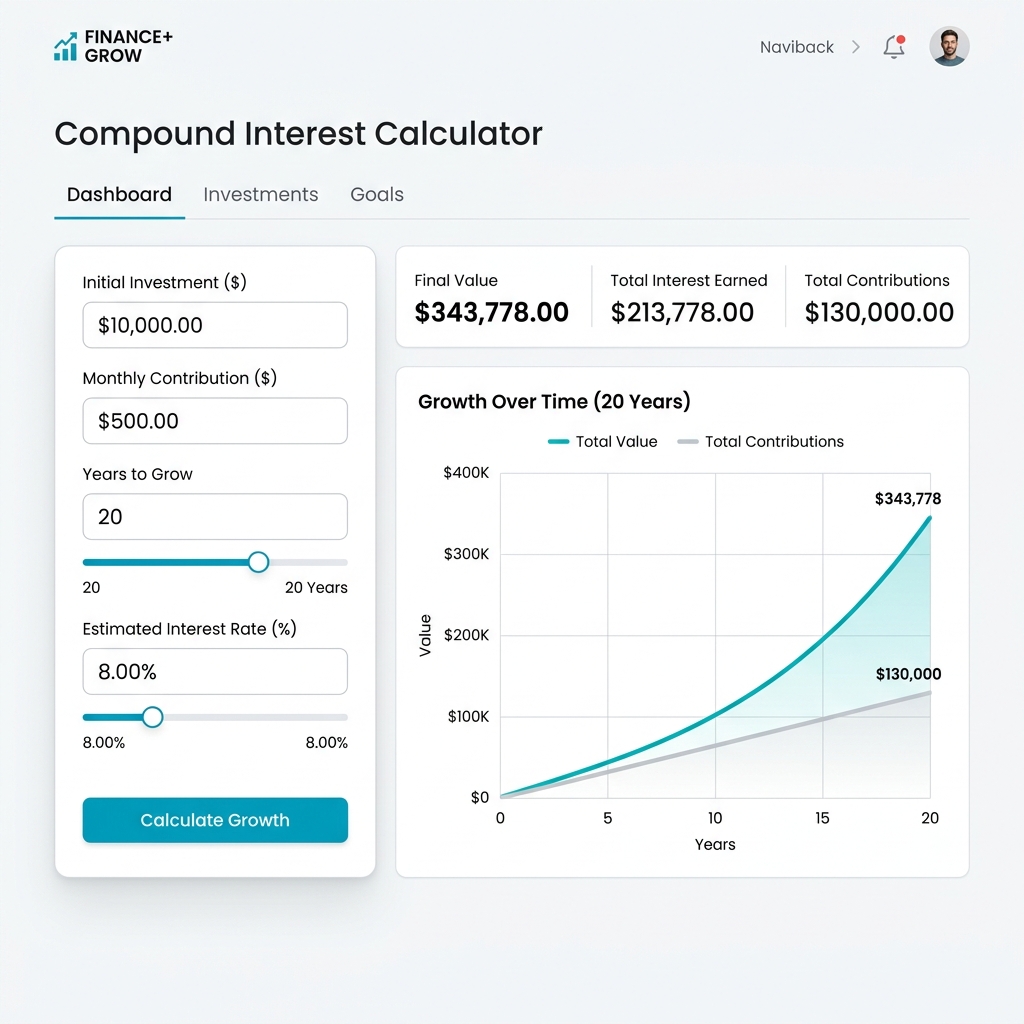
- Initial Investment: Enter the starting amount you currently have saved or intend to invest right now.
- Monthly Contribution: Enter how much you plan to consistently add to the account every month.
- Years to Grow: The time horizon you plan to leave the money invested without touching it. (e.g., 20 or 30 years).
- Estimated Interest Rate: The annual percentage yield (APY) you expect to earn. A diversified index fund typically aims for 7-10% long-term.
The Compound Interest Formula
To calculate future value with both an initial principal and regular monthly contributions, the math gets slightly complex. It combines the compound interest formula with the future value of an annuity formula.
| Variable | Meaning |
|---|---|
| A | The total Future Value of the investment. |
| P | The Principal (Initial Investment). |
| PMT | The monthly contribution amount. |
| r & n & t | Annual interest rate (r), times compounded per year (n), and total years (t). |
Example Compound Growth Projection
Let's see exactly how powerful consistency is. Imagine you start with $10,000 today, and you contribute just $500 every month for 20 years. You achieve an average historical market return of 8% annually.
Step 1: Calculate Your Contributions
Over 20 years, you make 240 monthly payments of $500, plus your initial $10,000.
Step 2: Add Compound Interest Magic
Because your money was invested at 8% and continuously reinvested, the interest snowball completely overtakes your principal contributions.
Step 3: Final Breakdown
Understanding Your Results
When you look at your results chart, you will notice that the growth curve starts out relatively flat, but bends upward sharply in the later years. This is the defining characteristic of exponential growth.
The Cost of Waiting
If you wait just 5 years to start investing, you don't just miss out on 5 years of growth—you miss out on the most profitable 5 years of compounding at the very end of your time horizon. Time in the market is vastly more important than timing the market.
Important Limitations
This calculator assumes a constant, fixed interest rate. In the real world, the stock market is highly volatile—you might lose 20% one year and gain 30% the next. Furthermore, this calculator does not account for inflation, which will reduce the purchasing power of your future wealth.
Common Investing Mistakes
1. Keeping cash under the mattress
With inflation historically averaging 3% a year, leaving your savings in a 0% interest checking account guarantees that your money is losing value every single day.
2. Interrupting compounding unnecessarily
The late Charlie Munger famously said, "The first rule of compounding: Never interrupt it unnecessarily." Pulling your money out of the market out of fear resets your compounding curve.
3. Underestimating fees
A 2% management fee from a financial advisor doesn't sound like much, but over 30 years, that tiny fee can literally eat up 40% of your total potential wealth. Stick to low-cost index funds when possible.
Frequently Asked Questions
What is compound interest?
Compound interest is the interest you earn on both your original money (the principal) and on the interest you've already earned. It's why investments grow exponentially over time rather than linearly.
How often should interest compound?
The more frequently interest compounds, the faster your money grows. Daily compounding is better than monthly compounding, which is better than annual compounding. However, the most critical factor is the amount of time you leave the money invested.
What is a realistic interest rate to use?
Historically, the U.S. stock market (S&P 500) has returned an average of around 9-10% annually before inflation. For conservative estimates, financial advisors often recommend using 6% or 7% to account for inflation and market volatility.
Does starting early really make a big difference?
Absolutely. Time is the most important variable in the compound interest formula. Investing $100 a month starting at age 20 will yield significantly more wealth at retirement than investing $500 a month starting at age 40.
Related Calculators
Author / Reviewer: Anmol Giri
Last updated: August 2026