401(k) Calculator
Visualize your future wealth. This 401(k) calculator estimates your retirement balance by factoring in your salary, employer match, and the power of compound interest over time.
401(k) Details
Adjust Your Numbers
Employer Match
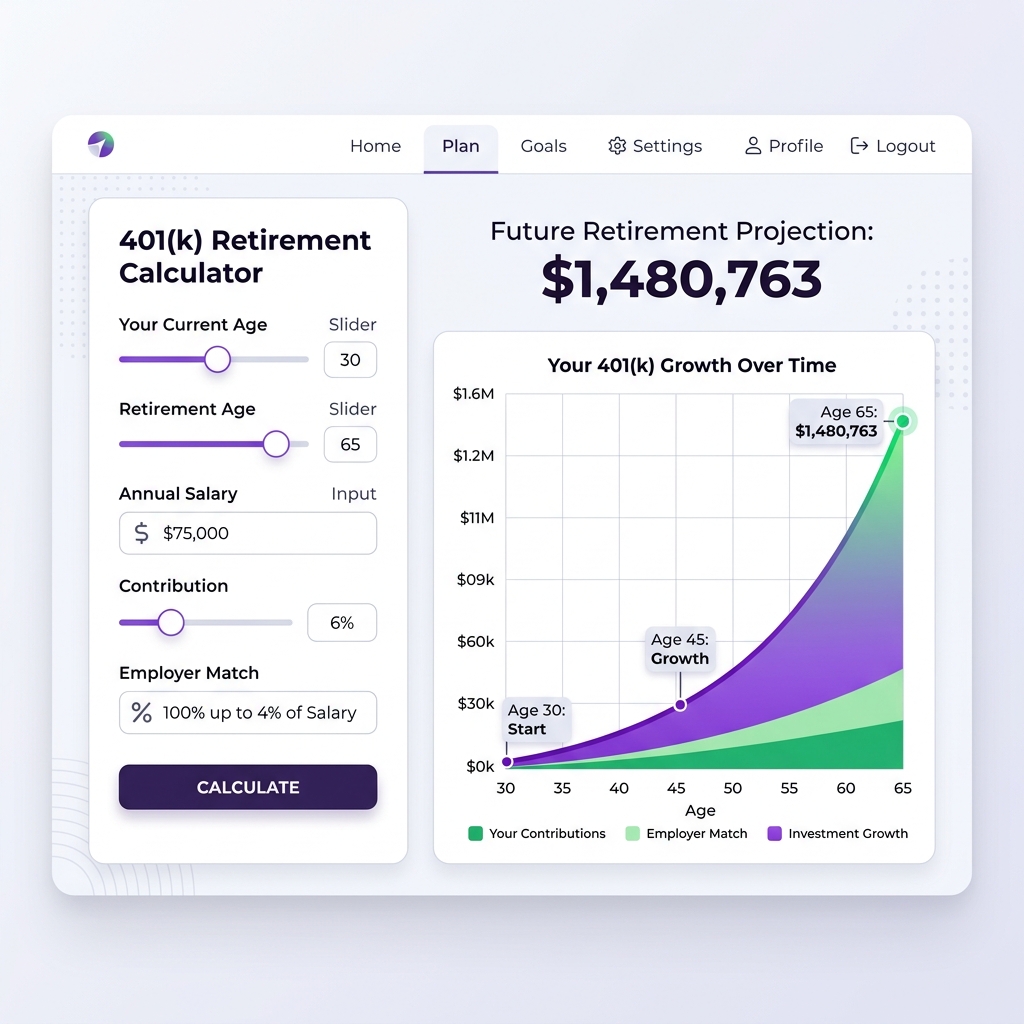
Future Projection
$1,480,763
Estimated balance at age 65 (35 years from now)
Total Free Money
$152,983
from employer match
You Contributed
$239,475
Employer Match
$152,983
Inv. Growth
$1,088,306
What is a 401(k)?
A 401(k) is an employer-sponsored retirement savings plan that allows workers to save and invest a piece of their paycheck before taxes are taken out. Taxes aren't paid until the money is withdrawn from the account (in retirement).
The 401(k) is considered the most powerful wealth-building tool available to the average employee for two main reasons:
- Employer Matches: Many employers will match a portion of your contributions. This is essentially "free money" and an instant 50% to 100% return on your investment.
- Tax-Advantaged Compound Interest: Because the money is taken out of your paycheck pre-tax, you can invest more upfront. Over decades, the interest you earn begins to earn its own interest, creating an exponential growth curve.
How to Use the 401(k) Calculator
- Enter your Details: Input your current age, planned retirement age, and any current 401(k) balance you already have saved.
- Set Your Income: Enter your current annual salary and your expected annual raise percentage (usually 2-3% to match inflation).
- Adjust Contributions: Select what percentage of your salary you plan to contribute. Remember, higher contributions lower your taxable income today!
- Add Employer Match: Input your company's matching rules. (e.g. 100% match up to 4% of salary).
- Review the Chart: Watch how your contributions, employer match, and investment growth stack up over time in the results chart.
The Compound Interest Formula
Under the hood, a 401(k) grows using the standard compound interest formula, adjusted for continuous monthly contributions:
| Variable | Meaning |
|---|---|
| A | The future value of your 401(k) at retirement. |
| P | Your principal (current 401(k) balance). |
| PMT | The monthly contribution (Your contribution + Employer Match). |
| r & t | The annual return rate (r) and the number of years until retirement (t). |
Example 401(k) Projection
Let's look at a realistic example of how powerful a 401(k) can be. Suppose you are 30 years old, make $75,000/year, and plan to retire at 65. You have $10,000 saved already.
Step 1: Calculate Total Yearly Contribution
You contribute 6% of your salary, and your employer matches 100% up to 4%.
Step 2: Apply Compound Growth (35 Years)
Assuming a conservative 7% annual return and a 2% annual salary raise, your money begins to compound. By the time you are 65, the math looks incredible.
Step 3: Total Retirement Balance
Understanding Your Results
Your results show your projected wealth at retirement age. It's broken down into three critical buckets:
- Your Contributions: The actual money that was deducted from your paychecks over the years.
- Employer Match: The "free money" your company gave you as a reward for saving.
- Investment Growth: The magic of compound interest. In a healthy 401(k), this should always be the largest number by far.
The "Free Money" Rule
Never leave money on the table. If your employer offers a match (e.g., 5%), you should do absolutely everything in your power to contribute at least 5% of your salary. If you contribute 0%, you are effectively taking a voluntary pay cut.
What Else Can You Calculate?
- The Cost of Waiting: Try changing your "Current Age" from 30 to 40, and see how drastically your final balance drops. This proves the importance of starting early.
- The Impact of Raises: See how increasing your annual raise by just 1% affects your final balance.
- Match Limitations: See the exact dollar amount your employer will contribute over your lifetime.
Important Limitations
This calculator provides a steady, linear projection. In reality, the stock market is volatile—some years you may gain 20%, other years you may lose 10%. Additionally, this calculator does not adjust the final balance for inflation. A million dollars in 30 years will not have the same purchasing power as a million dollars today. Finally, the calculator assumes you never take an early withdrawal (which carries a 10% IRS penalty).
Common 401(k) Mistakes
1. Not getting the full match
As mentioned, if your employer matches 5% and you only contribute 3%, you are giving up thousands of dollars of free money every single year.
2. Leaving the money in cash
When you contribute to a 401(k), the money must be invested (e.g., into a Target Date Fund or S&P 500 index fund). If you leave it in the default "Money Market" or cash sweep account, it will not grow at 7%, and inflation will destroy its value.
3. Cashing out when changing jobs
When you leave a job, do not cash out your 401(k). You will be hit with regular income tax PLUS a 10% early withdrawal penalty. Always "roll over" your old 401(k) into an IRA or your new employer's 401(k).
Frequently Asked Questions
How does a 401(k) employer match work?
An employer match is when your company contributes money to your 401(k) based on how much you contribute. For example, a common match is '100% up to 4% of your salary'. If you earn $100,000 and contribute 4% ($4,000), your employer will add $4,000 to your account for free.
What is a good rate of return for a 401(k)?
Historically, the stock market (S&P 500) has returned an average of 7% to 10% per year after inflation. When projecting over decades, using 6% to 7% is considered a safe, conservative estimate for a diversified retirement portfolio.
How much should I contribute to my 401(k)?
At a bare minimum, you should always contribute enough to get your full employer match—otherwise, you are leaving free money on the table. Financial experts often recommend saving 10% to 15% of your total income for retirement.
What is the maximum I can contribute in 2026?
Contribution limits change based on IRS rules. Generally, the employee limit in recent years has been around $23,000, with a $7,500 catch-up contribution allowed for those over age 50. Employer contributions do not count toward this employee limit.
Related Calculators
Author / Reviewer: Anmol Giri
Last updated: August 2026