The Complete Guide to Time and a Half (2026 Rules)
FLSA laws · Independent Contractors · Overtime Rules · Salary Exemptions
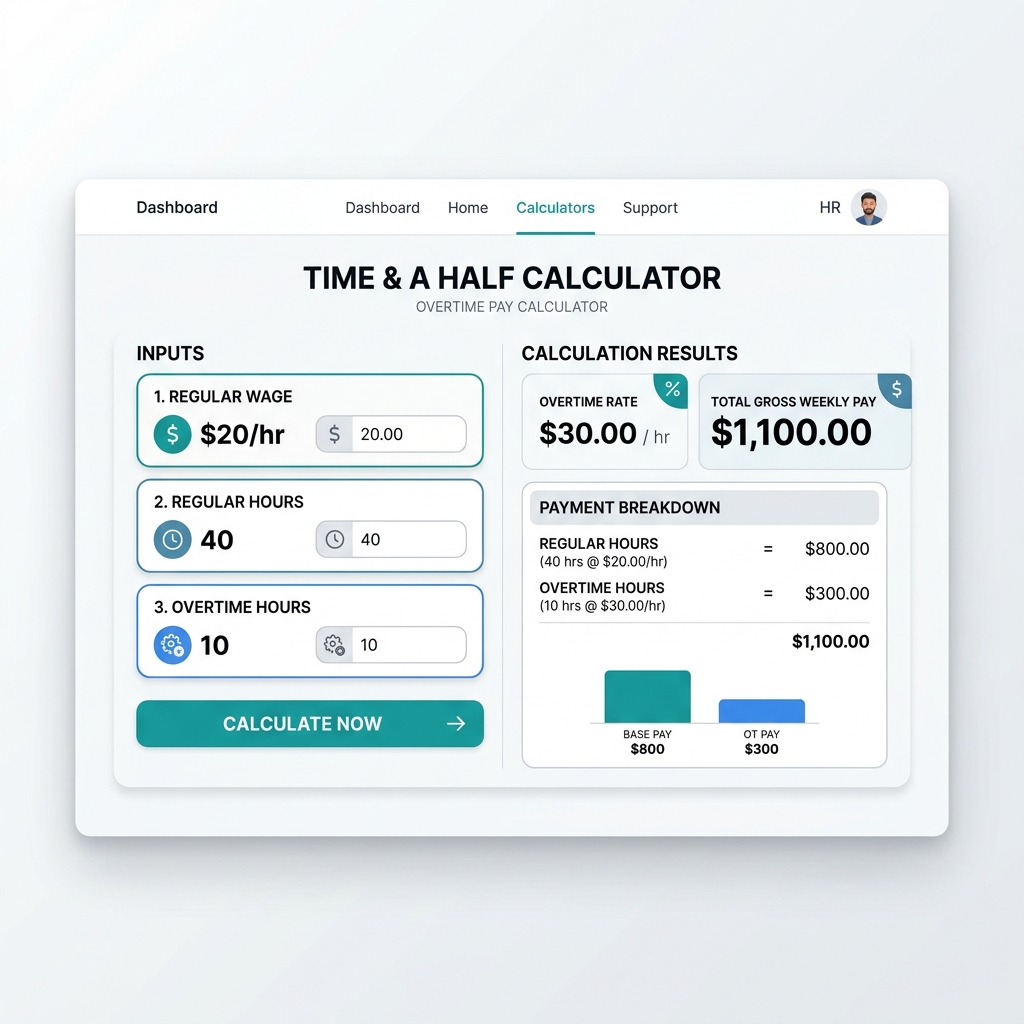
"Time and a half" is the standard overtime pay rate mandated by the US federal government under the Fair Labor Standards Act (FLSA). It means that for every hour of overtime worked, you are paid your regular hourly rate ("time") plus an additional 50% of that rate ("and a half").
How to Calculate Time and a Half (Formula & Examples)
Calculating time and a half is straightforward mathematics. You simply take your standard hourly wage and multiply it by 1.5.
Formula:
Regular Hourly Rate × 1.5 = Overtime RateExample 1: If you make $18.00 per hour, your time and a half rate is $18.00 × 1.5 = $27.00 per hour.
Example 2: If you make $25.00 per hour, your time and a half rate is $25.00 × 1.5 = $37.50 per hour.
If you want to estimate your total weekly paycheck after these overtime rules are applied and taxes are deducted, our comprehensive Paycheck Calculator is highly recommended. It factors in federal, state, and FICA taxes on top of your overtime pay.
The 40-Hour Workweek Rule (FLSA Mandate)
Under the FLSA, covered non-exempt employees must receive overtime pay for hours worked over 40 in a single workweek. A workweek is defined as a fixed and regularly recurring period of 168 hours (seven consecutive 24-hour periods).
It's important to note that the FLSA does not average hours over two weeks. If you work 50 hours one week and 30 hours the next, you are entitled to 10 hours of overtime for the first week, even though you averaged 40 hours over the two weeks.
No Weekend or Holiday Mandate
The FLSA does not require employers to pay time and a half for working on weekends, holidays, or regular days of rest, unless those hours push the total hours worked in the workweek past 40. Double time and holiday pay are strictly matters of agreement between an employer and employee. If you're looking for double-time calculations, you can use our Overtime Pay Calculator.
State by State Daily Overtime Exceptions
While federal law only looks at the 40-hour weekly threshold, several states have stricter labor laws that benefit the employee by enforcing daily overtime rules.
- California: Time and a half must be paid for hours worked over 8 in a single workday, and for the first 8 hours worked on the seventh consecutive day of work in a workweek. (They also mandate double time after 12 hours).
- Alaska & Nevada: Time and a half applies for any hours worked over 8 in a 24-hour period.
- Colorado: Time and a half is required after 12 hours in a single workday or shift.
Always check your local state department of labor for the most up-to-date daily overtime regulations.
Are Salaried Employees Entitled to 1.5x Pay? (Exempt vs Non-Exempt)
A common myth is that salaried employees never get overtime. This is false. Your eligibility depends on whether you are classified as Exempt or Non-Exempt.
If you are a non-exempt salaried employee, you are legally entitled to time and a half for overtime. To calculate this, your employer determines your regular hourly rate by dividing your weekly salary by 40 (or the standard hours your salary covers), then multiplies that by 1.5. If you want to see what your exact hourly rate is based on your annual salary, try our Hourly to Salary Calculator.
In 2026, the minimum salary threshold for exempt workers is strictly enforced. If your salary falls below this threshold (currently set at $43,888 annually, though subject to updates), you must be paid overtime, regardless of your job title or duties.
How Bonuses and Commissions Affect Your Overtime Rate
Many workers are surprised to learn that non-discretionary bonuses (like performance bonuses, attendance bonuses, or shift differentials) must be included in their "regular rate of pay" before calculating time and a half.
For example, if you earn $20/hr, work 50 hours, and get a $100 performance bonus that week, your base pay for the week isn't just $1,000 ($20 × 50). The $100 bonus increases your regular hourly rate for that specific week to $22/hr ($1,100 total / 50 hours). Your time and a half rate for the 10 overtime hours is calculated based on the new $22 rate, meaning your overtime rate is $33/hr, not $30/hr.
The Freelancer & Remote Worker Exception
If you are an independent contractor, freelancer, or a foreign remote worker acting as a contractor (often using a W-8BEN form for tax purposes), FLSA rules do not apply to you.
Time and a half only applies to traditional employer-employee relationships (W-2 employees) covered by US labor laws. As an independent contractor, you run your own business in the eyes of the law. Your overtime rate is dictated entirely by your contract. If you don't write an overtime clause into your freelance agreement, you aren't legally owed 1.5x pay.