Understanding Your True Hourly Value
Salary Conversions · Unpaid Overtime · W-2 vs 1099
A high annual salary looks great on paper, but if you are consistently working 50 to 60 hours a week, your actual hourly wage drops drastically. Calculating your salary to an hourly rate reveals how much your time is truly worth to your employer.
How to Use the Salary to Hourly Calculator
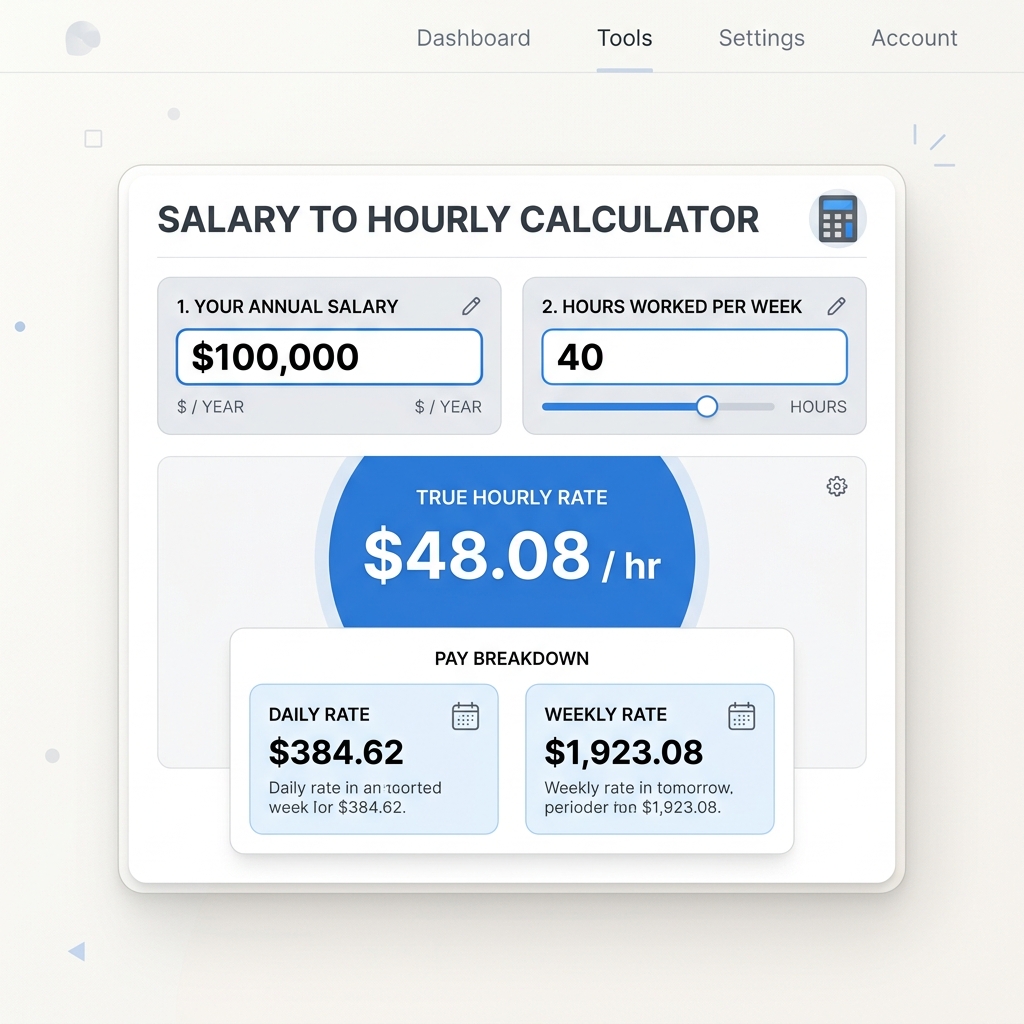
Simply enter your Annual Salary and adjust the Hours per Week slider if you work more or less than the standard 40 hours. The calculator will instantly break down your salary into an exact hourly wage, daily rate, and weekly rate.
How to Convert Salary to Hourly (The Math)
To find your baseline hourly rate, you divide your annual gross salary by the total number of hours you work in a year. In the United States, a standard full-time schedule is considered 40 hours per week for 52 weeks a year.
Formula:
40 hours × 52 weeks = 2,080 Total Yearly HoursAnnual Salary ÷ 2,080 = Hourly RateExample: If you are offered a $90,000 salary, your hourly breakdown is $90,000 ÷ 2,080 = $43.26 per hour.
The "Unpaid Overtime" Trap for Salaried Workers
If you are a salaried employee classified as "Exempt" under the FLSA, you are not legally entitled to Time and a Half for overtime. Your salary is a fixed amount meant to cover all hours you work, whether that's 40 hours or 60 hours.
If you have a $90,000 salary but your company culture pressures you into working 55 hours a week, your true yearly hours jump to 2,860. Your actual hourly wage drops from $43.26 to $31.46 per hour. Use our calculator above to adjust the "Hours per Week" slider and see the devastating effect unpaid overtime has on your true hourly rate.
Non-Exempt Salaried Workers
If you are salaried but classified as "Non-Exempt" (or your salary is below the $43,888 federal threshold), your employer must pay you overtime. They will calculate your hourly rate using the formula above, and then pay you 1.5x that rate for any hours worked over 40. Try our Overtime Calculator to see this math.
Transitioning to Freelance or Contracting?
Many professionals use a Salary to Hourly calculator when quitting a full-time W-2 job to become an independent contractor (1099) doing the same work.
Do not charge your exact salaried hourly rate as a contractor!
When you are an employee, your company pays for your health insurance, paid time off, 401(k) matching, and half of your FICA payroll taxes. As a contractor, you bear all of these costs, including a 15.3% Self-Employment Tax. To take home the same amount of money and maintain your lifestyle, you must charge roughly 30% to 40% more than your W-2 hourly rate.
For example, if your salaried hourly rate is $45/hr, you should charge at least $60/hr as a freelancer. If you want to do the inverse math, use our Hourly to Salary Calculator.
Finally, if you want to know what your final take-home pay is after all federal and state taxes are deducted from your salary, jump over to our Salary After Tax Calculator.