In This Guide — Jump to Any Section
- 01The exact formula (and where people go wrong)
- 02$20 an hour — full 2026 breakdown
- 03$25 an hour — monthly and annual breakdown
- 04$30 an hour — biweekly and annual
- 05$10–$100/hr master conversion table
- 06Part-time earnings at $20/hr (10–35 hrs/wk)
- 07Overtime at 1.5× — how much more you actually earn
- 08FICA breakdown: Social Security + Medicare
- 09Gross vs. net: what you actually keep
- 10State income tax: the variable nobody talks about
- 11How many hours in a US work year?
- 12Hourly vs salary: which pays more?
- 13Is $20/hr a good wage in 2026?
- 14Frequently asked questions
The Exact Formula (and Where People Go Wrong)
The formula is simple: Hourly Rate × Hours Per Week × 52 Weeks = Annual Gross Salary. Punch in $20 an hour at full time and you get $41,600. That's the number you'll see on job boards, offer letters, and salary comparison sites. But it is a gross figure — meaning before taxes take their share.
Here's where most people go wrong: they see $41,600 and assume that's their take-home pay. It's not. At $20/hr, a single filer loses:
- Federal income tax (after $15,000 standard deduction): ~$2,812
- Social Security (6.2% of gross): $2,579.20
- Medicare (1.45% of gross): $603.20
- State income tax (varies wildly — $0 to $4,000+): Depends on state
After all of that (federal only), you keep roughly $35,606 — not $41,600. That gap matters enormously when budgeting rent, car payments, or saving toward anything.
Part-time (30 hrs/wk): Rate × 1,560 = Annual gross
Part-time (20 hrs/wk): Rate × 1,040 = Annual gross
With overtime: add (OT hours × 52 × 1.5 × rate) to the base.
$20 an Hour Is How Much a Year? (2026 Full Breakdown)
At a standard 40-hour week, $20 an hour equals $41,600 per year in gross income. That puts you at 2.76 times the federal minimum wage ($7.25/hr) and just below the BLS national median hourly wage of $23.11 for all occupations.
$800
Weekly gross
$1,600
Biweekly gross
$3,467
Monthly gross
$41,600
Annual gross
After-tax take-home at $20/hr (2026, single filer)
Remember: this is federal tax only. California adds up to 9.3% on top of that. Texas, Florida, and Nevada charge zero state income tax. Where you live can swing your actual take-home by $1,500–$3,500 per year on a $20/hr income. We cover state taxes in detail in Section 10.
$25 an Hour Is How Much a Year? (2026)
$25 an hour equals $52,000 per year at full-time hours. This sits at the US median household income range for single earners and puts you comfortably above the BLS national median hourly wage of $23.11. Here's the full picture:
$1,000
Weekly gross
$2,000
Biweekly gross
$4,333
Monthly gross
$52,000
Annual gross
$52,000 a year is where housing in mid-cost cities starts becoming manageable — the standard guideline is to spend no more than 30% of gross income on rent, which gives you a $1,300/mo budget. That's tight in most major metros but workable in smaller cities and suburbs.
$30 an Hour Is How Much a Year? (2026)
$30 an hour equals $62,400 per year — just above the $60,000 milestone many US workers target. Your overtime rate jumps to $45.00/hr (1.5×), and five hours of weekly overtime adds $11,700 to your annual gross.
$1,200
Weekly gross
$2,400
Biweekly gross
$5,200
Monthly gross
$62,400
Annual gross
$10–$100/hr Master Conversion Table (2026)
All figures assume 40 hours/week × 52 weeks (2,080 hours). After-tax column uses 2026 federal brackets for single filers with the $15,000 standard deduction and FICA at 7.65%. State income tax is not included — see Section 10 for state-by-state notes.
Weekly
$400
Annual
$20,800
After Tax
~$18,942
Weekly
$480
Annual
$24,960
After Tax
~$22,582
Weekly
$520
Annual
$27,040
After Tax
~$24,418
Weekly
$600
Annual
$31,200
After Tax
~$27,718
Weekly
$680
Annual
$35,360
After Tax
~$31,017
Weekly
$720
Annual
$37,440
After Tax
~$32,742
Weekly
$800
Annual
$41,600
After Tax
~$35,606
Weekly
$880
Annual
$45,760
After Tax
~$38,987
Weekly
$1,000
Annual
$52,000
After Tax
~$43,364
Weekly
$1,120
Annual
$58,240
After Tax
~$48,012
See the full $10–$100/hr table on desktop, or use the calculator for your exact rate.
| Rate | Weekly | Biweekly | Monthly | Annual Gross | Est. After-Tax* | FICA | Eff. Rate |
|---|---|---|---|---|---|---|---|
| $10/hr | $400 | $800 | $1,733 | $20,800 | ~$18,942 | $1,591 | ~9.9% |
| $12/hr | $480 | $960 | $2,080 | $24,960 | ~$22,582 | $1,909 | ~9.5% |
| $13/hr | $520 | $1,040 | $2,253 | $27,040 | ~$24,418 | $2,068 | ~9.7% |
| $15/hr | $600 | $1,200 | $2,600 | $31,200 | ~$27,718 | $2,387 | ~11.2% |
| $17/hr | $680 | $1,360 | $2,947 | $35,360 | ~$31,017 | $2,705 | ~12.3% |
| $18/hr | $720 | $1,440 | $3,120 | $37,440 | ~$32,742 | $2,864 | ~12.6% |
| $20/hr | $800 | $1,600 | $3,467 | $41,600 | ~$35,606 | $3,182 | ~14.4% |
| $22/hr | $880 | $1,760 | $3,813 | $45,760 | ~$38,987 | $3,501 | ~14.8% |
| $25/hr | $1,000 | $2,000 | $4,333 | $52,000 | ~$43,364 | $3,978 | ~16.6% |
| $28/hr | $1,120 | $2,240 | $4,853 | $58,240 | ~$48,012 | $4,456 | ~17.6% |
| $30/hr | $1,200 | $2,400 | $5,200 | $62,400 | ~$50,558 | $4,774 | ~19.0% |
| $35/hr | $1,400 | $2,800 | $6,067 | $72,800 | ~$57,944 | $5,569 | ~20.4% |
| $40/hr | $1,600 | $3,200 | $6,933 | $83,200 | ~$65,157 | $6,365 | ~21.7% |
| $45/hr | $1,800 | $3,600 | $7,800 | $93,600 | ~$72,093 | $7,160 | ~23.0% |
| $50/hr | $2,000 | $4,000 | $8,667 | $104,000 | ~$78,755 | $7,956 | ~24.3% |
| $60/hr | $2,400 | $4,800 | $10,400 | $124,800 | ~$91,734 | $9,547 | ~26.5% |
| $75/hr | $3,000 | $6,000 | $13,000 | $156,000 | ~$110,736 | $11,934 | ~29.0% |
| $100/hr | $4,000 | $8,000 | $17,333 | $208,000 | ~$141,712 | $15,912 | ~31.9% |
* After-tax uses 2026 federal brackets, $15,000 standard deduction (single filer), FICA 7.65%. State tax not included. Your actual take-home will differ.
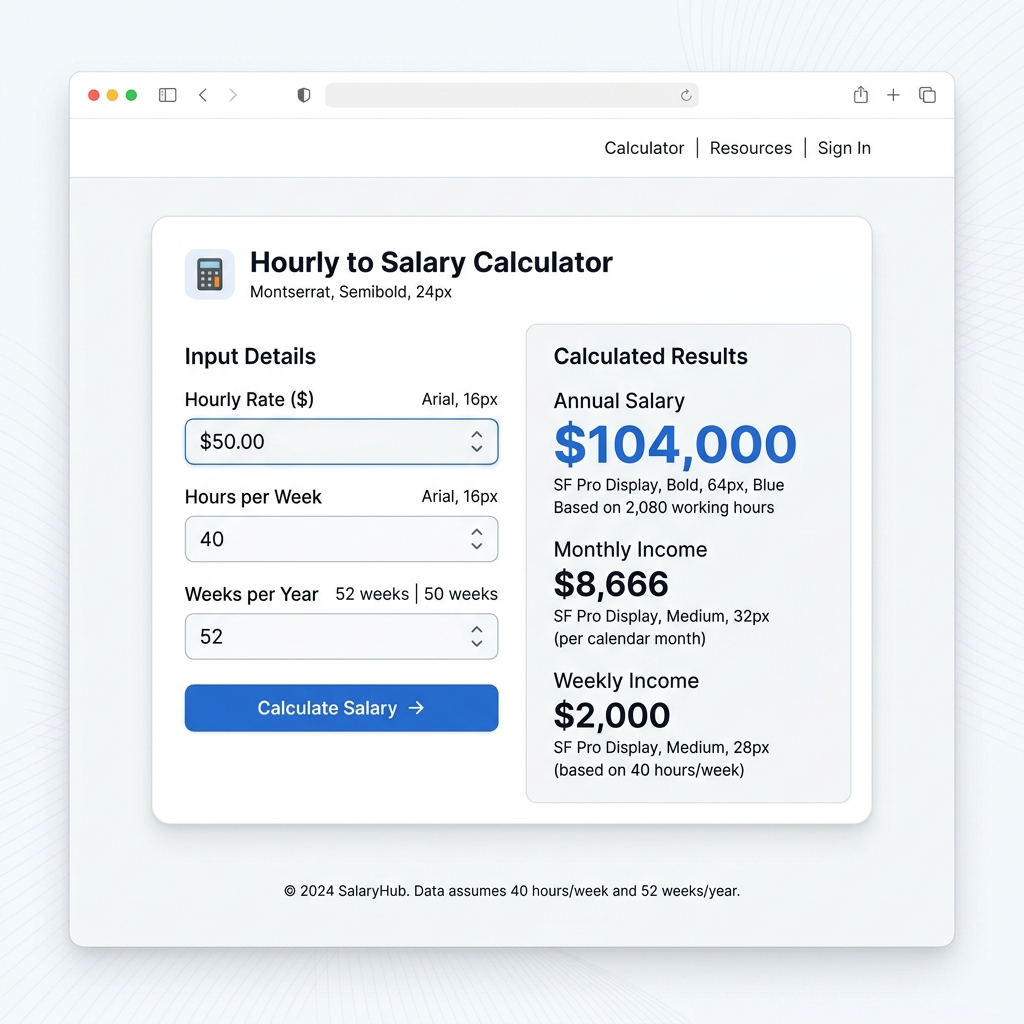
Skip the math. Use the free calculator.
Enter your hourly rate and hours. Get annual, biweekly, overtime, and after-tax results updated for 2026 federal brackets.
Use Free CalculatorPart-Time Earnings at $20/hr (10–50 hrs/wk)
Not everyone works 40 hours a week. Here's what $20/hr looks like across different schedules — including overtime hours marked with an asterisk (rows above 40 hrs assume FLSA overtime at 1.5× for hours over 40).
Weekly
$200
Monthly
$867
After Tax
~$9,652
Weekly
$400
Monthly
$1,733
After Tax
~$18,942
Weekly
$500
Monthly
$2,167
After Tax
~$23,317
Weekly
$600
Monthly
$2,600
After Tax
~$27,718
Weekly
$700
Monthly
$3,033
After Tax
~$32,097
Weekly
$800
Monthly
$3,467
After Tax
~$35,606
Weekly
$950
Monthly
$4,117
After Tax
~$42,147
Weekly
$1,100
Monthly
$4,767
After Tax
~$48,218
| Schedule | Weekly | Biweekly | Monthly | Annual Gross | Est. After-Tax |
|---|---|---|---|---|---|
| 10 hrs/wk | $200 | $400 | $867 | $10,400 | ~$9,652 |
| 20 hrs/wk | $400 | $800 | $1,733 | $20,800 | ~$18,942 |
| 25 hrs/wk | $500 | $1,000 | $2,167 | $26,000 | ~$23,317 |
| 30 hrs/wk | $600 | $1,200 | $2,600 | $31,200 | ~$27,718 |
| 35 hrs/wk | $700 | $1,400 | $3,033 | $36,400 | ~$32,097 |
| 40 hrs/wk | $800 | $1,600 | $3,467 | $41,600 | ~$35,606 |
| 45 hrs/wk* | $950 | $1,900 | $4,117 | $49,400 | ~$42,147 |
| 50 hrs/wk* | $1,100 | $2,200 | $4,767 | $57,200 | ~$48,218 |
* Rows above 40 hrs/wk include FLSA overtime pay at 1.5× for hours over 40.
Overtime at 1.5× — How Much More You Actually Earn
Under the Fair Labor Standards Act (FLSA), most non-exempt US employees must receive at least 1.5× their regular hourly rate for all hours worked beyond 40 per week. This is "time and a half" — and the impact on annual income is massive.
A $20/hr worker doing just 5 hours of overtime weekly earns $7,800 extra per year — nearly an 18.75% raise without any change to their base rate. Ten overtime hours/week adds $15,600 — more than a standard annual raise.
Extra/yr
+$1,170
Total annual
$32,370
Extra/yr
+$5,850
Total annual
$37,050
Extra/yr
+$11,700
Total annual
$42,900
Extra/yr
+$1,560
Total annual
$43,160
Extra/yr
+$7,800
Total annual
$49,400
Extra/yr
+$15,600
Total annual
$57,200
Extra/yr
+$9,750
Total annual
$61,750
Extra/yr
+$11,700
Total annual
$74,100
Extra/yr
+$15,600
Total annual
$98,800
| Base Rate | OT Rate (1.5×) | OT Schedule | Extra Per Year | Annual w/ OT |
|---|---|---|---|---|
| $15/hr | $22.50 | 1 OT hr/wk | +$1,170 | $32,370 |
| $15/hr | $22.50 | 5 OT hrs/wk | +$5,850 | $37,050 |
| $15/hr | $22.50 | 10 OT hrs/wk | +$11,700 | $42,900 |
| $20/hr | $30.00 | 1 OT hr/wk | +$1,560 | $43,160 |
| $20/hr | $30.00 | 5 OT hrs/wk | +$7,800 | $49,400 |
| $20/hr | $30.00 | 10 OT hrs/wk | +$15,600 | $57,200 |
| $25/hr | $37.50 | 5 OT hrs/wk | +$9,750 | $61,750 |
| $30/hr | $45.00 | 5 OT hrs/wk | +$11,700 | $74,100 |
| $40/hr | $60.00 | 5 OT hrs/wk | +$15,600 | $98,800 |
FICA Breakdown: Social Security + Medicare (2026)
FICA stands for the Federal Insurance Contributions Act. As an employee, you pay 7.65% of your gross wages in FICA taxes — 6.2% to Social Security and 1.45% to Medicare. Your employer matches this exactly. If you're self-employed, you pay both sides (15.3% total).
$20/hr / $41,600
Social Security
$2,579.20
Medicare
$603.20
Total FICA
$3,182.40
After FICA
$38,418
$25/hr / $52,000
Social Security
$3,224.00
Medicare
$754.00
Total FICA
$3,978.00
After FICA
$48,022
$30/hr / $62,400
Social Security
$3,868.80
Medicare
$904.80
Total FICA
$4,773.60
After FICA
$57,626
$40/hr / $83,200
Social Security
$5,158.40
Medicare
$1,206.40
Total FICA
$6,364.80
After FICA
$76,835
$50/hr / $104,000
Social Security
$6,448.00
Medicare
$1,508.00
Total FICA
$7,956.00
After FICA
$96,044
| Rate / Annual | Social Security (6.2%) | Medicare (1.45%) | Total FICA | Gross After FICA |
|---|---|---|---|---|
| $20/hr / $41,600 | $2,579.20 | $603.20 | $3,182.40 | $38,418 |
| $25/hr / $52,000 | $3,224.00 | $754.00 | $3,978.00 | $48,022 |
| $30/hr / $62,400 | $3,868.80 | $904.80 | $4,773.60 | $57,626 |
| $40/hr / $83,200 | $5,158.40 | $1,206.40 | $6,364.80 | $76,835 |
| $50/hr / $104,000 | $6,448.00 | $1,508.00 | $7,956.00 | $96,044 |
Gross vs. Net Pay: What You Actually Keep
Gross pay is your total earnings before any deductions — the number on your offer letter, job post, or salary comparison site. Net pay is what lands in your bank account after federal income tax, FICA, state income tax, and any pre-tax deductions (health insurance, 401k) are removed.
The gap between gross and net for a $20/hr worker in 2026 is roughly $6,000 per year in federal taxes and FICA alone — before state taxes. Pre-tax 401(k) contributions and health insurance premiums reduce taxable income and effectively close part of this gap.
State Income Tax: The Variable Nobody Talks About
Federal taxes are the same for every American at the same income level. State taxes are wildly different — from zero to over 13% — and can swing your take-home by thousands of dollars per year on a $20/hr income.
No state income tax (9 states)
Texas, Florida, Nevada, Washington, Wyoming, South Dakota, Alaska, Tennessee, New Hampshire
+$0 to state
Low state tax (1–4%)
Arizona (2.5%), Indiana (3.05%), Colorado (4.4%), Michigan (4.25%), Kentucky (4.5%)
−$520–$1,040/yr at $20/hr
Mid state tax (5–7%)
New York (~6.8%), Wisconsin (5.3%), Minnesota (6.8%), Oregon (up to 9.9%)
−$1,300–$2,600/yr at $20/hr
High state tax (8–13%+)
California (up to 13.3%), Hawaii (11%), New Jersey (up to 10.75%)
−$2,080–$4,160/yr at $20/hr
A $20/hr worker in California can pay $2,000–$3,000 more per year in state income tax than the same worker in Texas or Florida. That's the equivalent of losing almost $1.50/hr to your state government — effectively dropping your real hourly rate from $20 to $18.50 or less.
How Many Hours Are in a US Work Year?
The standard US work year is 2,080 hours (40 hrs × 52 weeks). This is the number used in all salary conversion formulas. But actual hours worked are usually less — and that gap matters when comparing hourly vs. salaried positions.
2,080 hrs
Standard work year
40 hrs × 52 weeks
1,952 hrs
With 10 PTO days + 6 holidays
512 hrs off paid
1,880 hrs
With 15 PTO + 10 holidays
200 hrs off paid
Here's why this matters for comparing offers: a $60,000 salaried job where you actually work 50 hours/week pays you an effective $23.08/hr — lower than a $25/hr hourly contract where you work exactly 40. Always convert salary offers to effective hourly rate using your expected real hours.
Hourly vs. Salary: Which Pays More in the Real World?
The question isn't which type of pay is better — it's which one pays more for the specific job and lifestyle you want. Each has genuine advantages that matter depending on your situation.
Advantages of Hourly Pay
- Paid for every minute worked — employers can't extend your day for free
- Overtime at 1.5× for hours over 40 (FLSA non-exempt protection)
- Easier to track exact income for budgeting
- More negotiating leverage for contract and temp roles
- Part-time and flexible scheduling options
Advantages of Salary
- Predictable paycheck — same amount every period
- Often includes PTO, health insurance, 401k match
- Easier mortgage/loan applications (stable documented income)
- Advancement tracks and performance bonuses
- Slow weeks don't reduce your pay
Is $20/hr a Good Wage in 2026?
The short answer: it depends heavily on where you live and what you're comparing it to. Here's the honest benchmark:
vs. Federal minimum wage
$20/hr is 2.76× the federal minimum wage of $7.25/hr. It's above the current minimum in all 50 states. That's a good starting point — but minimum wage is an extremely low bar.
vs. BLS national median ($23.11/hr)
$20/hr is about 13.5% below the BLS national median hourly wage of $23.11 for all occupations (most recent data). You're in the lower half nationally, though not far off.
vs. MIT Living Wage by city
MIT Living Wage Calculator estimates a single adult needs $21–$37/hr depending on city. $20/hr covers living expenses in lower-cost cities but falls short in Boston, NYC, LA, SF, and Seattle.
Career growth context
Many $20/hr roles are entry-to-mid level. The jump from $20 to $25/hr adds $10,400/yr — achievable in 1–2 years in most fields with consistent performance. Job-switching typically delivers 10–20% raises faster than internal promotions.
Get your exact after-tax take-home — instantly
Enter your hourly rate, hours worked, filing status, and state. Get annual, monthly, biweekly, and after-tax results updated for 2026.
Use Free CalculatorFrequently Asked Questions
$20 an hour is how much a year?
$20/hr × 40 hrs × 52 weeks = $41,600/year gross. After federal income tax (~$2,812) and FICA ($3,182), estimated take-home for a single filer is approximately $35,606 — or $2,967/month. State taxes reduce this further.
$18 an hour is how much a year?
$18/hr × 40 hrs × 52 weeks = $37,440/year gross. After federal taxes and FICA, estimated take-home is approximately $32,742 for a single filer — roughly $2,729/month.
$22 an hour is how much a year?
$22/hr × 40 hrs × 52 weeks = $45,760/year gross. After federal taxes and FICA, estimated take-home is approximately $38,987 — or $3,249/month.
What is $20 an hour biweekly?
$20/hr biweekly gross is $1,600 (80 hours × $20). After taxes and FICA, your estimated biweekly net paycheck is approximately $1,370 for a single filer in a no-state-tax state.
What is $20/hr monthly?
$20/hr monthly gross is $3,467 (based on $41,600 ÷ 12). Biweekly paychecks don't divide evenly into months — some months you get 2 checks, some get 3. Actual monthly take-home is approximately $2,967 after federal taxes and FICA.
What is time and a half for $20 an hour?
Time and a half for $20/hr is $30/hr ($20 × 1.5). This applies to all hours over 40 per week under FLSA for non-exempt employees. Working 5 OT hours/week adds $7,800/year to your base $41,600 salary.
Is $20 an hour considered poverty level?
$20/hr ($41,600/year) is above the federal poverty guidelines for a single person ($15,060 in 2026) and for a family of two ($20,440). It's not poverty level. However, it falls below MIT's living wage estimate in many high-cost cities, where housing and childcare costs make $20/hr insufficient.
How much federal tax do I pay on $20 an hour?
At $20/hr ($41,600/year), a single filer pays approximately $2,812 in federal income tax after the $15,000 standard deduction leaves $26,600 taxable. The first $11,925 is taxed at 10% ($1,192.50), and the remaining $14,675 at 12% ($1,761). Plus $3,182 in FICA — total federal obligation is ~$5,994.
Free US Calculator
Updated May 20, 2026
Sources: IRS 2026 brackets · BLS OES data · FLSA (DOL) · MIT Living Wage Calculator