In This Guide
- 1What is self-employment tax and who pays it
- 2How SE tax is calculated — the exact formula
- 3Worked examples: $60K–$200K net profit
- 4Self-employed vs W-2 employee tax comparison
- 52026 quarterly estimated tax deadlines
- 6How much to set aside from every payment received
- 7Every Schedule C deduction — complete list
- 8The QBI deduction — up to 20% off your taxable income
- 9SEP-IRA and Solo 401(k) — the biggest tax shelter available
- 105 legal strategies to reduce your self-employment tax
- 11The costliest mistakes 1099 workers make
- 12Use the free SE tax calculator
What is self-employment tax and who pays it
When you work as a W-2 employee, your employer withholds 7.65% of your wages for Social Security and Medicare (FICA), and your employer pays a matching 7.65% on top — for a total of 15.3% contributed to the federal social insurance system.
When you are self-employed — as a freelancer, independent contractor, sole proprietor, or single-member LLC — there is no employer. You pay both halves yourself. That's the self-employment tax: the full 15.3% of your net business profit, applied to fund Social Security (12.4%) and Medicare (2.9%).
Who must pay SE tax: any person with net self-employment income of $400 or more in a tax year. This includes freelancers, consultants, Uber and DoorDash drivers, Etsy sellers, content creators, real estate agents, tutors, and anyone else receiving 1099 income from services rendered.
SE tax is separate from income tax — you pay both
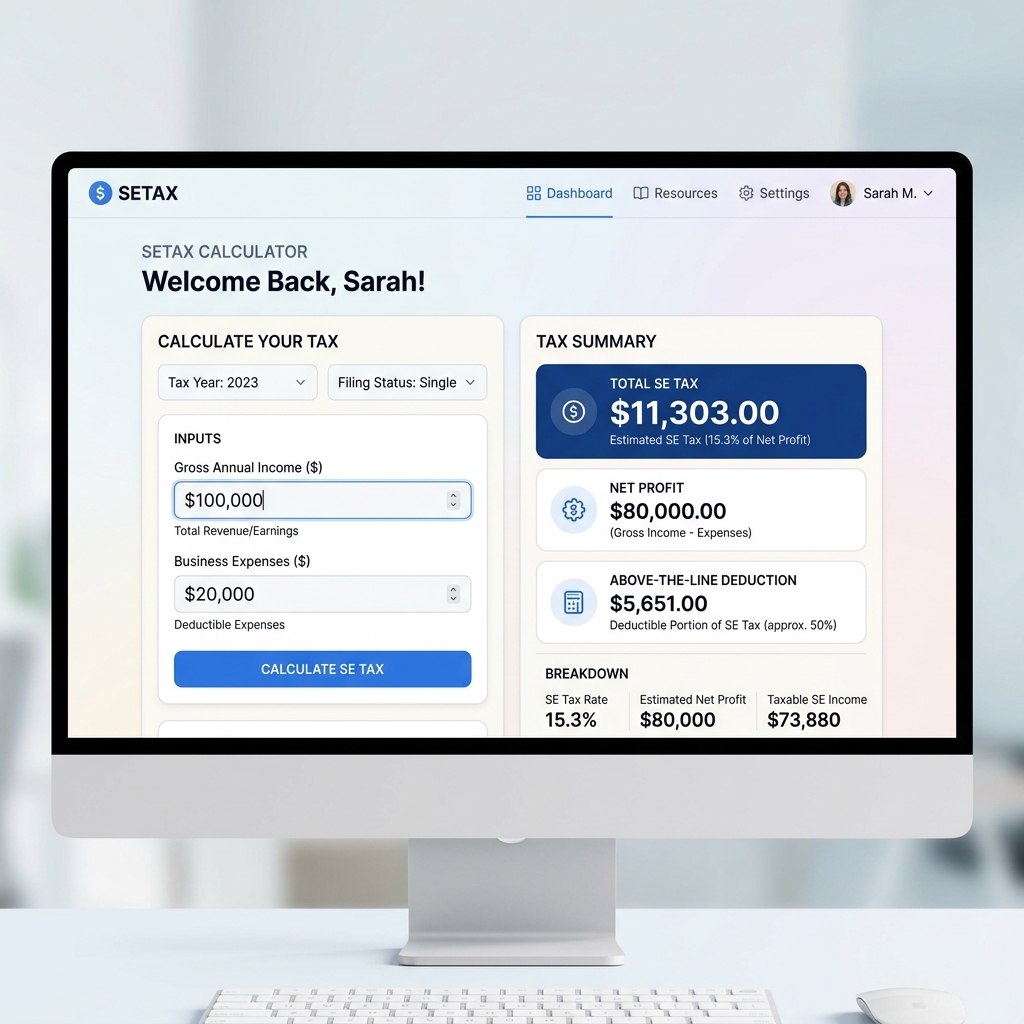
Many first-time freelancers are shocked to discover that the 15.3% SE tax is added on top of their regular income tax obligation. A freelancer earning $80,000 net profit in the 22% federal bracket pays approximately $11,304 in SE tax PLUS $9,256 in federal income tax — a total of $20,560 before state taxes.
How SE tax is calculated — the exact IRS formula
The SE tax calculation has two important nuances that reduce the actual dollar amount below what 15.3% of gross self-employment income would suggest:
The SE tax formula — step by step:
Step 1: Net profit = Gross revenue − Business expensesStep 2: SE taxable income = Net profit × 92.35% (IRS allows 7.65% reduction — equivalent to the "employer share" deduction)Step 3: SE tax = SE taxable income × 15.3% (12.4% SS on up to $184,500 + 2.9% Medicare on all net earnings)Step 4: Above-line deduction = SE tax × 50% (you deduct half of SE tax from your gross income)Step 5: Adjusted Gross Income = Net profit − (SE tax × 50%) − other deductionsStep 6: Federal income tax = Applied to AGI via regular bracketsTotal tax = SE tax + federal income tax + state income tax
Why SE tax applies to 92.35%, not 100% of net profit
The 92.35% factor (technically 1 minus 0.0765) represents the IRS's acknowledgment that half of the SE tax is theoretically paid by an "employer." Since you are both employer and employee, the IRS reduces the taxable base by the equivalent of the employer's share before calculating the SE tax. On $100,000 net profit, SE tax applies to $92,350 — saving $1,169 compared to applying it to the full $100,000.
Worked examples: SE tax at $60K–$200K net profit (2026)
Single filer · Standard deduction applied · No additional deductions · No QBI deduction applied (see section 8 to add that saving).
| Net Profit | SE Taxable Base (92.35%) | SE Tax (15.3%) | Half SE Deduction | Federal Income Tax | Total Tax | Quarterly Payment |
|---|---|---|---|---|---|---|
| $60,000 net profit | $55,410 | $8,478 | $4,239 | ~$5,642 | ~$14,120 | ~$3,530/quarter |
| $80,000 net profit | $73,880 | $11,304 | $5,652 | ~$9,256 | ~$20,560 | ~$5,140/quarter |
| $120,000 net profit | $110,820 | $16,955 | $8,478 | ~$18,792 | ~$35,747 | ~$8,937/quarter |
| $200,000 net profit | $184,500 (SS cap) | $23,302 | $11,651 | ~$41,140 | ~$64,442 | ~$16,110/quarter |
Federal income tax assumes standard deduction ($16,100 single, 2026). No QBI deduction, no additional deductions. State taxes not included. Use the calculator for your exact numbers.
Self-employed vs W-2 employee — the real tax difference
Understanding the full comparison shows both where self-employed workers pay more — and where the tax code gives them significant advantages that W-2 employees cannot access.
| Tax Factor | W-2 Employee | Self-Employed (1099) |
|---|---|---|
| FICA rate paid | 7.65% (employer pays other 7.65%) | 15.3% (pays both sides) |
| Tax withholding | Automatic each paycheck | Must calculate & pay quarterly |
| Standard deduction | Same ($16,100 single, 2026) | Same ($16,100 single, 2026) |
| Home office deduction | Not available (W-2 workers) | Yes — Schedule C |
| Vehicle deduction | Not available (W-2 workers) | Yes — $0.725/mile (2026) |
| Health insurance ded. | Limited (only if itemizing) | 100% above-the-line deduction |
| Retirement contribution | Employee limit: $23,500 | SEP-IRA up to $70,000 (2026) |
| QBI deduction | Not available | Up to 20% of net income |
| 50% SE tax deduction | Not applicable | Yes — deducted from AGI |
| Gross income needed | Lower (employer covers SS/Med) | Higher (must cover both halves) |
The hidden cost: equivalent gross income comparison
A W-2 employee earning $100,000 costs their employer $107,650 (salary + employer FICA). A self-employed contractor billing $100,000 gross keeps only what's left after paying both employee AND employer FICA themselves. To match a W-2 employee's net take-home, a freelancer must bill approximately $110,000–$115,000 gross — factoring in SE tax and no employer-paid benefits.
Get your SE tax estimate in 30 seconds — with every deduction
SE tax (15.3%) · QBI deduction · Quarterly estimates · Profit allocation breakdown.
2026 quarterly estimated tax deadlines — never miss one
If you expect to owe $1,000 or more in federal tax for the year, the IRS requires you to make quarterly estimated payments. Missing or underpaying triggers an underpayment penalty — calculated as the federal short-term interest rate plus 3 percentage points on the shortfall. In 2026, that's approximately 7–8% annualized.
Q1 2026
Jan 1 – Mar 31, 2026
Same as individual tax filing deadline
Q2 2026
Apr 1 – May 31, 2026
Only 2 months of income covered
Q3 2026
Jun 1 – Aug 31, 2026
3 months of income
Q4 2026
Sep 1 – Dec 31, 2026
Final payment for 2026 tax year
Safe harbor rule — avoid penalties regardless of actual income
You can avoid underpayment penalties entirely if you pay at least: 100% of your prior year's tax liability (or 110% if prior year AGI exceeded $150,000). This "safe harbor" approach means you base quarterly payments on last year's tax return, not this year's income — removing guesswork from volatile freelance income.
How much to set aside from every client payment
The single most practical rule for freelancers: set aside a percentage of every payment received into a dedicated tax savings account immediately. Don't wait until Q1 — many first-year freelancers spend money they owe.
| Annual Net Income | Recommended Set-Aside % | Why |
|---|---|---|
| Under $30,000 | 20–25% | SE tax + low income bracket = lower total rate |
| $30,000–$60,000 | 25–30% | SE tax + 12–22% federal + state tax |
| $60,000–$100,000 | 28–32% | 22% bracket + SE tax + state tax |
| $100,000–$160,000 | 30–35% | 24% bracket + SE tax hitting upper levels |
| Over $160,000 | 35–40% | 32%+ bracket, additional Medicare, high state tax |
Keep this money in a dedicated high-yield savings account (earning 4–5% APY in 2026) separate from your operating funds. The interest it earns while waiting for tax deadlines is a bonus — and the psychological separation prevents accidental spending.
Every Schedule C deduction — complete list for 2026
Business deductions reduce your net profit — which reduces both your SE tax AND your federal income tax. This double benefit makes business deductions exceptionally valuable for self-employed workers.
Home Office
High — reduces both income tax AND SE taxDeduction: Actual expenses OR $5/sq ft (max 300 sq ft = $1,500)
Limit: Must be used regularly and exclusively for business
Vehicle / Mileage
High — especially for delivery, sales, client visitsDeduction: $0.725/mile (2026 IRS rate) OR actual vehicle expenses
Limit: Must track mileage with a log. Business-use only.
Self-Employed Health Insurance
High — reduces AGI, not just taxable incomeDeduction: 100% of premiums — above-the-line deduction
Limit: Cannot exceed net self-employment income. Not available if eligible for employer plan.
SEP-IRA / Solo 401(k)
Very high — largest deduction available to most self-employed workersDeduction: SEP-IRA: 25% of net, max $70,000. Solo 401(k): up to $70,000 total.
Limit: Must be funded before tax filing deadline (+ extensions for SEP-IRA).
Equipment & Technology
High — computers, cameras, tools, machinery all qualifyDeduction: Section 179: 100% first-year deduction for qualifying property
Limit: $1,160,000 limit (2026). Must be used >50% for business.
Professional Development
Medium — often overlooked, consistently deductibleDeduction: Courses, books, certifications, conferences
Limit: Must be directly related to your current business, not a new career
Phone & Internet
Medium — track carefully, average 60–80% deductible for most freelancersDeduction: Business-use percentage of total bill
Limit: Must track and document business-use percentage
Meals (Business)
Low-medium — 50% limit reduced impact vs full deductionDeduction: 50% of business meals with clients/colleagues
Limit: Must document: who, what, where, business purpose
Document everything — the IRS requires proof
Every deduction requires substantiation: receipts, bank statements, mileage logs, and business-purpose documentation. In an audit, the burden of proof is on you. Use accounting software (QuickBooks Self- Employed, FreshBooks, or even a dedicated spreadsheet) to categorize every expense throughout the year. Reconstructing records at tax time is error-prone and stressful.
The QBI deduction — up to 20% off your taxable income
Section 199A, the Qualified Business Income deduction, is the most underutilized tax benefit available to self-employed workers. It allows most freelancers and contractors to deduct up to 20% of their qualified business income from federal taxable income — on top of the standard deduction.
QBI deduction worked example: $80,000 net profit, single filer
Net profit (Schedule C): $80,000
Minus half SE tax deduction: −$5,652
Adjusted Gross Income: $74,348
Minus standard deduction: −$16,100
Before QBI deduction: $58,248
QBI deduction (20% of $80,000): −$16,000
Taxable income after QBI: $42,248
Federal income tax (without QBI): $9,256
Federal income tax (with QBI): $5,490
QBI saves you: $3,766 in federal tax
The QBI deduction does NOT reduce SE tax — only federal income tax. But $3,766 in annual tax savings is substantial and completely legal.
Who qualifies for the full QBI deduction?
Most self-employed workers qualify for the full 20% deduction below income thresholds. However, workers in "Specified Service Trades or Businesses" (SSTBs) — including consultants, attorneys, financial advisors, and physicians — face phase-outs beginning at $197,300 (single) or $394,600 (MFJ) in 2026. Trades and crafts, technology workers outside consulting, real estate, and most freelance creative work are NOT SSTBs and get the full benefit.
SEP-IRA and Solo 401(k) — the biggest tax shelter for self-employed
The retirement account options available to self-employed workers are dramatically more powerful than what most W-2 employees have access to. Both SEP-IRA and Solo 401(k) contributions reduce your net taxable income, which reduces both SE tax and federal income tax.
| Factor | SEP-IRA | Solo 401(k) |
|---|---|---|
| 2026 max contribution | Up to 25% of net, max $70,000 | Up to $70,000 total ($77,500 age 50+) |
| Employee contribution limit | Only employer-side (25%) | $23,500 employee + $46,500 employer-side |
| Admin complexity | Very simple — one form | More complex — plan document required |
| Deadline to contribute | Tax filing + extensions | Must open by Dec 31, fund by tax deadline |
| Roth option | No | Yes — Roth Solo 401(k) available |
| Loan provision | No | Yes — can borrow from account |
| Best for | Simplicity, higher income workers | Lower income earners (higher % contribution), those wanting Roth |
At $120,000 net profit, contributing $30,000 to a SEP-IRA reduces federal income tax by approximately $6,600 (at 22% bracket) AND reduces QBI-eligible income, which cascades into further savings. The real after-tax cost of a $30,000 SEP-IRA contribution is closer to $21,000–$23,000 — and the full $30,000 grows tax-deferred.
5 legal strategies to reduce your self-employment tax
Maximize every legitimate business deduction
Every dollar of Schedule C business expenses directly reduces net profit — which is the base for SE tax calculation. $10,000 more in legitimate deductions reduces SE tax by $1,413 (15.3% × 92.35% × $10,000) AND reduces federal income tax by $2,200 (at 22% bracket). Track and document every business expense meticulously throughout the year.
→ Each $1,000 in deductions = ~$141 SE tax savings + federal income tax savings
Contribute to a SEP-IRA or Solo 401(k) before the deadline
Retirement contributions for self-employed workers are made on Schedule 1, reducing AGI before any other calculations. A $20,000 SEP-IRA contribution on $100,000 net profit reduces the net taxable profit for income tax purposes and creates a large above-the-line deduction. Note: retirement contributions do NOT reduce SE tax — they reduce income tax only.
→ $20,000 SEP-IRA at 22% bracket = $4,400 in federal income tax savings
Claim the QBI deduction (Section 199A)
Most freelancers and contractors qualify for the 20% Qualified Business Income deduction. This is an automatic above-the-line-style deduction that requires no special account or additional spending — just proper business structure and income below the phase-out thresholds. It reduces federal income tax substantially without any cash outflow.
→ $80,000 net profit → QBI saves approximately $3,766 in federal income tax
Deduct self-employed health insurance premiums
If you pay for your own health insurance and are not eligible for employer-sponsored coverage, you can deduct 100% of premiums for yourself, your spouse, and dependents as an above-the-line deduction. In 2026, average individual market premiums run $400–$800/month ($4,800–$9,600/year). At a 22% bracket, deducting $7,200/year saves $1,584 in federal income tax.
→ $600/month premium deduction = $1,584/year in federal tax savings (22% bracket)
Consider an S-Corp election for higher income earners
At net profits above $60,000–$80,000, electing S-Corporation status can significantly reduce SE tax. As an S-Corp owner-employee, you pay SE tax (payroll tax) only on a 'reasonable salary' — not on the full net profit. Profit distributions above the salary are not subject to SE tax, potentially saving $3,000–$15,000/year. This strategy requires additional complexity: payroll setup, separate business account, corporate formalities, and typically a CPA.
→ $120K net profit as S-Corp with $70K salary → saves ~$7,645 in SE tax vs sole proprietor
The costliest mistakes 1099 workers make with taxes
Not making quarterly payments — then getting hit with penalties AND a large bill
The most common first-year freelancer mistake. Federal income taxes are pay-as-you-go. If you wait until April and owe more than $1,000, you'll pay both the tax AND an underpayment penalty. In 2026, that penalty runs approximately 7–8% annualized on the shortfall amount. On a $20,000 tax bill paid 10 months late (missing 4 quarters), the penalty is approximately $1,200–$1,600.
Mixing business and personal finances
Commingling personal and business expenses creates an audit risk and makes expense tracking inaccurate. The IRS can disallow deductions it cannot clearly trace as business expenses. Use a dedicated business bank account and credit card from day one. The cost (often $0 for basic business checking) is insignificant against the deductions it helps you track and defend.
Ignoring the home office deduction out of fear
Many freelancers skip the home office deduction because they've heard it triggers audits. This is outdated information. The simplified method ($5/sq ft, max 300 sq ft = $1,500 deduction) is straightforward, well-documented, and not an audit red flag for legitimate home-based workers. A $1,500 deduction at 22% bracket saves $333 in income tax and also reduces QBI-eligible income.
Not tracking mileage throughout the year
The IRS mileage rate is $0.725/mile in 2026. For a freelancer driving 10,000 business miles annually, that's $7,250 in deductions — worth $1,595 in tax savings at 22%. But you must have a contemporaneous mileage log (date, destination, purpose, miles). Reconstructed logs created at tax time are frequently disallowed in audits. Use a mileage tracking app (MileIQ, Everlance) from the start.
Calculate your exact SE tax, quarterly payments, and take-home
Enter gross revenue, business expenses, and filing status. See SE tax, federal income tax, quarterly voucher amount, and net take-home — all itemised.
All calculations based on 2026 IRS Publication 15, Schedule SE instructions, IRS Rev. Proc. 2025-32, and the Social Security Administration's 2026 wage base of $184,500. SE tax rates (15.3%), QBI deduction thresholds ($197,300/$394,600), and retirement plan limits ($70,000 SEP-IRA/Solo 401k) reflect official 2026 IRS guidance. S-Corporation strategies are simplified for illustration and should be evaluated with a licensed CPA for your specific situation. This guide is for informational and educational purposes only and does not constitute tax or legal advice. Consult a licensed tax professional for your specific filing situation.
Last updated: May 2026