In This Guide
- 1How salary after tax is calculated — step by step
- 22026 federal income tax brackets
- 3Effective vs marginal tax rate — the number that matters
- 4FICA: Social Security & Medicare in 2026
- 5Salary after tax: $40K–$200K quick reference table
- 6Salary after tax by state — all 50 states
- 7No-income-tax states — the real dollar difference
- 8One Big Beautiful Bill — new deductions for 2026
- 9How 401(k) and HSA cut your actual tax bill
- 10Pre-tax deduction impact table
- 11Salary after tax in California, Texas, NY, and Florida
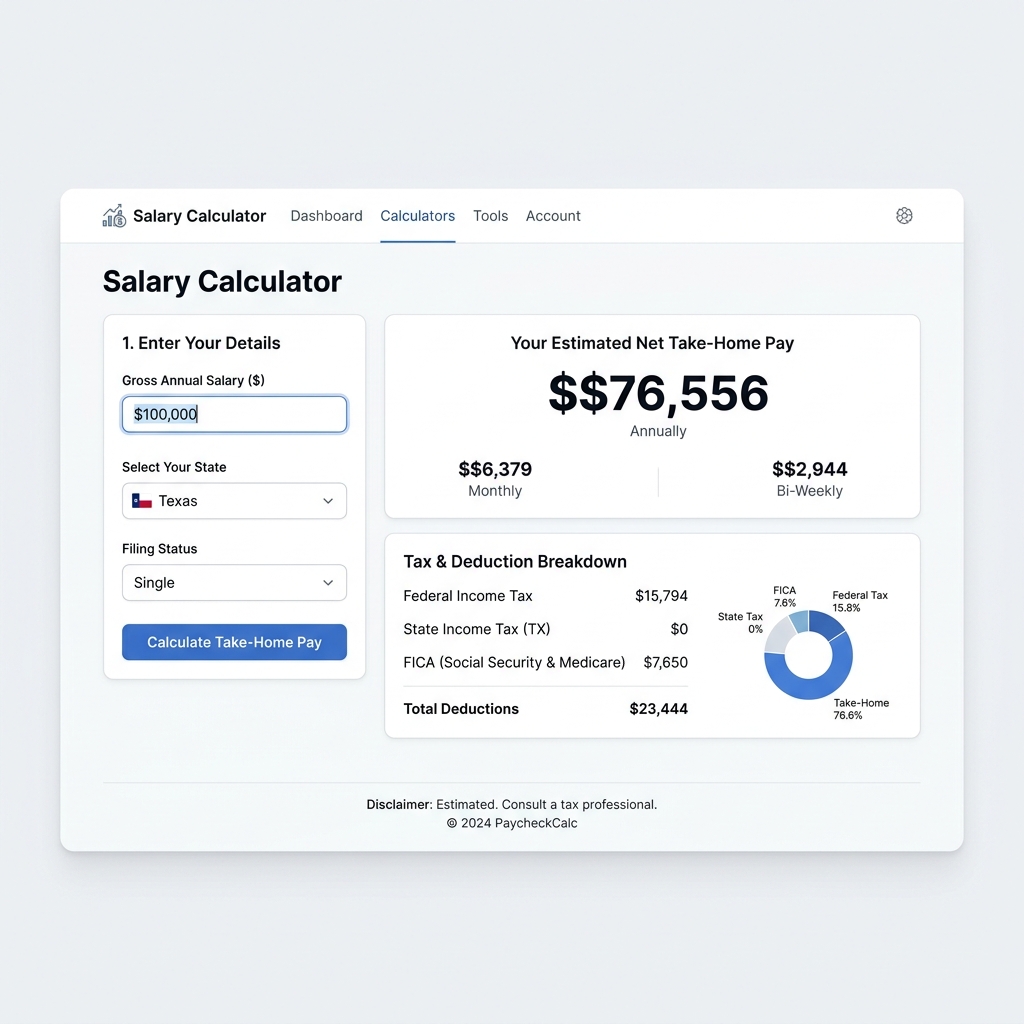
- 12Use the free salary after tax calculator
How salary after tax is calculated — step by step
Every US salary goes through the same sequence of deductions before reaching your bank account. Understanding each step puts you on equal footing with the IRS, your employer's payroll department, and anyone quoting you a salary figure.
The salary-after-tax formula:
Step 1: Gross Salary
Step 2: − Pre-Tax Deductions (401k, HSA, health insurance)
= Adjusted Gross Income (AGI)
Step 3: − Standard Deduction ($16,100 single / $32,200 MFJ)
= Taxable Income
Step 4: Apply progressive federal brackets → Federal Tax
Step 5: Social Security 6.2% (up to $184,500) + Medicare 1.45%
Step 6: State income tax (varies 0%–13.3%)
Step 7: Net Take-Home = Gross − All of the above
The key insight most people miss: steps 1–3 happen before federal and state taxes are calculated. Every dollar into a pre-tax 401(k), HSA, or Section 125 health insurance plan reduces your taxable income at step 3, which directly lowers the tax calculated at step 4. This is why pre-tax contributions save you more than their face value.
2026 federal income tax brackets
The US uses a progressive bracket system — only the income within each bracket is taxed at that rate, never your entire salary. The IRS adjusts brackets annually for inflation; 2026 brackets increased approximately 2.8–4% from 2025.
| Rate | Single Filer | Married Filing Jointly |
|---|---|---|
| 10% | $0 – $11,925 | $0 – $23,850 (MFJ) |
| 12% | $11,926 – $48,475 | $23,851 – $96,950 (MFJ) |
| 22% | $48,476 – $103,350 | $96,951 – $206,700 (MFJ) |
| 24% | $103,351 – $197,300 | $206,701 – $394,600 (MFJ) |
| 32% | $197,301 – $250,525 | $394,601 – $501,050 (MFJ) |
| 35% | $250,526 – $626,350 | $501,051 – $751,600 (MFJ) |
| 37% | Over $626,350 | Over $751,600 (MFJ) |
Standard deduction: $16,100 (single) · $32,200 (MFJ) · $24,150 (HoH). Applied before the brackets — your taxable income is always lower than gross salary.
Effective vs marginal tax rate — the number that actually matters
This is the most misunderstood concept in personal tax planning. Your marginal rate is the rate on your last dollar of income — your "bracket." Your effective rate is total tax divided by total income — what you actually pay as a percentage. The effective rate is always lower than the marginal rate.
Worked example: $75,000 salary, single filer, 2026
Gross salary: $75,000
− Standard deduction: $16,100
Taxable income: $58,900
10% on first $11,925: $1,193
12% on $11,926–$48,475: $4,386
22% on $48,476–$58,900: $2,293
Total federal tax: $7,872
Marginal rate (top bracket): 22%
Effective rate (actual): 10.5% ($7,872 ÷ $75,000)
You are in the "22% bracket" but your effective federal rate is only 10.5% because only the last $10,425 of taxable income is taxed at 22%. Every dollar below that threshold is taxed at 10% or 12%.
This distinction matters enormously for 401(k) decisions. When someone says "contributing to my 401(k) saves me 22% in taxes," that's only true for contributions that reduce income in the 22% bracket. Contributions that reduce income in the 12% bracket save 12%, not 22%.
FICA: Social Security & Medicare in 2026
FICA (Federal Insurance Contributions Act) is mandatory and cannot be reduced by the standard deduction or most pre-tax contributions. It applies to gross wages and funds Social Security and Medicare.
| Tax | Rate | 2026 Wage Cap | Max Employee Tax |
|---|---|---|---|
| Social Security (OASDI) | 6.2% | $184,500 | $11,439 |
| Medicare (HI) | 1.45% | No cap | Unlimited |
| Additional Medicare | 0.9% | >$200K (single)/$250K (MFJ) | Varies |
The SS wage base paycheck jump
Once your wages reach $184,500 in the calendar year, Social Security withholding stops completely. Workers earning above this threshold see a noticeable paycheck increase — at $184,500 salary, that's approximately $435 extra per bi-weekly paycheck from that point forward.
Salary after tax: $40K–$200K quick reference (2026)
Single filer · Standard deduction applied · No pre-tax deductions · US average state tax (~4%). Your actual take-home varies by state — use the calculator for your exact number.
| Salary | Federal Tax | FICA | Avg State | Monthly Net | Annual Net | Eff. Rate |
|---|---|---|---|---|---|---|
| $40,000 | $2,568 | $3,060 | $1,600 | $2,731 | $32,772 | 18.1% |
| $50,000 | $4,068 | $3,825 | $2,000 | $3,342 | $40,107 | 19.8% |
| $60,000 | $5,918 | $4,590 | $2,400 | $3,924 | $47,092 | 21.5% |
| $65,000 | $6,843 | $4,973 | $2,600 | $4,215 | $50,584 | 22.2% |
| $70,000 | $7,918 | $5,355 | $2,800 | $4,494 | $53,927 | 23.0% |
| $75,000 | $7,872 | $5,738 | $3,000 | $4,868 | $58,390 | 23.1% |
| $80,000 | $10,294 | $6,120 | $3,200 | $5,032 | $60,386 | 24.4% |
| $90,000 | $12,794 | $6,885 | $3,600 | $5,560 | $66,721 | 25.9% |
| $100,000 | $15,794 | $7,650 | $4,000 | $6,046 | $72,556 | 27.4% |
| $120,000 | $21,294 | $9,180 | $4,800 | $7,061 | $84,726 | 29.4% |
| $150,000 | $30,544 | $11,475 | $6,000 | $8,582 | $102,981 | 31.3% |
| $200,000 | $46,544 | $14,505 | $8,000 | $10,996 | $131,951 | 34.5% |
†FICA at $200K includes 0.9% Additional Medicare Tax. State estimated at 4%.
Get your exact number — salary, state, and deductions
Federal + state + FICA · 401(k) & HSA deductions · One Big Beautiful Bill · Effective tax rate · All 50 states.
Salary after tax by state — $100,000 salary comparison (2026)
Federal tax is identical regardless of where you live. State tax is the variable that most dramatically changes your take-home pay — and the one most people underestimate when evaluating job offers.
| State | Rate | State Tax | Annual Net | Monthly Net | vs Texas |
|---|---|---|---|---|---|
| 🤠 Texas | 0% | $0 | $76,556 | $6,380 | — |
| 🏖️ Florida | 0% | $0 | $76,556 | $6,380 | — |
| ❄️ Nevada | 0% | $0 | $76,556 | $6,380 | — |
| 🌲 Washington | 0%* | $0 | $76,556 | $6,380 | — |
| 🌵 Arizona | 2.5% flat | $1,875 | $74,681 | $6,223 | −$1,875 |
| Pennsylvania | 3.07% flat | $2,303 | $74,253 | $6,188 | −$2,303 |
| 🏔️ Colorado | 4.4% flat | $3,300 | $73,256 | $6,105 | −$3,300 |
| 🌾 Michigan | 4.05% flat | $4,050 | $72,506 | $6,042 | −$4,050 |
| 🌸 Georgia | 5.49% | $4,118 | $72,438 | $6,037 | −$4,118 |
| 🗽 New York | 4–10.9% | $5,820 | $70,736 | $5,895 | −$5,820 |
| 🏙️ New Jersey | 1.4–10.75% | $5,525 | $71,031 | $5,919 | −$5,525 |
| 🌉 California | 1–13.3% | $6,500 | $70,056 | $5,838 | −$6,500 |
| ☁️ Oregon | 4.75–9.9% | $7,200 | $69,356 | $5,780 | −$7,200 |
*Washington has no wage income tax but levies 7% capital gains tax above $270,000. NYC adds 3.078%–3.876% city tax on top of NY state tax. All figures single filer, $100,000 salary, standard deduction only.
No-income-tax states — the real dollar difference on your salary
Nine US states collect no broad-based wage income tax. The financial impact is significant and permanent — not a one-time benefit, but a recurring annual advantage that compounds over a career.
🤠 Texas
No income tax — $6,500+/yr more than CA at $100K
🏖️ Florida
No income tax — warm weather, zero state withholding
❄️ Nevada
No income tax — popular with remote workers
❄️ Alaska
No income tax + no statewide sales tax
🌾 South Dakota
No income tax — low overall tax burden
🦅 Wyoming
No income tax — low cost of living
⛵ Tennessee
No wage income tax (Hall Tax ended 2022)
🌿 N. Hampshire
No wage income tax
🌲 Washington
No wage tax — 7% capital gains above $270K
At a $100,000 salary, relocating from California to Texas adds $6,500/year in take-home pay — approximately $541/month more, every month, for as long as you live there. Over 20 years invested at 7% average annual return, that difference compounds to approximately $335,000 in additional wealth.
One Big Beautiful Bill — new deductions that change your 2026 tax picture
The One Big Beautiful Bill, signed into law on July 4, 2025, introduced several new above-the-line deductions for tax years 2025–2028. These stack on top of the standard deduction and can significantly reduce taxable income for eligible workers.
1. Qualified Tips Deduction — up to $25,000/year
Eligible tipped workers — restaurant servers, bartenders, hair stylists, hotel staff, valets, and others in customarily tipped occupations — can deduct up to $25,000 in qualifying tip income from federal taxable income. The deduction phases out above $150,000 adjusted gross income ($300,000 for married filing jointly). A server earning $45,000 base salary plus $20,000 in tips could reduce their federal taxable income by up to $20,000 under this provision.
Expiry: December 31, 2028, unless extended by Congress.
2. Overtime Premium Deduction — up to $12,500 single / $25,000 joint
The extra 0.5× premium portion of overtime pay (the amount above the regular rate) is deductible up to $12,500 for single filers and $25,000 for married filing jointly. This does not include your regular pay — only the overtime premium itself. A worker earning $25/hour who works 200 overtime hours annually earns a premium of $2,500 ($25 × 0.5 × 200 hours), which would be fully deductible. Workers with higher overtime earnings see proportionally larger benefits.
Applies to hours worked in excess of 40/week under FLSA. Expiry: December 31, 2028.
3. Enhanced Senior Deduction for 65+ taxpayers
Taxpayers aged 65 and older receive an enhanced additional standard deduction on top of the regular standard deduction. This provision particularly benefits retirees with Social Security income and pension distributions. The exact amounts interact with existing senior deduction rules — consult a CPA for your specific situation.
Expiry: December 31, 2028, unless extended.
Important: expiry date matters for planning
All One Big Beautiful Bill provisions expire December 31, 2028 unless Congress acts to extend them. This creates a planning window — workers in eligible occupations should maximize these deductions through 2028 and plan conservatively for 2029 and beyond.
How 401(k) and HSA cut your actual tax bill in 2026
Pre-tax deductions are the most powerful tool available to most US workers for legally reducing their tax bill. Unlike tax credits that reduce tax owed, pre-tax deductions reduce the income that is taxed in the first place — which is particularly valuable in higher brackets.
401(k) tax savings by salary and contribution (2026)
| Salary | Contribution | Bracket | Fed Tax Saved | Total Tax Saved* | Real Cost to You |
|---|---|---|---|---|---|
| $80,000 | $5,000 | 22% | $1,100+ | $1,565+ | $3,435 |
| $80,000 | $10,000 | 22% | $2,200+ | $3,130+ | $6,870 |
| $80,000 | $23,500 | 22% | $5,170+ | $7,356+ | $16,144 |
| $120,000 | $10,000 | 24% | $2,400+ | $3,330+ | $6,670 |
| $120,000 | $23,500 | 24% | $5,640+ | $7,827+ | $15,673 |
| $200,000 | $23,500 | 32% | $7,520+ | $8,786+ | $14,714 |
*Total includes estimated federal + state income tax savings (using 4% avg state rate). 401(k) does not reduce FICA — Health/HSA/FSA benefits through Section 125 plans also reduce FICA.
The HSA triple tax advantage
A Health Savings Account (HSA) paired with a High Deductible Health Plan offers something no other account type provides: contributions are pre-tax (reducing both income tax and FICA), growth is tax-free, and qualified withdrawals are tax-free. The 2026 limits are $4,300 (self-only) and $8,550 (family). Unlike FSAs, HSA balances roll over indefinitely — making them also an effective supplemental retirement account.
Pre-tax deduction impact on salary after tax — full table
| Deduction | 2026 Limit | Reduces Taxable Income | Also Reduces FICA? | Effective Saving (22% bracket) |
|---|---|---|---|---|
| Traditional 401(k) | $23,500 (<50) / $31,000 (50+) | Yes — federal & state | No | 22–32% of each dollar |
| HSA (self-only) | $4,300 | Yes — federal & state | Yes — saves FICA too | ~28–30% of each dollar |
| HSA (family) | $8,550 | Yes — federal & state | Yes — saves FICA too | ~28–30% of each dollar |
| Health ins (§125) | Varies by plan | Yes — federal & state | Yes — saves FICA too | ~29–32% of each dollar |
| FSA (health) | $3,300 | Yes — federal & state | Yes — saves FICA too | ~28–30% of each dollar |
| Commuter Benefits | $325/mo transit | Yes | Yes | ~28–30% of each dollar |
| Dep. Care FSA | $5,000/yr | Yes — federal | Yes | ~22–32% of each dollar |
| Roth 401(k) | $23,500 (<50) | No — post-tax | No | $0 now (tax-free later) |
Salary after tax in California, Texas, New York, and Florida
These four states generate the most searches for salary-after-tax comparisons — and they represent the extreme ends of the spectrum.
🌉 California — highest state tax burden
- › Top marginal rate: 13.3% (highest in the US)
- › SDI (State Disability Insurance): ~1.1% on wages
- › $60K salary: take-home ~$44,500/year after CA + federal + FICA
- › $100K salary: take-home ~$70,056/year ($5,838/month)
- › $150K salary: take-home ~$100,000/year — effectively a 33% total tax rate
- › NYC comparison: California higher for $150K+, New York higher for $200K+ including city tax
🤠 Texas — zero state income tax
- › No state income tax on any type of income
- › $60K salary: take-home ~$49,492/year — $4,992 more than California
- › $100K salary: take-home ~$76,556/year ($6,380/month)
- › $150K salary: take-home ~$110,000/year — approximately $10,000 more than California
- › Note: Texas has higher property taxes (avg 1.6–2.4% of assessed value) — factor in if buying a home
- › Remote workers relocating to Texas from California save $4,000–$12,000+/year depending on income
🗽 New York — state + NYC city tax
- › State rate: progressive 4%–10.9% on upper incomes
- › NYC adds: 3.078%–3.876% city income tax for NYC residents
- › $100K salary in NY state (outside NYC): take-home ~$70,736/year
- › $100K salary in NYC: take-home ~$67,000/year after state + city tax
- › NYC is consistently one of the highest-tax jurisdictions in the US for workers
- › Commuters who live in NJ/CT pay NY state tax on NY income (reciprocity rules apply)
🏖️ Florida — zero state income tax
- › No state income tax on any type of income
- › Identical take-home to Texas on all salary levels
- › $100K salary: take-home ~$76,556/year ($6,380/month)
- › No statewide income tax since Florida's constitution prohibits it
- › Popular relocation destination for high-income workers from NY, NJ, and CA
- › No reciprocity issues — Florida residents working remotely for out-of-state employers pay no FL income tax
Calculate your exact take-home pay by salary and state
Enter your salary, state, filing status, and 401(k). See annual, monthly, and biweekly take-home with every tax line itemised — 2026 IRS rates, One Big Beautiful Bill included.
All calculations based on 2026 IRS Publication 15-T withholding tables, IRS Revenue Procedure 2025-32, and state tax authority publications as of May 2026. One Big Beautiful Bill provisions based on the law as enacted July 4, 2025 — verify current law before tax filing. Estimates may differ from actual withholding based on local taxes, W-4 elections, and employer-specific payroll configurations. Not financial or tax advice — consult a licensed CPA or enrolled agent for your specific situation.
Last updated: May 2026