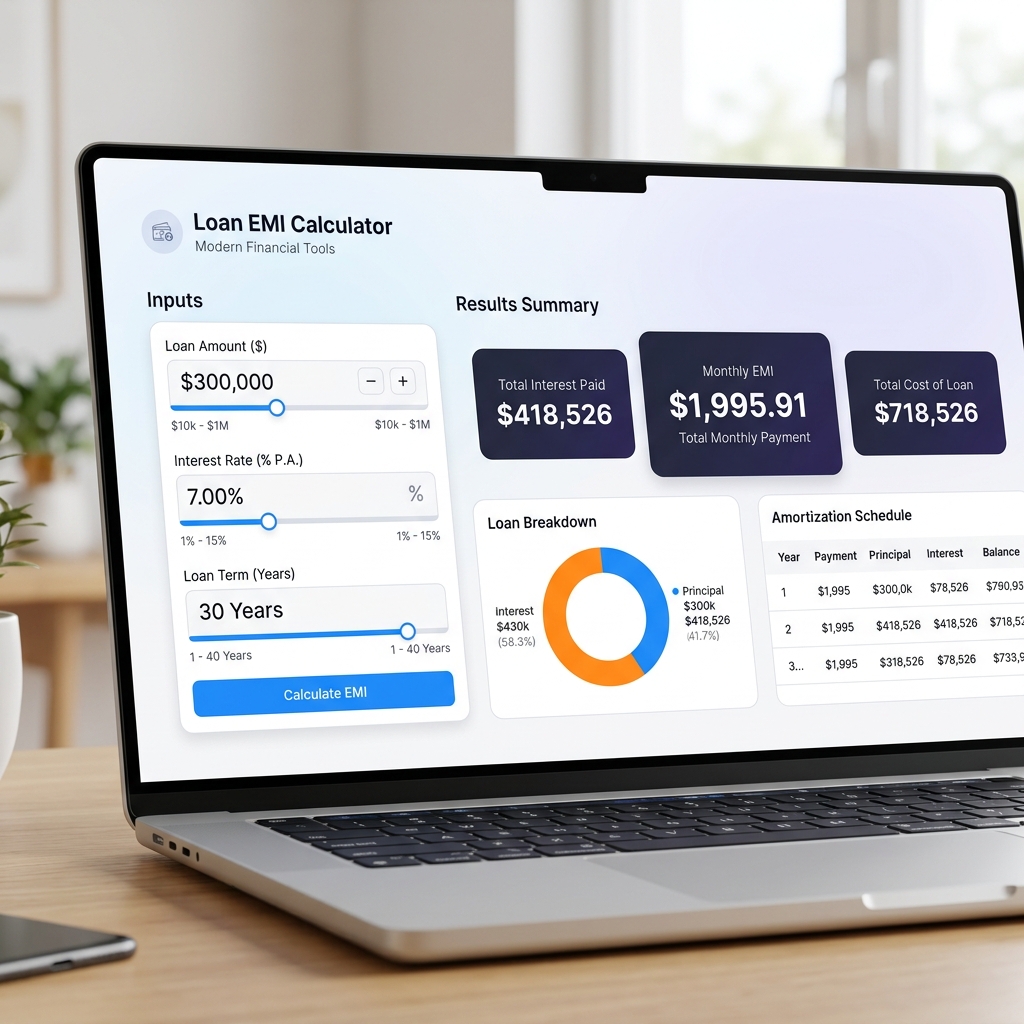
How monthly loan payments are calculated
Every lender uses the same standard amortization formula — recognised by CFPB (US), FCA (UK), FCAC (Canada), and ASIC (Australia). Most borrowers never see it, which is why a 0.5% rate difference on a $300,000 mortgage — just $90/month — adds up to $32,000 over 30 years.
Standard Loan Amortization Formula
P = Loan principal amount
r = Annual rate ÷ 12 ÷ 100
n = Years × 12 (months)
Worked example: $25,000 auto loan payment
Borrowing $25,000 at 7% APR for 60 months:
What a loan amortization schedule tells you
A loan amortization schedule shows — month by month — exactly how much of each payment goes to interest and how much reduces your balance. Lenders rarely explain this, and it costs most borrowers tens of thousands in missed savings.
Why early payments feel like they do nothing
On a $300,000 mortgage at 6.5%, Month 1 sends $1,625 to interest and only $271 toward your actual balance. By Month 360, nearly the entire payment reduces principal. This front-loading is intentional — understanding it makes extra payments obvious.
Sample amortization schedule — $300,000 at 6.5% for 30 years
← scroll →
| Month | Payment | Interest | Principal | Balance |
|---|---|---|---|---|
| 1 | $1,896 | $1,625 | $271 | $299,728 |
| 12 | $1,896 | $1,624 | $272 | $296,513 |
| 60 | $1,896 | $1,594 | $302 | $275,950 |
| 120 | $1,896 | $1,547 | $349 | $267,368 |
| 240 | $1,896 | $1,401 | $495 | $241,793 |
| 360 | $1,896 | $10 | $1,886 | $0 |
Monthly loan payment quick-reference — 2026
All figures at 7% annual rate — close to US averages as of May 2026. A 15-year mortgage costs $700/month more than a 30-year but saves over $233,000 in total interest.
← scroll →
| Loan Amount | Type / Term | Monthly | Total Interest | Total Cost |
|---|---|---|---|---|
| $15,000 | Personal · 36 mo | $463 | $1,668 | $16,668 |
| $25,000 | Auto · 60 mo | $495 | $4,700 | $29,700 |
| $35,000 | Auto · 72 mo | $378 | $7,216 | $42,216 |
| $50,000 | Student · 10 yr | $581 | $19,720 | $69,720 |
| $200,000 | Mortgage · 30 yr | $1,331 | $279,160 | $479,160 |
| $300,000 | Mortgage · 30 yr | $1,996 | $418,740 | $718,740 |
| $300,000 | Mortgage · 15 yr | $2,696 | $185,280 | $485,280 |
| $400,000 | Mortgage · 30 yr | $2,661 | $558,320 | $958,320 |
Skip the math — get your loan payment in 10 seconds
Monthly payment · Full amortization schedule · Extra payment savings · Works for any loan worldwide.
Current mortgage rates — US, UK, Canada, Australia, India (May 2026)
A 0.5% rate difference on $300,000 equals roughly $30,000 over 30 years. Always get at least 3 quotes. Rates change daily — verify with your lender.
← scroll →
| Country | Loan Type | Rate Range | Note |
|---|---|---|---|
| 🇺🇸 US | 30-yr Fixed Mortgage | 6.30–6.55% | Bankrate May 2026 |
| 🇺🇸 US | Auto Loan (new car) | 6.50–8.00% | 48–72 month terms |
| 🇺🇸 US | Personal Loan | 10–22% | 1–5 year terms |
| 🇬🇧 UK | 2-yr Fixed Mortgage | 4.20–5.10% | Most popular term |
| 🇨🇦 CA | 5-yr Fixed Mortgage | 4.40–5.25% | Stress test applies |
| 🇦🇺 AU | Variable Home Loan | 5.90–7.40% | RBA benchmark rate |
| 🇮🇳 IN | Home Loan (EMI) | 7.10–9.90% | RBI repo rate linked |
Sources: Bankrate, Freddie Mac, Bank of England, RBA, RBI — May 2026.
Extra mortgage payments: how to save $74,000+
Every dollar you pay early eliminates future interest on that dollar for the remaining life of the loan. The table uses a $300,000 mortgage at 7% for 30 years:
← scroll →
| Extra Payment | Interest Saved | New Loan Term | Time Saved |
|---|---|---|---|
| $0 (baseline) | — | 30 years | baseline |
| $100/month | $30,200 | 25yr 8mo | −4.3 yrs |
| $200/month | $74,000 | 23yr 1mo | −6.9 yrs |
| $500/month | $133,000 | 18yr 6mo | −11.5 yrs |
| $1,000/month | $177,000 | 14yr 3mo | −15.8 yrs |
How to apply extra payments correctly
Add the extra amount to your regular payment and write "apply to principal" in the memo field. Most US lenders honour this. Always verify on your next statement that the extra reduced your balance, not just your next due date.
Biweekly mortgage payments — the $90,000 strategy
52 weeks ÷ 2 = 26 half-payments per year, which equals 13 full monthly payments instead of 12. That one extra payment goes entirely to principal every year.
$400,000
Loan Amount
~$90,000
Interest Saved
5 years
Time Saved
On a $400,000 mortgage at 6.5% for 30 years, switching to biweekly payments saves ~$90,000 in total interest and finishes the loan 5 years early — with zero increase to your monthly budget.
Fixed vs variable rate mortgage — which is better in 2026?
Fixed Rate Mortgage
Best for most in 2026- Monthly payment never changes
- Best for loans held 5+ years
- US 30-yr fixed: ~6.39% (May 2026)
- Protects against future rate rises
Variable Rate Mortgage
Only if selling/refinancing soon- Rate moves with SOFR / BoE / RBA
- Starts lower than fixed initially
- Risk: payments can rise
- ARM gap vs fixed is small in 2026
How much home loan can I afford?
Most US lenders use the debt-to-income ratio (DTI) — total monthly debt as a percentage of gross income. Standard cap: 43%; most lenders prefer 36% or lower.
Quick home loan affordability example
Hidden costs your calculator won't show
Property taxes ($200–$600/mo), homeowner's insurance (~$150/mo), PMI if down payment is under 20%, HOA fees, and maintenance (1–2% of home value/year) typically add $400–$900/month on top of your base mortgage. Your truly affordable loan is usually 15–20% less than the raw number.
Car loan monthly payment guide
A 72-month auto loan looks affordable monthly but costs 15–20% more in total interest and leaves you underwater on a depreciating asset for the first several years.
← scroll →
| Credit Score | New Car Rate | Used Car Rate |
|---|---|---|
| 750+ (Excellent) | 5.5–7.0% | 6.5–8.0% |
| 700–749 (Good) | 6.5–8.5% | 7.5–10.0% |
| 650–699 (Fair) | 8.5–12.0% | 10.0–15.0% |
| Below 650 | 14–20%+ | 18–25%+ |
The 72-month and 84-month car loan trap
Long-term auto loans lower the monthly payment but cost 15–20% more in total interest — and leave you owing more than the car is worth for years. Stick to 48–60 months.
10 smart loan strategies for 2026
Make one extra loan payment per year
Apply your tax refund or bonus directly to principal. A $2,000 extra payment on a $300,000 mortgage shortens the loan by 3–4 years.
Switch to biweekly mortgage payments
Pay half your monthly amount every two weeks — 13 full payments per year. Saves ~$90,000 on a $400K mortgage at 6.5%.
Never extend a car loan beyond 60 months
72 and 84-month loans cost 15–20% more in total. You'll owe more than the car is worth for years.
Always compare at least 3 lenders
A 0.5% rate difference on $300,000 equals ~$30,000 over 30 years. Pre-approval from multiple lenders takes one afternoon.
Keep total monthly debt under 36% of income
Above 40%, one unexpected expense can trigger a missed payment. Build your buffer before adding more debt.
Refinance when rates drop 1%+ and you'll stay
Break-even = closing costs ÷ monthly savings. If under 30 months and you're staying, refinancing makes sense.
4 More Strategies
Frequently asked questions
- How do I calculate my monthly loan payment?
- Use: Monthly Payment = [P × r × (1+r)^n] ÷ [(1+r)^n – 1], where P = loan amount, r = annual rate ÷ 12 ÷ 100, n = total months. Example: $25,000 at 7% for 60 months = $495/month, with $4,702 total interest.
- How much does paying $200 extra per month save on a $300,000 mortgage?
- At 7% over 30 years: $200 extra/month saves $74,000 in interest and cuts 6.9 years. Even $100 extra saves $30,200 and cuts 4.3 years.
- Do biweekly mortgage payments really save money?
- Yes. You make 26 half-payments per year — equal to 13 full payments. That extra annual payment reduces principal. On $400,000 at 6.5%, this saves ~$90,000 and finishes the loan 5 years early.
- Fixed or variable rate mortgage — which is better in 2026?
- Fixed is better for most in 2026. US 30-year fixed rates are ~6.39%. Variable offers minimal savings vs the risk of rising payments. Choose variable only if selling or refinancing within 3–5 years.
- How much home loan can I afford?
- Standard rule: total monthly debt ≤ 36% of gross income. On $8,000/month with $650 in other debt, max mortgage is ~$2,230/month — supporting ~$353,000 at 6.5% over 30 years. Add taxes, insurance, and maintenance.
- What credit score do I need for the best mortgage rate?
- 760+ typically qualifies for the best rates. 700–759 may add 0.25–0.5%. Below 640, rates jump significantly. Even a 20-point improvement before applying can save thousands.
Calculate your exact payment + full amortization schedule
Monthly payment · Full amortization schedule · Extra payment savings · Works for any loan worldwide.
All calculations use the standard actuarial amortization method consistent with CFPB (US), FCA (UK), FCAC (Canada), and ASIC (Australia) guidelines. Rate data sourced from Bankrate, Freddie Mac, and regional central banks as of May 2026. Rates change daily — always verify with your lender. This guide is informational and does not constitute financial advice.
Last updated: May 28, 2026