In This Guide
- 1The 30% rule — where it came from and what it really means
- 2The gross income illusion no one tells you about
- 3Three ways to calculate your rent budget
- 4How much rent by salary: $25K–$150K reference table
- 5How much rent by hourly wage: $15–$50/hr table
- 6What salary you need in 13 major US cities
- 7What landlords require — the 3× rule and what they don't tell you
- 8Debt-to-income ratios: front-end and back-end explained
- 9The 50/30/20 rule applied to rent
- 10The renter's emergency fund rule nobody mentions
- 11When you can't afford the 30% rule — what to do
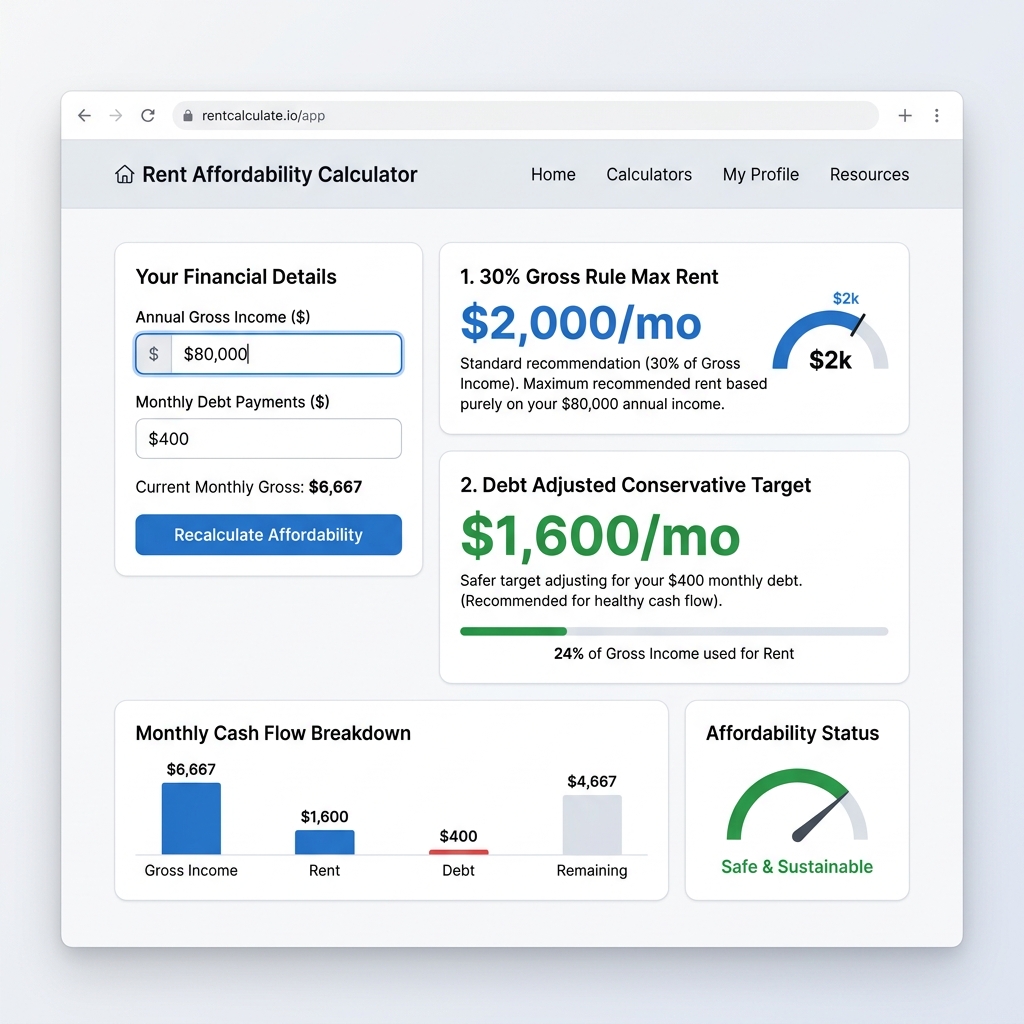
- 12Use the free rent affordability calculator
The 30% rule — where it came from and what it really means
The 30% rule has been the standard benchmark for rent affordability since 1981, when the US government established it as the threshold for "affordable housing" in federal housing assistance programmes. The idea is simple: spend no more than 30% of your gross monthly income on rent.
On a $5,000/month gross income, the 30% rule gives $1,500/month maximum rent. On $6,250/month, it gives $1,875. On $8,333/month, it gives $2,500. The math is easy, which is exactly why landlords love it — they can check your income quickly and make a decision.
But here's what the rule was never designed to do: accurately reflect what you can genuinely afford after taxes, debt, and real living costs. It was created as a public housing eligibility benchmark, not as personal financial advice. Understanding this distinction is the key to making smarter housing decisions.
The gross income illusion no one tells you about
Here is the most important thing most rent guides skip entirely: the 30% rule uses gross income — your salary before any taxes are deducted. After federal income tax, FICA (Social Security 6.2% + Medicare 1.45%), and state income tax, most US workers take home only 70–80% of their gross pay. This means that 30% of gross is actually 37–43% of your real take-home money.
The gross income illusion — what 30% really costs you
$50,000/yr ($4,167/mo gross)
30% rule: $1,250/mo
Take-home: $3,300–$3,500/mo
Real cost: 36–38% of take-home
$75,000/yr ($6,250/mo gross)
30% rule: $1,875/mo
Take-home: $4,800–$5,200/mo
Real cost: 36–39% of take-home
$100,000/yr ($8,333/mo gross)
30% rule: $2,500/mo
Take-home: $6,000–$7,000/mo
Real cost: 36–42% of take-home
$30,000/yr ($2,500/mo gross)
30% rule: $750/mo
Take-home: $2,050–$2,150/mo
Real cost: 35–37% of take-home
This is why using net income (30% of take-home, not gross) gives a more honest picture of what you can afford without financial stress. Use our calculator to see both figures side by side.
Three ways to calculate your rent budget — which to use and when
There is no single universally correct answer to how much rent you can afford. The right method depends on what you're trying to do:
The 30% Gross Income Rule
Use when: applying for an apartmentThis is the standard landlords use. Most rental applications require gross monthly income of at least 3× the monthly rent — roughly equivalent to the 30% gross threshold. You'll need to meet this to qualify, regardless of your actual budget. On a $5,000/month gross income, your maximum qualifying rent is $1,500/month.
Limitation: doesn't account for taxes, debt, savings goals, or high-cost-of-living states.
Conservative Net Income Method
Use when: personal budgeting and deciding whether you can actually afford itCalculate your actual monthly take-home after all taxes, then apply 30% to that figure. This gives a rent budget that genuinely leaves room for savings, debt repayment, and living expenses. It's typically $200–$400/month lower than the gross-income rule — and far more sustainable long-term.
Limitation: landlords don't use this. It's for your planning, not your application.
Debt-Adjusted Budget Method
Use when: you have student loans, car payments, or credit card debtStart with net take-home. Subtract all monthly debt payments. Subtract a minimum savings target (20% of net is the standard). The remainder, minus a buffer for utilities and necessities, is your true available rent budget. Every dollar of debt you carry reduces your rent budget by approximately that same dollar.
Limitation: requires accurate knowledge of all monthly debt obligations — which changes as you pay debt down.
How much rent can I afford by salary? ($25K–$150K)
All figures assume no pre-existing debt. The conservative column uses 30% of estimated net take-home (after federal + average state tax).
| Annual Salary | Monthly Gross | 30% Rule Max | Est. Take-Home | Conservative Rent | Income Needed (3×) |
|---|---|---|---|---|---|
| $25,000 | $2,083 | $625/mo | $1,700/mo | $510–$595/mo | $28,800/yr |
| $30,000 | $2,500 | $750/mo | $2,050/mo | $615–$718/mo | $36,000/yr |
| $40,000 | $3,333 | $1,000/mo | $2,730/mo | $820–$955/mo | $43,200/yr |
| $50,000 | $4,167 | $1,250/mo | $3,400/mo | $1,020–$1,190/mo | $54,000/yr |
| $60,000 | $5,000 | $1,500/mo | $4,050/mo | $1,215–$1,418/mo | $64,800/yr |
| $75,000 | $6,250 | $1,875/mo | $4,950/mo | $1,485–$1,733/mo | $72,000/yr |
| $80,000 | $6,667 | $2,000/mo | $5,250/mo | $1,575–$1,838/mo | $90,000/yr |
| $100,000 | $8,333 | $2,500/mo | $6,500/mo | $1,950–$2,275/mo | $108,000/yr |
| $120,000 | $10,000 | $3,000/mo | $7,700/mo | $2,310–$2,695/mo | $126,000/yr |
| $150,000 | $12,500 | $3,750/mo | $9,500/mo | $2,850–$3,325/mo | $144,000/yr |
Conservative rent = 30% of estimated net take-home (federal + avg state tax). Income needed uses the landlord 3× monthly rent rule.
Get your real rent budget in 30 seconds
30% rule · Conservative net income · Debt-adjusted method · DTI analysis · 50/30/20 breakdown.
What rent can I afford by hourly wage? ($15–$50/hr)
Based on 40 hours/week × 52 weeks/year. After-tax figures assume national average effective rate.
| Hourly Wage | Annual Gross | Max Rent (30%) | Est. Take-Home/mo | Conservative | Market Reality |
|---|---|---|---|---|---|
| $15/hr (min wage) | $31,200 | $780/mo | $2,100/mo | $630/mo | Midwest/South low-cost markets only |
| $18/hr | $37,440 | $936/mo | $2,500/mo | $750/mo | Affordable in lower-cost markets |
| $20/hr | $41,600 | $1,040/mo | $2,800/mo | $840/mo | Tight in most metro areas |
| $22/hr | $45,760 | $1,144/mo | $3,050/mo | $915/mo | Comfortable in mid-tier cities |
| $25/hr | $52,000 | $1,300/mo | $3,450/mo | $1,035/mo | Feasible in most US cities |
| $30/hr | $62,400 | $1,560/mo | $4,100/mo | $1,230/mo | Comfortable in most markets |
| $35/hr | $72,800 | $1,820/mo | $4,750/mo | $1,425/mo | Good flexibility in most markets |
| $40/hr | $83,200 | $2,080/mo | $5,400/mo | $1,620/mo | Comfortably affords most 1BR units |
| $50/hr | $104,000 | $2,600/mo | $6,700/mo | $2,010/mo | Affords most 2BR across the US |
Average US rent in 2026: $1,800–$2,000/month. Workers earning under $30/hr face significant affordability challenges in major metro areas.
What salary do you need in 13 major US cities? (2026)
Based on median 1-bedroom rent · 30% gross income rule · standard 3× landlord qualification. Affordability assessed against a $75,000 annual salary.
| City | Median 1BR Rent | Income Needed (3×) | Annual Salary Required | At $75K Salary |
|---|---|---|---|---|
| 🌆 New York City, NY | $3,400 | $10,200/mo | $122,400/yr | Unaffordable on $75K |
| 🌉 San Francisco, CA | $3,200 | $9,600/mo | $115,200/yr | Unaffordable on $75K |
| 🌊 Boston, MA | $3,400 | $10,200/mo | $122,400/yr | Unaffordable on $75K |
| 🌴 Miami, FL | $2,800 | $8,400/mo | $100,800/yr | Very stretched |
| ☀️ Los Angeles, CA | $2,600 | $7,800/mo | $93,600/yr | Very stretched |
| 🌧️ Seattle, WA | $2,300 | $6,900/mo | $82,800/yr | Stretched on $75K |
| 🤠 Austin, TX | $1,700 | $5,100/mo | $61,200/yr | Borderline |
| 🏙️ Chicago, IL | $1,800 | $5,400/mo | $64,800/yr | Borderline |
| 🌸 Atlanta, GA | $1,600 | $4,800/mo | $57,600/yr | Affordable ✓ |
| 🌵 Phoenix, AZ | $1,400 | $4,200/mo | $50,400/yr | Affordable ✓ |
| 🎸 Nashville, TN | $1,600 | $4,800/mo | $57,600/yr | Affordable ✓ |
| 🌾 Columbus, OH | $1,150 | $3,450/mo | $41,400/yr | Very Affordable ✓ |
| 🌊 Indianapolis, IN | $1,100 | $3,300/mo | $39,600/yr | Very Affordable ✓ |
Sources: Zillow, Rent.com, CoStar 2026 estimates. Rents change rapidly — verify current rates before making housing decisions.
What landlords require — the 3× rule and what they don't tell you
The 3× income rule — your gross monthly income must be at least three times the monthly rent — is not a law. It's an industry convention that landlords use because it correlates with lower default rates. Understanding its nuances can make or break your apartment search.
Standard 3× income requirement by rent level
| Monthly Rent | Required Monthly Gross | Required Annual Income |
|---|---|---|
| $800/mo | $2,400/mo | $28,800 |
| $1,000/mo | $3,000/mo | $36,000 |
| $1,200/mo | $3,600/mo | $43,200 |
| $1,500/mo | $4,500/mo | $54,000 |
| $2,000/mo | $6,000/mo | $72,000 |
| $2,500/mo | $7,500/mo | $90,000 |
| $3,000/mo | $9,000/mo | $108,000 |
| $3,500/mo | $10,500/mo | $126,000 |
What landlords never tell you
NYC and Boston use 40× annual rule
In highly competitive markets, some landlords require annual income ≥ 40× monthly rent. For $2,000/month: 40 × $2,000 = $80,000/year — stricter than the 3× rule ($72,000). Know which standard your target landlord uses before applying.
Roommates' incomes are combined
For a $3,000/month shared apartment with two roommates, each person only needs to qualify at $1,500/month rent — requiring $54,000/year individually, not $108,000. This makes shared housing dramatically more accessible.
Guarantors can cover income gaps
If your income doesn't meet the threshold, a co-signer (guarantor) with sufficient income — often 5× or 6× the monthly rent — can vouch for your lease. Common for students and recent graduates. Some landlords accept institutional guarantors like Insurent for a fee.
Self-employed income is evaluated differently
Freelancers and contractors typically need 2 years of tax returns showing consistent net income. Landlords use Schedule C net profit, not gross revenue. If your business expenses are high, your qualifying income may be far lower than your total invoiced revenue.
Debt-to-income ratios: front-end and back-end explained
Your debt-to-income ratio (DTI) is the most accurate measure of rent affordability. Mortgage lenders use it as their primary qualification metric — and it works just as well for renting.
Front-End DTI (Housing Ratio)
Formula: Monthly rent ÷ gross monthly income
Example: $1,500 ÷ $5,000 gross = 30% ✓
Below 28% → Excellent
28–33% → Acceptable (landlord threshold)
Above 33% → May not qualify
Back-End DTI (All Debt)
Formula: (Rent + all monthly debt) ÷ gross monthly income
Example: ($1,500 + $400 debt) ÷ $5,000 = 38% ⚠
Below 36% → Financially healthy
36–43% → Stretched but manageable
Above 43% → High stress — reconsider
The real-world impact of debt on rent budget: If you earn $5,000/month gross and carry $500/month in debt (car loan + student loans), your back-end DTI at the 36% ceiling is $1,800 total (rent + debt). Subtract $500 debt and your maximum safe rent is $1,300 — not the $1,500 the 30% front-end rule suggests. Higher debt directly compresses your rent ceiling.
The 50/30/20 rule applied to rent — the budget framework that actually works
The 50/30/20 rule, popularized by Senator Elizabeth Warren in her book "All Your Worth," divides net take-home pay into three buckets. Applied to rent, it gives a clearer framework than the 30% gross rule because it uses real money — what you actually have available to spend.
50% — Needs
- › Rent, utilities, groceries, transport, insurance
- › Minimum debt payments
- › Rent alone should be under 30% of this 50% bucket
- › If rent is at 50% of take-home, you have zero buffer for any other needs
At $3,500/mo take-home: needs bucket = $1,750/mo. Rent should ideally be under $1,050/mo to leave room for all other needs.
30% — Wants
- › Dining out, entertainment, travel, hobbies
- › Subscriptions, clothing, personal care beyond basics
- › This is the first category to disappear if rent is too high
- › Many renters in high-cost cities have zero want budget
If your rent alone consumes 40%+ of take-home, this bucket is effectively gone — every dollar of excess rent comes from somewhere.
20% — Savings & debt payoff
- › Emergency fund (3–6 months of expenses)
- › Retirement contributions (401k, IRA)
- › Extra debt payments above minimums
- › This is the category that compounds into long-term wealth
Never let rent eat into this permanently. Every $100/month you can't save compounds to $80,000+ less at retirement over 30 years (7% annual return).
The renter's emergency fund rule nobody mentions
Most personal finance guides tell you to build a 3–6 month emergency fund. What they don't specify: renters need a specifically sized renter's emergency fund before they even move in, plus ongoing reserves for scenarios unique to renters.
| Cost | Typical Amount | Note |
|---|---|---|
| Security deposit | 1–2 months rent | Often non-refundable if you break lease early |
| First month upfront | 1 month rent | Due at lease signing, before you move in |
| Last month buffer | 2 months rent | Cover rent if you lose income while job searching |
| Moving costs (local) | $1,000–$2,500 | Professional movers for 1BR in 2026 |
| Moving (interstate) | $4,000–$10,000 | Cross-country move with full-service movers |
| Lease break penalty | 1–3 months rent typically | Varies by lease — know this before signing |
| Total move-in fund | 4–5 months rent + moving | Absolute minimum before committing to a lease |
The renter's rule of thumb
Before signing any lease, ensure you have at least 4–5 months of rent in liquid savings. This covers move-in costs (security deposit + first month), a buffer for job disruption (2 months), and minor emergencies — without touching your long-term investments or retirement accounts.
When you can't afford the 30% rule — what to do
In New York, San Francisco, Boston, Miami, and Los Angeles, the 30% rule is practically impossible for workers earning below $80,000–$120,000. Renters in these markets routinely spend 35–50% of income on housing — not from financial failure, but from market reality. Here are the options that actually work:
Roommates — the most effective tool
Sharing a $3,000/month apartment with one roommate brings your per-person cost to $1,500/month — a $54,000/year income qualifies. With two roommates: $1,000/month, requiring only $36,000/year. Roommates can reduce your effective housing cost by 33–50% without changing your income.
Commuter suburbs — the time-money tradeoff
Living 30–45 minutes outside major metros can reduce rent by $600–$1,500/month. Calculate the total cost: commuting adds time (30 min × 2 × 250 days = 250 hours/year) and money ($150–$400/month in transit or gas). The net savings are often still $400–$800/month, which compounds significantly.
Pre-tax deductions to effectively increase take-home for rent
Maximizing your 401(k) reduces federal and state taxable income, lowering your tax bill. The after-tax cost of a $500/month 401(k) contribution is only $350–$380 (depending on your bracket) — meaning you save $120–$150/month in taxes. This money could go toward rent. Health insurance premiums through a Section 125 plan also reduce FICA, creating additional take-home for housing.
Negotiate rent — more effective in 2026 than ever
In markets where rental vacancy rates have risen (Sun Belt cities, suburban metros), landlords have increased negotiating flexibility. Offering a longer lease (18 or 24 months), paying several months upfront, or being a verifiably excellent tenant (high credit score, stable employment) can often negotiate $100–$300/month off listed rent.
Calculate your exact rent budget — debt-adjusted
Enter your salary, monthly debt, and see all three methods: 30% gross rule, conservative net income, and debt-adjusted budget. Plus landlord qualification check.
Rent data sourced from Zillow, Rent.com, and CoStar 2026 estimates. City median rents change rapidly — verify current rates before making housing decisions. Take-home estimates use 2026 IRS federal tax brackets and national average state tax rate. Individual results vary by state, filing status, deductions, and employer benefits. Not financial or legal advice. Consult a licensed financial advisor or housing counselor for major housing decisions.
Last updated: May 2026