In This Guide
- 1How your paycheck is calculated
- 22026 federal income tax brackets
- 3FICA: Social Security & Medicare explained
- 42026 key IRS numbers
- 5Salary take-home table: $40K–$200K
- 6State income tax comparison
- 7States with zero income tax
- 8How 401(k) & HSA reduce your tax bill
- 9California vs Texas take-home comparison
- 10New York City paycheck — city tax included
- 11How to maximize your take-home pay
- 12Use the free paycheck calculator
How your paycheck is calculated
Every paycheck follows the same equation. It's not complicated once you see it clearly:
Net Pay = Gross Pay
− Federal Income Tax
− State Income Tax
− FICA (Social Security 6.2% + Medicare 1.45%)
− Pre-Tax Deductions (401k, HSA, health insurance)
− Post-Tax Deductions
− Local Taxes (NYC, Philadelphia, etc.)
For most middle-income workers, net pay is 65–80% of gross pay. In high-tax states at higher incomes, it can drop below 65%.
2026 federal income tax brackets
These are marginal brackets — only the income within each bracket is taxed at that rate, not your entire salary. The IRS adjusted all thresholds roughly 2.8–4% for inflation in 2026.
Single filers
| Rate | Taxable Income Range |
|---|---|
| 10% | $0 – $12,400 |
| 12% | $12,401 – $50,400 |
| 22% | $50,401 – $105,700 |
| 24% | $105,701 – $201,775 |
| 32% | $201,776 – $256,225 |
| 35% | $256,226 – $640,600 |
| 37% | Over $640,600 |
Standard deduction: $16,100 (single) · $32,200 (married filing jointly) · $24,150 (head of household)
Marginal vs effective rate — the most misunderstood thing in US taxes
If you earn $60,000 single in 2026, you are not taxed at 22% on your whole salary. After the $16,100 standard deduction, your taxable income is $43,900. The first $12,400 is taxed at 10% ($1,240), the rest at 12% ($3,780). Total federal tax: $5,020. Effective rate: 8.4% — not 22%.
FICA: Social Security & Medicare explained
FICA is mandatory — there's no way to reduce or avoid it through deductions or filing status. Both you and your employer each pay half.
| Tax | Rate | Wage Cap | Max Employee Tax |
|---|---|---|---|
| Social Security | 6.2% | $184,500 | $11,439 |
| Medicare | 1.45% | No cap | Unlimited |
| Additional Medicare | 0.9% | Wages over $200K (single) | Varies |
Self-employed? You pay both sides
W-2 employees pay 7.65% FICA. Self-employed workers pay the full 15.3% self-employment tax. The IRS does allow deducting half of the SE tax from taxable income, which softens the hit.
2026 key IRS numbers
Sourced from IRS Revenue Procedure 2025-32 and the Social Security Administration. The One Big Beautiful Bill (signed July 4, 2025) permanently extended TCJA provisions and introduced the new Senior Bonus Deduction.
$184,500
Social Security wage base
6.2% stops here
$24,500
401(k) limit (under 50)
+$6,500 catch-up at 50+
$16,100
Standard deduction — single
Up from $15,750
$32,200
Standard deduction — married
Filing jointly
$4,400
HSA limit — self-only
+$350 from 2025
$8,750
HSA limit — family
+$400 from 2025
$6,000
Senior Bonus Deduction (65+)
New for 2026
$11,439
Max SS tax (employee)
6.2% × $184,500
Salary take-home table: $40K–$200K (2026)
Single filer · No pre-tax deductions · US national average state tax (~4%). Your actual take-home will vary by state — use the calculator for your exact figure.
| Salary | Federal Tax | FICA | Avg State Tax | Monthly Net | Annual Net | Eff. Rate |
|---|---|---|---|---|---|---|
| $40,000 | $2,568 | $3,060 | $1,600 | $2,731 | $32,772 | 18.1% |
| $50,000 | $4,068 | $3,825 | $2,000 | $3,342 | $40,107 | 19.8% |
| $60,000 | $5,918 | $4,590 | $2,400 | $3,924 | $47,092 | 21.5% |
| $75,000 | $9,043 | $5,738 | $3,000 | $4,768 | $57,219 | 23.7% |
| $100,000 | $15,794 | $7,650 | $4,000 | $6,046 | $72,556 | 27.4% |
| $120,000 | $21,294 | $9,180 | $4,800 | $7,060 | $84,726 | 29.4% |
| $150,000 | $30,544 | $11,475 | $6,000 | $8,582 | $102,981 | 31.3% |
| $200,000 | $46,544 | $14,505 | $8,000 | $10,996 | $131,951 | 34.0% |
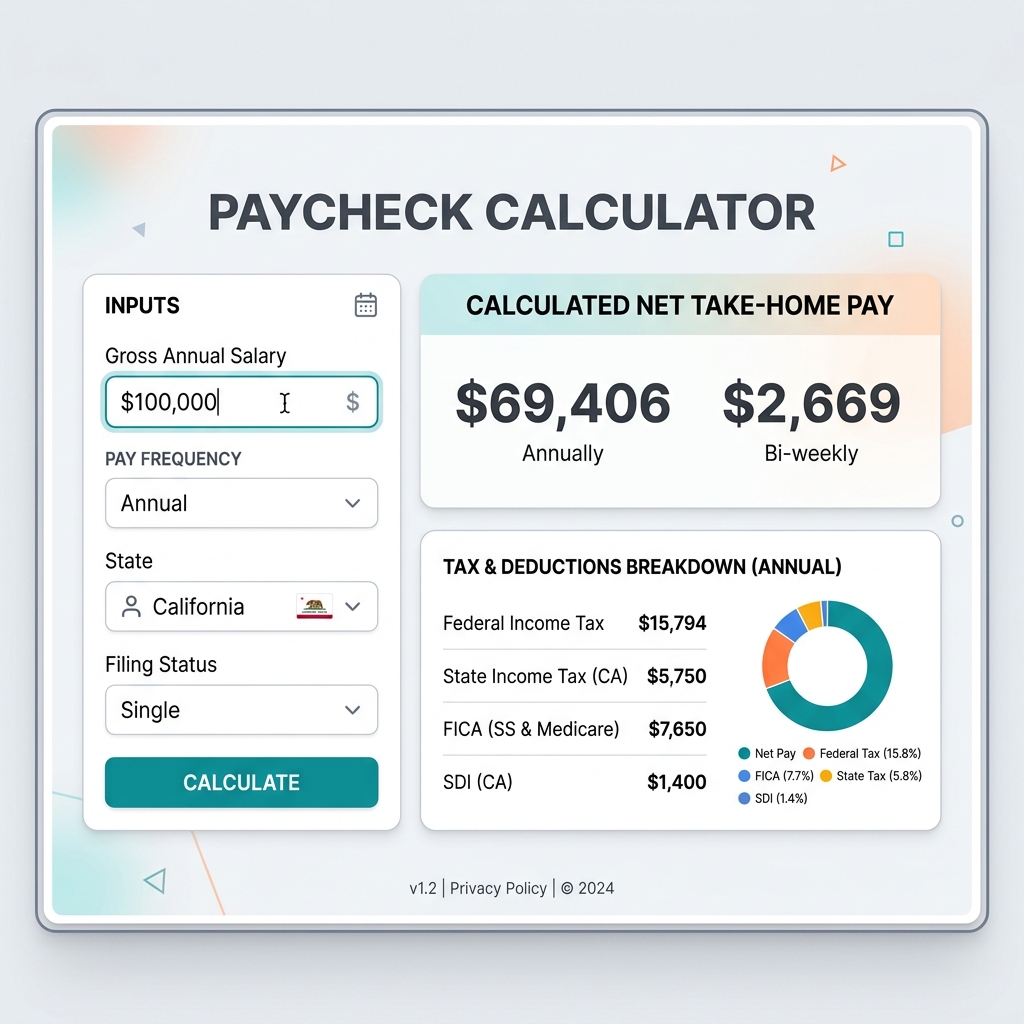
Skip the estimates — get your exact number
All 50 states · Federal + state tax · FICA · 401(k) · HSA · Health insurance · 2026 IRS rates.
State income tax comparison (2026)
Impact on a $75,000 salary, single filer. This shows why state selection matters more than most people realize.
| State | Rate | State Tax on $75K | Est. Take-Home | vs No-Tax State |
|---|---|---|---|---|
| 🏖️ Florida | 0% | $0 | $57,219 | — |
| 🤠 Texas | 0% | $0 | $57,219 | — |
| ☀️ Nevada | 0% | $0 | $57,219 | — |
| 🌲 Washington | 0%* | $0 | $57,219 | — |
| 🌵 Arizona | 2.5% | $1,875 | $55,344 | −$1,875 |
| Pennsylvania | 3.07% | $2,303 | $54,916 | −$2,303 |
| 🏔️ Colorado | 4.4% | $3,300 | $53,919 | −$3,300 |
| 🌸 Georgia | 5.49% | $4,118 | $53,101 | −$4,118 |
| 🗽 New York | 4–10.9% | $4,780 | $52,439 | −$4,780 |
| 🌉 California | 1–13.3% | $5,750 | $51,469 | −$5,750 |
*Washington has no wage income tax but does have a 7% capital gains tax above $270,000 (2026). California figures include SDI.
States with zero income tax — 2026
🤠 Texas
No income tax
🏖️ Florida
No income tax
🎰 Nevada
No income tax
❄️ Alaska
No income tax
🌾 South Dakota
No income tax
🦅 Wyoming
No income tax
⛵ Tennessee
No wage income tax
🌿 N. Hampshire
No wage income tax
🌲 Washington
No wage tax*
Moving from California to Texas on a $100,000 salary saves roughly $6,150/year (~$512/month) in state income tax alone. At $150,000, the gap grows to $9,100/year.
How 401(k) & HSA reduce your tax bill
Pre-tax deductions reduce your taxable income before federal and state taxes are calculated. Every dollar you put into a qualifying pre-tax account saves real cash — not just deferred money.
| Deduction | 2026 Amount | Fed Tax Saved (22%) | FICA Saved | Total Saved |
|---|---|---|---|---|
| 401(k) 5% ($75K salary) | $3,750/yr | $450–825 | $0 | $600–$1,020 |
| 401(k) max (under 50) | $24,500/yr | $5,390 | $0 | $5,390+ |
| HSA self-only | $4,400/yr | $968 | $337 | $1,305 |
| HSA family | $8,750/yr | $1,925 | $669 | $2,594 |
| Health insurance $300/mo | $3,600/yr | $792 | $275 | $1,067 |
| FSA | $3,400/yr | $748 | $260 | $1,008 |
HSA: the triple tax advantage
HSA contributions are pre-tax (reduce taxable income), growth is tax-free, and withdrawals for qualified medical expenses are tax-free. The 2026 limits are $4,400 (self-only) and $8,750 (family). This is one of the most tax-efficient savings vehicles available to US workers.
California vs Texas take-home pay comparison
One of the most searched salary comparisons in the US — the difference is real and grows significantly with income.
| Salary | CA Take-Home | TX Take-Home | TX Advantage/yr | TX Advantage/mo |
|---|---|---|---|---|
| $60,000 | ~$43,100 | ~$47,200 | +$4,100/yr | +$342/mo |
| $80,000 | ~$56,300 | ~$61,800 | +$5,500/yr | +$458/mo |
| $100,000 | ~$71,400 | ~$77,550 | +$6,150/yr | +$513/mo |
| $150,000 | ~$101,800 | ~$110,900 | +$9,100/yr | +$758/mo |
| $200,000 | ~$128,600 | ~$139,900 | +$11,300/yr | +$942/mo |
The honest picture — property taxes matter too
Texas income tax savings are real. But Texas property tax rates average 1.6–2.4% of assessed value annually — significantly higher than California's Prop 13-capped rates. On a $500,000 home, Texas property tax can run $8,000–$12,000/year vs $5,000–$7,000 in California. Run both numbers before deciding.
New York City paycheck — city tax included
NYC workers face three layers: federal, New York State, and a separate New York City income tax — making it one of the highest-tax jurisdictions in the US.
| Federal Income Tax | ~$15,800 | 15.8% |
| Social Security (6.2%) | $6,200 | 6.2% |
| Medicare (1.45%) | $1,450 | 1.5% |
| New York State Tax | ~$6,350 | 6.4% |
| New York City Tax (≤3.876%) | ~$3,620 | 3.6% |
| Total Deductions | ~$33,420 | 33.4% |
| Annual Take-Home | ~$66,580 | 66.6% |
| Monthly Take-Home | ~$5,548 | — |
The same $100,000 in Texas nets roughly $77,550 — nearly $11,000 more per year than New York City.
How to maximize your take-home pay in 2026
Max your 401(k) — or at least hit the employer match
The 2026 limit is $24,500 (under 50). Every dollar reduces your taxable income. A 5% contribution on $75,000 saves $600–$1,020/year in taxes. If your employer matches, that's free money on top.
Open an HSA if you're on a High Deductible Health Plan
Triple tax advantage: pre-tax contributions, tax-free growth, tax-free withdrawals for medical expenses. 2026 limits: $4,400 (self-only), $8,750 (family). Balances roll over indefinitely — no use-it-or-lose-it.
Update your W-4
Many people haven't updated their W-4 since starting their job. If you've gotten married, had children, bought a home, or started a side business, your withholding is probably wrong. The IRS free Tax Withholding Estimator at irs.gov/W4app takes 10 minutes.
Use all available pre-tax benefits
Beyond 401(k) and HSA: Dependent Care FSA (up to $5,000/yr), Commuter Benefits ($340/month pre-tax for transit/parking), FSA ($3,400/yr). These are all legally reducing your taxable income.
Understand bonus withholding — it's not your final tax rate
Bonuses are withheld at a flat 22% federal rate. This doesn't mean you owe 22% — your actual rate depends on total income. You may get some back at filing. Knowing this avoids the '$5,000 bonus only netted $3,700' shock.
Calculate your exact take-home pay by state
Enter salary, select your state, add 401(k) and health insurance. See your real net paycheck broken down by federal tax, state tax, and FICA — instantly.
All tax calculations based on IRS Revenue Procedure 2025-32, Social Security Administration data, and state tax authority publications as of May 2026. Take-home estimates are for informational purposes only. Actual withholding may differ based on local taxes, W-4 elections, and employer-specific payroll configurations. Not tax advice — consult a licensed CPA or enrolled agent for your specific situation.
Last updated: May 2026