In This Guide
- 1How compound interest actually works — with real math
- 2$500 and $1,000/month savings tables over 1–30 years
- 3How much should you save per month?
- 4Realistic interest rates to use in 2026
- 5Emergency fund: how much, where to keep it
- 6How much should you have saved by age?
- 7Your FIRE number and how to reach it
- 85 strategies that actually accelerate savings
- 9The 4 savings mistakes that cost people the most
- 10Use the free savings calculator
How compound interest actually works — with real math
Compound interest is the single most powerful force in personal finance. Albert Einstein allegedly called it "the eighth wonder of the world." Whether or not he said it, the math justifies the reverence.
The compound interest formula is:
The compound interest formula:
A = P × (1 + r/n)^(n×t)
A = Final amount
P = Principal (initial deposit)
r = Annual interest rate (decimal — 7% = 0.07)
n = Compounding periods per year (12 = monthly)
t = Time in years
Simple vs compound — why the difference is massive
Simple interest earns interest only on your original principal. If you deposit $10,000 at 7% simple interest for 20 years, you earn $14,000 in interest (7% × $10,000 × 20 years).
Compound interest earns interest on your principal AND on all the interest you've already earned. That same $10,000 at 7% compounded monthly for 20 years grows to $40,103 — almost 3× more than simple interest, and 4× your original deposit, with no additional contributions.
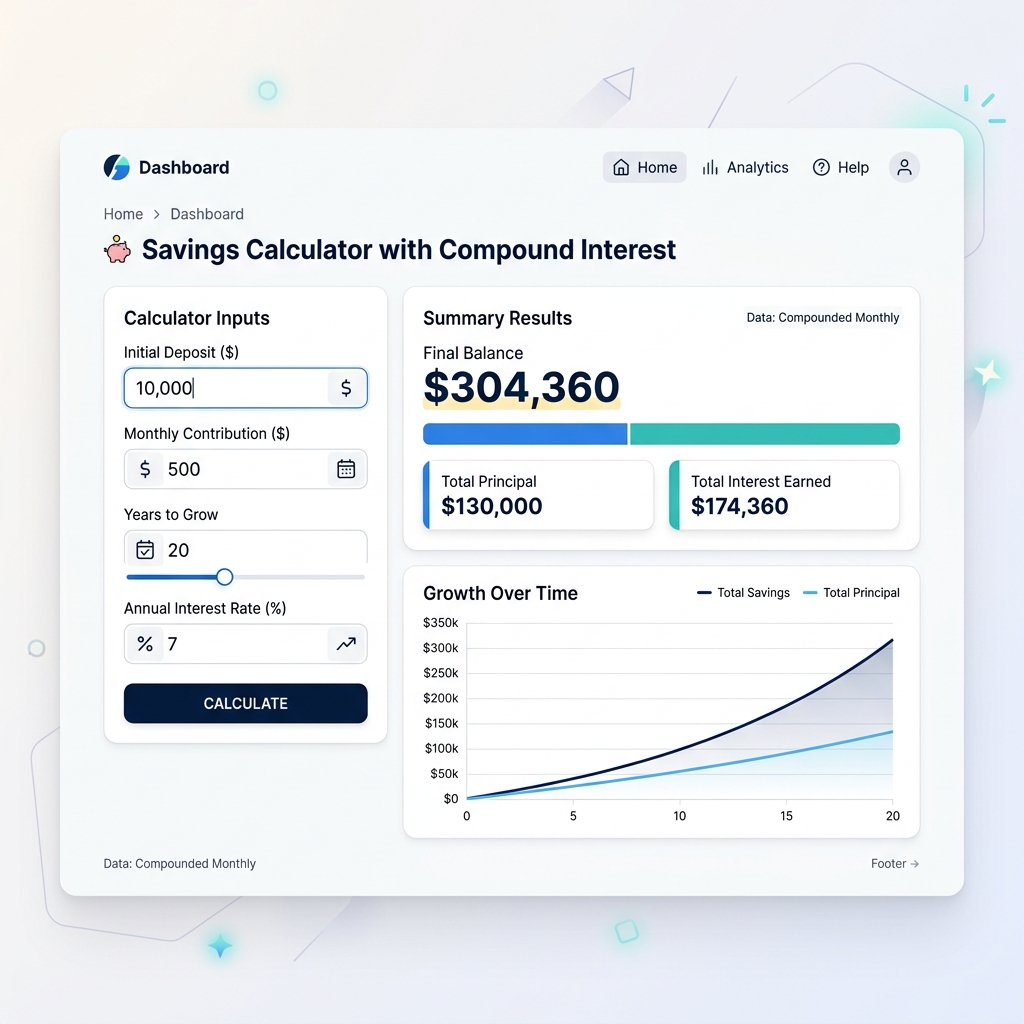
Real example: $10,000 initial deposit + $500/month for 20 years at 7%
Initial deposit: $10,000
Monthly contributions: $500 × 240 months = $120,000
Total money invested: $130,000
Final balance at 7%: $282,243
Interest earned: $152,243
Return on investment: 117% — more than doubled
You put in $130,000 over 20 years. Compound interest added another $152,243 — more than your total contributions. That's the compounding effect working for you.
The rule of 72 — how long to double your money
The Rule of 72 gives a quick mental estimate: divide 72 by your annual interest rate to find the approximate years to double your money.
| Annual Rate | Years to Double (Rule of 72) | $10,000 becomes in 20 yrs |
|---|---|---|
| 1% (basic savings) | 72 years | $12,202 |
| 3% (HYSA low) | 24 years | $18,061 |
| 5% (HYSA high) | 14.4 years | $26,533 |
| 7% (balanced fund) | 10.3 years | $38,697 |
| 10% (S&P 500 hist.) | 7.2 years | $67,275 |
$500 and $1,000/month savings tables over 1–30 years
These tables assume no initial deposit — purely monthly contributions with monthly compounding. They show exactly how much compound interest adds over time compared to simply stashing the money under a mattress.
Saving $500/month — what you'll have at different rates
| Time | Contributed (no interest) | At 5% | At 7% | At 10% |
|---|---|---|---|---|
| 1 year | $6,000 | $6,171 | $6,228 | $6,305 |
| 2 years | $12,000 | $12,698 | $12,952 | $13,382 |
| 3 years | $18,000 | $19,568 | $20,147 | $21,171 |
| 5 years | $30,000 | $34,070 | $35,519 | $38,082 |
| 10 years | $60,000 | $77,641 | $86,731 | $102,422 |
| 15 years | $90,000 | $132,385 | $155,797 | $205,511 |
| 20 years | $120,000 | $205,516 | $260,465 | $379,684 |
| 25 years | $150,000 | $303,168 | $411,267 | $662,976 |
| 30 years | $180,000 | $416,129 | $615,461 | $1,130,244 |
Saving $1,000/month — doubled contribution, not doubled result
| Time | Contributed | At 5% | At 7% | At 10% |
|---|---|---|---|---|
| 1 year | $12,000 | $12,341 | $12,456 | $12,611 |
| 2 years | $24,000 | $25,396 | $25,904 | $26,763 |
| 5 years | $60,000 | $68,140 | $71,039 | $76,163 |
| 10 years | $120,000 | $155,282 | $173,463 | $204,845 |
| 15 years | $180,000 | $264,770 | $311,594 | $411,022 |
| 20 years | $240,000 | $411,033 | $520,930 | $759,368 |
| 30 years | $360,000 | $832,258 | $1,230,922 | $2,260,488 |
The key insight these tables reveal
At 10 years, doubling your monthly contribution from $500 to $1,000 roughly doubles your balance (as you'd expect). But at 30 years, the same doubling produces a balance almost identical to doubling — because compound interest on the larger balance also roughly doubles. This means starting earlier at $500/month beats starting 5 years later at $1,000/month in almost every scenario.
Model your savings growth with any rate and timeline
Compound interest · Goal tracking · Monthly required savings · Investment breakdown pie chart.
How much should you save per month in 2026?
The right monthly savings amount depends entirely on your specific goals. There is no universal number — but there are proven frameworks.
The 50/30/20 rule — the starting point for most people
Allocate 50% of take-home pay to needs, 30% to wants, and 20% to savings and debt repayment. On a $4,000/month take-home, that's $800/month to savings. On $3,000/month, it's $600/month. This isn't optimal for aggressive wealth-building, but it's sustainable for most households and creates real progress.
→ At $800/month for 20 years at 7%: $510,832 total
The 15% retirement rule — the baseline for long-term security
Financial planners typically recommend saving 15% of gross income for retirement. This includes any employer 401(k) match. On $70,000/year gross, that's $10,500/year or $875/month. If your employer matches 3%, you need to contribute 12% ($700/month) to hit the 15% target.
→ $875/month for 30 years at 7% = $1,076,720
Goal-based calculation — the most accurate method
For a specific goal (emergency fund, house down payment, college fund), calculate backwards from your target: Monthly Required = (Goal − Current Savings × (1+r)^n) ÷ [((1+r)^n − 1) / r]. Use the savings calculator to reverse-engineer your required monthly contribution for any goal and timeline.
→ Example: $50,000 in 5 years at 5% with $5,000 already saved → need $694/month
Realistic interest rates to use in 2026
Using the right interest rate for your savings calculator is critical. Being too optimistic means planning on money you won't have. Being too conservative means undersaving unnecessarily. Here's what's realistic in 2026:
| Account / Asset Type | 2026 Rate | Best For |
|---|---|---|
| High-Yield Savings Account (HYSA) | 4.0–5.2% APY | Best for: emergency fund, short-term goals |
| Money Market Account | 4.0–5.0% APY | Best for: flexible short-term savings |
| 1-Year CD | 4.5–5.1% APY | Best for: locking in rates, 12-month horizon |
| 5-Year CD | 3.8–4.5% APY | Best for: medium-term goals with guaranteed rate |
| Treasury Bonds (10-yr yield) | ~4.3% APY | Best for: safe medium-term, tax advantages |
| Bond Index Fund | 3.5–5.5% | Best for: conservative portfolio allocation |
| S&P 500 Index Fund (historical) | ~10% nominal | Best for: long-term (10+ years), accepts volatility |
| Diversified 60/40 Portfolio | 5–7% historical | Best for: balanced risk, retirement accounts |
Inflation reduces real returns
US inflation ran at approximately 3.3% in early 2026. A 5% HYSA rate gives a real return of only ~1.7%. For long-term wealth building, use inflation-adjusted returns: subtract 2.5–3% from nominal rates. A 7% stock market return becomes approximately 4–4.5% in real purchasing power.
Emergency fund: how much, where to keep it, and when to use it
Before investing a single dollar in stocks or retirement accounts, you need a proper emergency fund. It's not optional — it's the foundation that prevents you from liquidating investments at the worst possible time when life happens.
How much emergency fund do you need?
| Your Situation | Recommended Fund | Example ($4K/mo expenses) |
|---|---|---|
| Stable job, dual income, no dependents | 3 months | $12,000 |
| Single income, stable job | 4 months | $16,000 |
| Self-employed or variable income | 6 months | $24,000 |
| Business owner, irregular income | 6–9 months | $24,000–$36,000 |
| Single income + dependents | 6 months | $24,000 |
| Any job with low stability | 6 months | $24,000 |
Where to keep your emergency fund in 2026
Keep your emergency fund in a high-yield savings account (HYSA)earning 4–5.2% APY. It needs to be liquid (accessible in 1–2 business days), FDIC-insured, and in a separate account from your regular spending to prevent accidental spending. Top HYSA options in 2026 include Marcus by Goldman Sachs, SoFi, Marcus, and most credit unions. Do not invest your emergency fund in stocks, CDs with penalties, or any account you can't access immediately.
How much should you have saved by age in 2026?
These benchmarks come from Fidelity's retirement savings guidelines and are widely used by financial planners. They assume you want to retire at 67 and replace 10× your salary in savings at retirement. Treat them as targets, not requirements.
| Age | Savings Target | Context |
|---|---|---|
| Age 25 | ~$10,000–$20,000 | Emergency fund built, starting retirement contributions |
| Age 30 | 1× annual salary | e.g. $60K saved if you earn $60K |
| Age 35 | 2× annual salary | e.g. $140K saved if you earn $70K |
| Age 40 | 3× annual salary | e.g. $240K saved if you earn $80K |
| Age 45 | 4× annual salary | e.g. $360K saved if you earn $90K |
| Age 50 | 6× annual salary | e.g. $600K saved if you earn $100K |
| Age 55 | 7× annual salary | Half decade from early retirement zone |
| Age 60 | 8× annual salary | Final stretch — maintain contributions |
| Age 67 | 10× annual salary | Target for comfortable Social Security-supplemented retirement |
Most people fall short of these benchmarks — that doesn't mean retirement is impossible. Social Security provides income (average benefit: ~$1,900/month in 2026), and the benchmarks assume no pension, no inheritance, and retiring exclusively on savings. Use them as directional guides, not pass/fail criteria.
Your FIRE number — how much you need to retire early
FIRE (Financial Independence, Retire Early) is built around one core idea: if you can accumulate 25× your annual expenses in invested assets, you can safely withdraw 4% per year indefinitely without depleting your portfolio. This is the "4% rule" from the Trinity Study.
| Annual Expenses | FIRE Number (25×) | Monthly Savings Needed | Approx. Time (from $0) |
|---|---|---|---|
| $20,000/yr | $500,000 | $1,040/mo | 19 yrs (7%) |
| $30,000/yr | $750,000 | $1,560/mo | 21 yrs (7%) |
| $40,000/yr | $1,000,000 | $2,080/mo | 22 yrs (7%) |
| $50,000/yr | $1,250,000 | $2,600/mo | 24 yrs (7%) |
| $60,000/yr | $1,500,000 | $3,120/mo | 25 yrs (7%) |
| $80,000/yr | $2,000,000 | $4,160/mo | 27 yrs (7%) |
| $100,000/yr | $2,500,000 | $5,200/mo | 29 yrs (7%) |
Monthly savings needed assumes starting from $0 at 7% annual return. Having an existing savings balance dramatically reduces the time required.
The most powerful FIRE lever: reduce annual expenses
Reducing annual expenses from $60,000 to $40,000 doesn't just cut your FIRE number by $500,000 — it also means you can save more each month, reaching the lower target even faster. The compound effect works in both directions: lower expenses simultaneously shrink the target and increase the monthly savings you can direct toward it.
5 strategies that actually accelerate savings growth
Maximize tax-advantaged accounts first
401(k) contributions up to the employer match are a guaranteed 50–100% return before any market gain. HSA contributions provide a triple tax advantage. IRA contributions reduce taxable income. In 2026, you can contribute $23,500 to a 401(k) and $7,000 to an IRA — that's $30,500 in tax-advantaged saving before touching taxable accounts.
→ 401(k) match alone can add $2,000–$5,000/year to your effective savings
Automate everything — make saving invisible
People who automate savings save significantly more than those who manually transfer money. Set up automatic transfers on payday — before the money hits your checking account, it's gone into savings. Studies consistently show automation is the #1 behavioral driver of savings success. Set it and forget it is not laziness; it's strategy.
→ Automatic savers save 2–3× more than manual savers on average
Invest windfalls immediately, not incrementally
Tax refunds, bonuses, inheritance, and raises are the highest-leverage moments in savings. A $5,000 tax refund invested at age 35 at 7% grows to $38,061 by age 65. The same $5,000 spent on lifestyle inflation grows to $0. Commit to investing a minimum percentage of every windfall — 50% is a widely recommended default.
→ $5,000 invested at 35 → $38,061 at 65 (7% return)
Increase your savings rate with every income increase
Lifestyle inflation is the silent killer of wealth. When you get a raise, immediately increase your 401(k) contribution or automatic transfer by at least half the raise amount before adjusting your budget. This keeps you making progress while still enjoying some income increase. A 3% raise on a $70,000 salary is $2,100/year — banking $1,050 of that adds $1,050/year to your savings rate.
→ Saving half of each raise doubles wealth-building speed over a career
Use index funds — not individual stocks or actively managed funds
Over 20-year periods, more than 90% of actively managed funds underperform the S&P 500 index after fees. A total market index fund charging 0.03% (like Vanguard VTSAX or Fidelity FZROX) keeps more of your returns. On a $200,000 portfolio, the difference between a 0.03% and 1% expense ratio is approximately $2,000 per year — compounding over 30 years, that's a six-figure difference.
→ Lower fund fees compound into $50,000–$200,000 differences over 30 years
The 4 savings mistakes that cost people the most
Starting too late — every 5-year delay is catastrophic
Someone who starts saving $500/month at 25 and stops at 35 (10 years, $60,000 contributed) ends up with more at 65 than someone who starts at 35 and saves continuously until 65 (30 years, $180,000 contributed) — at a 7% return. The first person has $602,070; the second has $566,764. This is the time-value-of-money principle at full power. Time in the market beats timing the market every time.
Keeping savings in a regular savings account earning near 0%
The national average savings account interest rate in 2026 is approximately 0.45% APY. High-yield savings accounts offer 4.0–5.2%. On a $30,000 emergency fund, the difference is $1,050–$1,425 per year in additional interest earned — for zero extra effort. This is free money most people leave on the table by defaulting to their primary bank's savings account.
Raiding retirement accounts early — the double penalty
Withdrawing from a 401(k) or IRA before age 59½ triggers a 10% early withdrawal penalty plus ordinary income tax on the amount. On a $20,000 withdrawal in the 22% bracket, you lose approximately $6,400 immediately. But the compounding loss is even worse: $20,000 at 7% over 25 years would have grown to $108,552. The early withdrawal truly costs you $108,552, not $20,000.
Optimizing for returns before building the emergency fund
Many people invest in stocks before building an emergency fund, reasoning that they're maximizing returns. The problem: when an emergency occurs (and it always does), they're forced to sell investments — often during a market downturn, locking in losses. A 20% market drop means a $10,000 emergency costs you $12,500 from your portfolio. Build your emergency fund first, invest after.
Calculate exactly how fast your savings will grow
Enter your goal, initial deposit, monthly contribution, and interest rate. See how long it takes, how much interest you'll earn, and the monthly savings you need — free, instant.
Investment return assumptions (7%, 10%) are based on historical long-term averages and are not guarantees of future performance. Past performance does not predict future results. Interest rates for HYSAs, CDs, and money market accounts sourced from public data as of May 2026 and change frequently — verify current rates before making financial decisions. Emergency fund and retirement benchmarks sourced from Fidelity Investments and standard financial planning guidelines. This guide is for informational and educational purposes only and does not constitute investment, financial, or tax advice. Consult a licensed financial advisor for your specific situation.
Last updated: May 2026